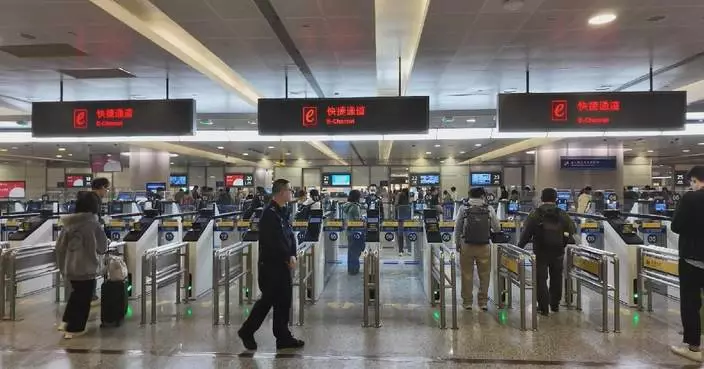
China's passenger traffic on railways, highways and civil aviation remains stable on Friday, the second day of the New Year holiday.
Chinese transportation departments have been taking various measures to facilitate holiday travel for passengers.
According to China State Railway Group, the railways are expected to handle 12.6 million passenger trips on Friday, with 785 additional passenger trains across the country to accommodate increased travel demand.
Several railway stations in China, including the one in Xiangyang City, opened a green channel for passengers carrying large ski equipment, encouraging people to enjoy ice and snow activities during the holiday.
Yichun City, in east China's Jiangxi Province, upgraded convenience services for passengers, offering hot water, reading glasses, and luggage assistance to facilitate travel.
Regarding highways, travel during the New Year's Day holiday was mainly short- and medium-distance intra-provincial trips to visit relatives and friends.
As of 9:00 Friday, 18 sections of national and provincial highways in seven provinces and regions, such as north China's Shanxi Province and southwest China's Sichuan Province, were proactively closed due to snowfall.
China's civil aviation system is projected to handle 1.85 million passenger trips nationwide on Friday, up 19 percent year on year.
Also on the day, China's waterways are expected to handle 820,000 passenger trips, a 46.65 percent increase compared to the same period in 2025.

China's passenger traffic on railways, highways, civil aviation remains stable
Coffee estates in Pu'er City, southwest China's Yunnan Province, are offering a new kind of holiday experience, combining farming, tourism and China's growing coffee culture.
As the New Year holiday spurs travel, visitors are arriving at coffee estates in Pu'er, looking for a slower, calmer way to welcome the year ahead.
"The air here is great, and the overall vibe is very relaxing. We can also learn a lot about coffee, and it's especially fun for kids," said Zhang Boai, a tourist from Beijing.
"I'm really, really excited. Coming here today and seeing such a large coffee plantation, with different kinds of cherries -- red, green, deep red -- has given me a completely new and deeper understanding of coffee as a crop," said Zhang Lei, a tourist from Hangzhou.
With abundant sunlight, a mild climate and rich soil, Pu'er offers ideal conditions for growing high-quality Arabica coffee.
In recent years, a growing number of coffee estates have emerged across the city. Combining cultivation, processing and accommodation, they represent a new way of exploring how a single crop can generate more value.
"Our project officially opened in January 2025. Since then, we've welcomed about 300,000 visitors, mostly from big cities like Beijing, Shanghai and Guangzhou," said Dai Xiaoyan, general manager of Beautiful Star Village, Windy Coffee Valley.
Picking fresh cherries is just the first step. Here, visitors slow down to experience every stage of coffee making -- from drying and roasting to tasting and cupping -- and even create small souvenirs from coffee beans, making the journey as memorable as the drink itself.
"I've been drinking coffee for a long time, but I've never really understood how it's made, so this experience is really interesting," said Wang Han, a tourist from Shanghai
China is becoming one of the world's major coffee-consuming markets. That rising appetite is fueling the development of the domestic industry.
In producing regions like Pu'er, coffee harvests are shifting -- from supplying raw materials for global coffee brands to producing higher-quality, premium beans.
Now, by integrating coffee production with tourism, new opportunities are being created for local farmers.
"Before, we only grew a little coffee, some corn, and raised a few pigs, so our income was limited. Now, my wife works on the project and also runs a tie-dye business with them," said Huang Yubing, a local farmer.
Huang has also been experimenting with what he calls "Bao Bao Coffee," roasting beans in a popcorn machine for a unique flavor. He said his sources of income have become far more diversified.
From the hills of Pu'er to the first cup of the year, coffee is changing how people travel, unwind, and reconnect with the land, while quietly transforming the lives of those who grow it.

Coffee tourism booms in southwest China during New Year holiday