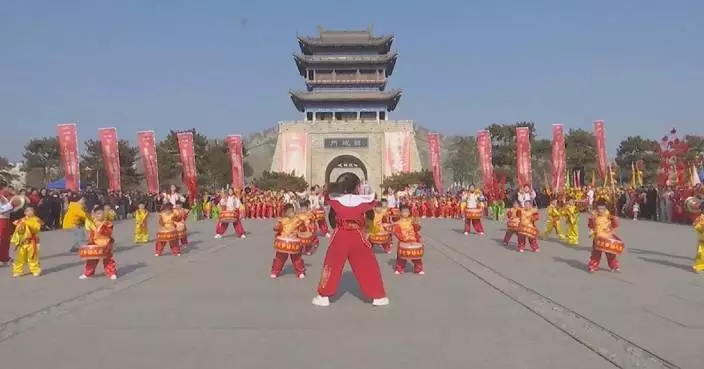
From lights shows to lantern parades, celebrations have been held across China to wave goodbye to 2025 and ring in 2026, attracting holidaymakers to culturally rich destinations.
On New Year's Day in central China's Hunan Province, revelers and tourists posed in front of traditional buildings of Fenghuang Ancient Town, home to 28 ethnic groups. Visitors enjoyed the beauty of local culture and strolled along stone-paved streets to enjoy views on both sides of the Tuojiang River, with some wearing traditional Chinese outfits to welcome the year 2026.
"This place is filled with ethnic culture, and there are also many elements of intangible cultural heritage here," said Tu Xiang, a tourist.
"There will be a light show in the ancient town tonight and we are so excited about it. We can't wait to see a particularly beautiful Fenghuang Ancient Town at night," said Kang Gaidi, another tourist.
As night set in, the town was illuminated, with traditional buildings bathed in warm yellow light, a drone show, and a holographic sky projection reading "Happy New Year to everyone" as a phoenix-shaped lantern flew by.
In Donghu Lake, central China's Hubei Province, nearly 400 passengers aboard a fleet of 10 ships braved the cold to wait for the first sunrise of the new year.
"Although I didn't see the sunrise today, I was really happy to be able to cheer to the new year and share greetings with tourists from all over the country," said Pan Yunming, a ship passenger.
In east China's Jiangsu Province, rows of beautifully decorated trees with glowing lights and ornaments line festive streets in the downtown area of Suqian City at night. It is estimated that key shopping districts and malls logged about 300,000 visits on the first day of the New Year holiday on Thursday.
In Jilin Province, northeast China, a popular street held a traditional parade featuring tiger-headed, fish-shaped lanterns.
"The fish lanterns are very unique and festive, symbolizing abundance year after year. I followed the parade and took many fun photos. I had a great experience in this snowy landscape," said Mou Yanying, a visitor attending the parade.
Nearby, the scenic area prepared drone displays, ice and snow-themed live performances, lantern shows and snow sculptures, to entertain holidaymakers.

Celebrations held across China to ring in 2026
Coffee estates in Pu'er City, southwest China's Yunnan Province, are offering a new kind of holiday experience, combining farming, tourism and China's growing coffee culture.
As the New Year holiday spurs travel, visitors are arriving at coffee estates in Pu'er, looking for a slower, calmer way to welcome the year ahead.
"The air here is great, and the overall vibe is very relaxing. We can also learn a lot about coffee, and it's especially fun for kids," said Zhang Boai, a tourist from Beijing.
"I'm really, really excited. Coming here today and seeing such a large coffee plantation, with different kinds of cherries -- red, green, deep red -- has given me a completely new and deeper understanding of coffee as a crop," said Zhang Lei, a tourist from Hangzhou.
With abundant sunlight, a mild climate and rich soil, Pu'er offers ideal conditions for growing high-quality Arabica coffee.
In recent years, a growing number of coffee estates have emerged across the city. Combining cultivation, processing and accommodation, they represent a new way of exploring how a single crop can generate more value.
"Our project officially opened in January 2025. Since then, we've welcomed about 300,000 visitors, mostly from big cities like Beijing, Shanghai and Guangzhou," said Dai Xiaoyan, general manager of Beautiful Star Village, Windy Coffee Valley.
Picking fresh cherries is just the first step. Here, visitors slow down to experience every stage of coffee making -- from drying and roasting to tasting and cupping -- and even create small souvenirs from coffee beans, making the journey as memorable as the drink itself.
"I've been drinking coffee for a long time, but I've never really understood how it's made, so this experience is really interesting," said Wang Han, a tourist from Shanghai
China is becoming one of the world's major coffee-consuming markets. That rising appetite is fueling the development of the domestic industry.
In producing regions like Pu'er, coffee harvests are shifting -- from supplying raw materials for global coffee brands to producing higher-quality, premium beans.
Now, by integrating coffee production with tourism, new opportunities are being created for local farmers.
"Before, we only grew a little coffee, some corn, and raised a few pigs, so our income was limited. Now, my wife works on the project and also runs a tie-dye business with them," said Huang Yubing, a local farmer.
Huang has also been experimenting with what he calls "Bao Bao Coffee," roasting beans in a popcorn machine for a unique flavor. He said his sources of income have become far more diversified.
From the hills of Pu'er to the first cup of the year, coffee is changing how people travel, unwind, and reconnect with the land, while quietly transforming the lives of those who grow it.

Coffee tourism booms in southwest China during New Year holiday