Raohe County in northeast China's Heilongjiang Province welcomed an influx of Russian tourists during the New Year holiday from Thursday to Saturday, who came to experience winter entertainment activities, savor delicious Chinese cuisine, and enjoy shopping.
The Raohe Port recorded more than 2,000 tourists from Russia from December 30 to January 3.
At a local ice and snow-themed park, many were thrilled by the excitement of a 300-meter-long icy slide and the chance to ride snowmobiles.
"This scenic area is beautiful! I really enjoy being here. The activities organized by our Chinese friends are very interesting," said a Russian tourist Anya.
"We tried the ice activities and loved them very much. We'll definitely be back," said another Russian tourist Yulia.
The opening of a pontoon-supported ice passage between Raohe and Russia's Pokrovka Port on December 25 has further facilitated cross-border travel.
"Since the opening of the ice passage last month, many Russian tourists have come here to eat dumplings. I serve at least ten tables every day," said Diao Hongcheng, a local restaurant owner.

Northeast Chinese county welcomes surge of Russian tourists during New Year holiday

Northeast Chinese county welcomes surge of Russian tourists during New Year holiday
The China (Inner Mongolia) Pilot Free Trade Zone is accelerating the implementation of reform measures including customs clearance facilitation at ports, in efforts to boost quality growth of the local region's open economy.
China expanded its pilot free trade zones (FTZs) to 23 in April with the establishment of the one in north China's Inner Mongolia Autonomous Region.
The State Council's plan on the new pilot FTZ specifies 19 reform and innovation measures, including developing border trade in an innovative way, strengthening international logistics services, improving the efficiency of technology transfer and application, and expanding external exchanges across multiple fields.
The China (Inner Mongolia) Pilot FTZ covers 119.74 square kilometers and comprises three subzones in Hohhot, capital of the autonomous region, Manzhouli, a northern border city, and Erenhot, an inland port on the China-Mongolia border, each tasked with differentiated functions and the development of industries tailored to local conditions.
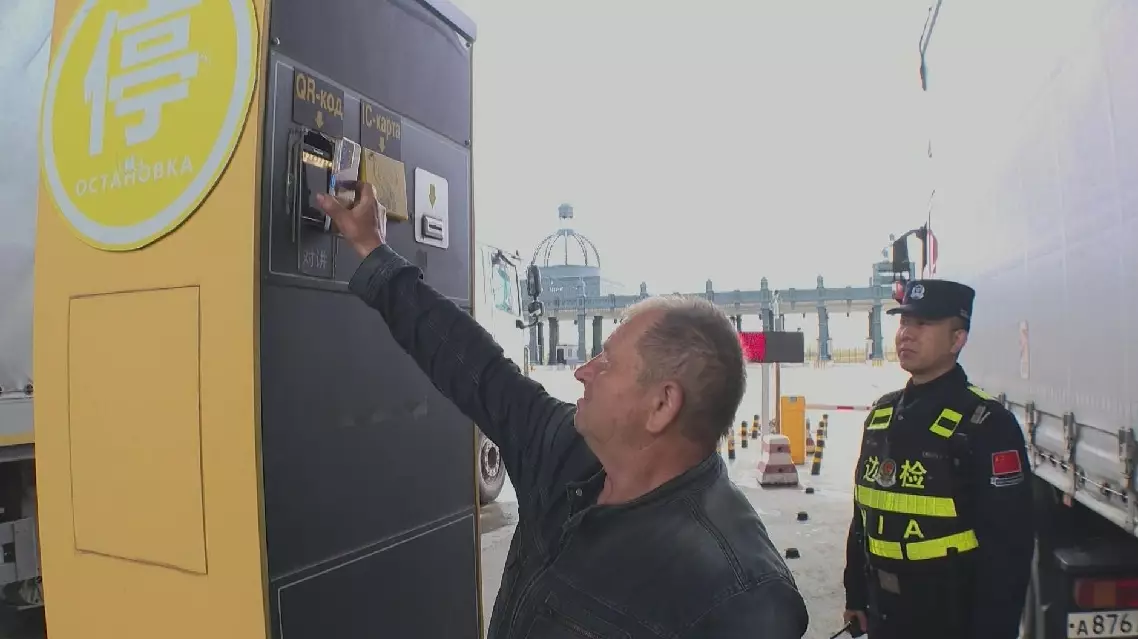
At the intelligent freight checkpoint of the Manzhouli inland port, drivers can complete customs clearance within just a few seconds by showing a QR code to the scanning machine.
The QR code is generated by a smartphone application, which collects the relevant customs clearance information in advance.
"Only one QR code is needed for customs clearance here. We can go through all the required formalities and have the entire application documentation processed through electronic data transmission. After getting the QR code and having it scanned at the checkpoint, the driver will be allowed to enter the country. It's very convenient and fast," said Zhao Shuang, general manager of a freight company in Manzhouli.
From January to April, Manzhouli's total foreign trade volume increased by 43.1 percent year on year.
Inner Mongolia pilot FTZ accelerates reform to boost quality growth