Global economic output is forecast to grow by 2.7 percent in 2026, slightly below the 2.8 percent estimated for 2025 and well below the pre-pandemic average of 3.2 percent, according to the World Economic Situation and Prospects 2026, released Thursday by the United Nations.
The report, produced by the UN Department of Economic and Social Affairs (DESA), indicated that the global economy has demonstrated resilience, but trade tensions, fiscal pressures and rising uncertainties are continuously affecting the medium- and long-term growth outlook.
At the launch of the report, Assistant Secretary-General for Economic Development Navid Hanif said that supported by solid consumer spending and easing inflation, the global economy weathered the impact of sharp increases in U.S. tariffs in 2025.
"We project economic growth is to stabilize at 2.7 percent this year, compared to 2.8 percent in 2025. Last year, sharp tariff hikes disrupted global trade, yet the system proved more resilient than anticipated. But resilience should not be mistaken for strength," he said.
Hanif warned that subdued investment and shrinking fiscal space are weighing on economic activity, raising the prospect that the world economy could settle into a persistently slower growth path than in the pre-pandemic era.
According to the report, the economic growth in the United States is projected at around 2.0 percent in 2026, while that in the European Union is forecast at a slower 1.3 percent.
In Asia, growth is expected to remain stronger than in advanced economies, though slightly lower than in the previous years. China's economy is projected to grow by 4.6 percent, supported by targeted policy measures, according to the report.
"Considering the large size of China's economy, of course this will make a significant contribution to global growth, as it has been for many years now," said Ingo Pitterle, DESA's senior economist and officer-in-charge of the global economic monitoring branch.
The report noted that global trade proved resilient in 2025, expanding by a faster-than-expected 3.8 percent despite elevated policy uncertainty and rising tariffs. However, the momentum is expected to ease, with trade growth projected to slow to 2.2 percent in 2026.
At the same time, investment growth has remained subdued in most regions, weighed down by geopolitical tensions and tight fiscal conditions, according to the report.
The report also underscored that high prices are still eroding people's real incomes, despite the continued decline in global inflation levels. It projected that the headline inflation will slow further to 3.1 percent in 2026 after dropping from 4.0 percent in 2024 to an estimated 3.4 percent in 2025.
The United Nations called for stronger coordination across monetary, fiscal and industrial policies to stabilize prices while ensuring social well-being and long-term growth.

UN report forecasts global economic output to grow 2.7 pct in 2026
China plays a vital role in the wave of artificial intelligence (AI) and the development of future industries, said government officials and business leaders attending the China Development Forum 2026 that opened in Beijing on Sunday.
Speaking at the Symposium on Technological Innovation and Future Industry Development, Minister of Industry and Information Technology Li Lecheng said China will accelerate the innovative development of industries of the future.
"Centering around key areas like artificial general intelligence, quantum sci-tech, and clean, low-carbon hydrogen, we have deployed over 100 innovative research projects of future industries, unveiled the list and appointed leaders for these projects. We will continue to leverage the principal role of enterprises, vigorously nurturing leading technology enterprises and high-tech enterprises that lead in core technologies and possess strong innovation capabilities to drive the industries to advance towards cutting-edge and high-end fields," Li said.
From quantum technology to 6G, China is sharing its sci-tech achievements with countries around the world, working together to promote the development of future industries.
Business leaders from across the world said China is leading the breakthrough in AI technologies and will be fertile ground for the growth of future industries.
"From new energy, electric vehicles and high-end manufacturing to breakthroughs in robotics and artificial intelligence, China is at the best moment to share the fruits of sci-tech development with the world. In 2025, downloads of open-source (AI) models from China led the world, allowing global developers to freely access, fine-tune, and deploy these powerful models, truly making smart technologies a public good for all humanity," said Joseph Tsai, Chairman of Alibaba Group.
"China's complete industrial ecosystem will be fertile ground for the growth of future industries. Take embodied AI robots for example, their development relies not only on breakthroughs in intelligent algorithms but also on supporting components like precision transmission and execution parts like reducers and servo motors. A rich diversity of innovation pathways, a complete industrial system, and robust industrial supporting capabilities will be the fertile ground for the development of future industries," said Lei Jun, founder and chairman of Xiaomi Group.
"Not only manufacturing. So it's AI plus in every space, in every sector, in every industry. For us, we are the company in the world that powers AI in supplying energy systems to AI factories across the world. And therefore for us, the challenge is to make sure that we go fast enough, strong enough to support all the computing that is used by Chinese companies or by Chinese stakeholders," said Jean-Pascal Tricoire, chairman of Schneider Electric.
"Brain-computer interfaces have been listed as one of the six major future industries in China's 15th Five-Year Plan period this year. We are now fully leveraging AI technologies to decode information within the brain, using this capability to better address many issues related to brain diseases. This enables people with disabilities who have lost hands or feet to control prosthetic limbs with their thoughts, allowing them to regain their normal daily life," said Han Bicheng, founder of BrainCo, a Chinese neurotech company.
The two-day China Development Forum 2026 is themed on "China in Its 15th Five-Year Plan Period: Advancing High-Quality Development and Creating New Opportunities Together."
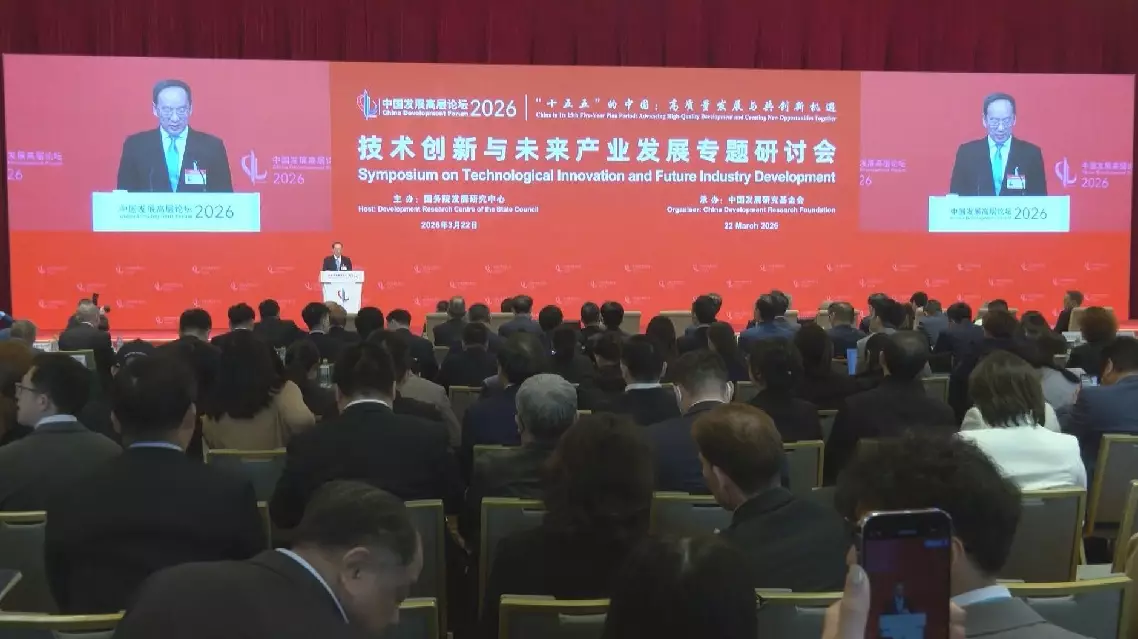
China to accelerate innovative development of future industries: official