25-year-old weather photography blogger Su Dike has spent the past seven years documenting China's typhoons and thunderstorms, transforming storm‑chasing into both a passion and a profession.
Su, also a filmmaker, has his storm-related videos accumulating over 30 million views on Chinese video website Bilibili.
As one of the few individual members of the China Meteorological Service Association, he also participated in satellite imagery directing for China Media Group's (CMG's) documentary series, "Bird's-eye China" or "Aerial China", which is the first Chinese program produced with drone technology.
Over the past seven years, Su, together with his partners, has chased more than 200 thunderstorms and typhoons, covering a total distance of more than 60,000 kilometers.
In Wuhan, capital city of central China's Hubei Province, Su shared a 130-minute documentary on storms with the students of Wuhan University, showing them the unique charm of the nature.
"They pass such passion and pioneering spirit to the public, which truly touched me," said Shen Zhangxiao, a student of Wuhan University.
Su believes that chasing storms is a way of making the life meaningful, despite many are worried about his safety amid the extreme weather.
"I actually treasure and love my life. I pursue adventure, like chasing storms, because I believe this is how my life should be lived. Like an extreme athlete, I should know how to ensure my safety in dangerous situations. The process of chasing storms is a vivid way of being alive for me. So I don't think chasing storms is a life-threatening thing, but a way to make my life blossom," Su said.
"I think the greatest joy comes from being in the right place at the right time. For us, it's a sense of accomplishment to use all known meteorological knowledge to try to predict the storm, track it, and see it finally form in the desired location. For me personally, there's another layer of accomplishment -- we captured these truly breathtaking footages," he said.
Su, together with his team members, has been putting their passion to good use by allowing scientists, students and meteorological organizations across the country to access their films, photos and data for free.

Young Chinese filmmaker shares unique experience of chasing storms across country
From cutting-edge technology exhibitions to retail stores thousands of kilometers away from Europe and Southeast Asia, China-made robot vacuum cleaners are increasingly becoming a popular choice among consumers worldwide.
At electronics retailers in Berlin, Germany, Chinese brands such as Roborock and Dreame occupy prominent positions in dedicated robot vacuum sections, offering a wide range of products priced between 200 and 2,000 euros.
Many local consumers said that when purchasing smart home appliances including robot vacuum cleaners, they tend to give priority to Chinese-made products.
"It's a good price and good quality. It's also the innovation. I have a feeling that the European brands are not innovating enough," said one customer.
"I think they're always on top of the other technologies. They are getting them out faster. A lot of us are switching to the Chinese technology," another consumer said.
Germany is one of the most important overseas markets for China's floor-cleaning robots.
According to data from market research firm GfK, from January to November 2025, more than six out of 10 robot vacuum cleaners sold in Western Europe were Chinese brands.
Industry data also point to a strong global momentum.
According to the International Data Corporation (IDC), global shipments of smart robot vacuum cleaners reached 17.424 million units in the first three quarters of 2025, representing a year-on-year increase of 18.7 percent.
Chinese brands including Roborock, Ecovacs, Dreame, Xiaomi and Narwal ranked among the world's top five in terms of shipment volume, with a combined share of nearly 70 percent of the global market.
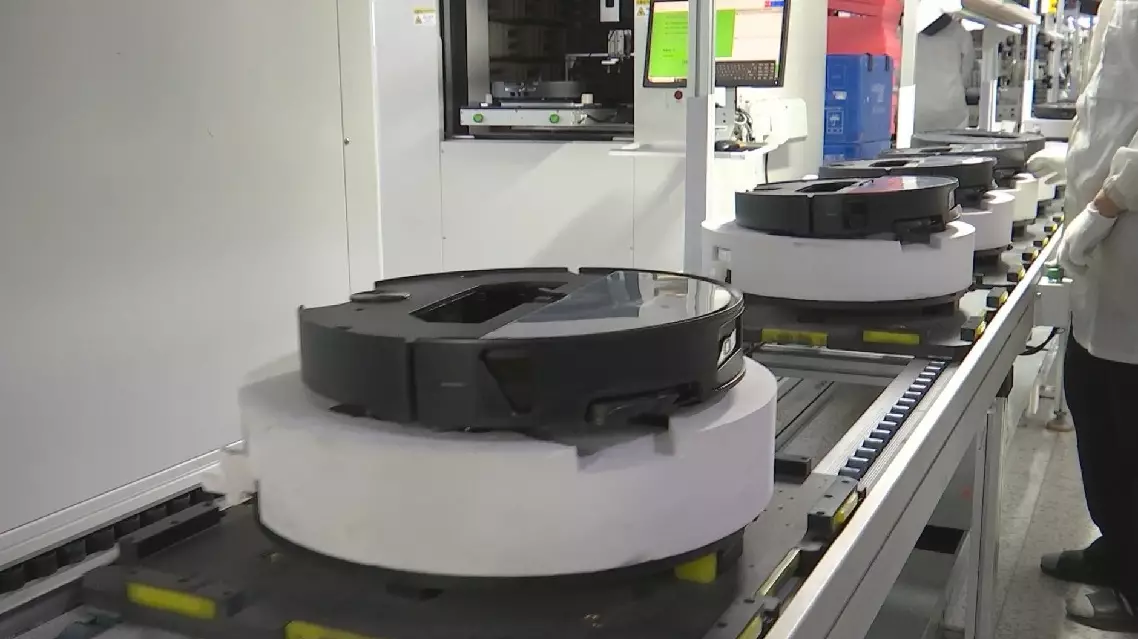
At a robot vacuum cleaner manufacturing plant in Huizhou, south China's Guangdong Province, workers were seen stepping up production of newly launched models that recently debuted at the Consumer Electronics Show in the United States, which concluded Friday in Las Vegas, Nevada.
The factory adjusted its production lines as early as December 2025 and stocked inventory in advance for overseas markets to ensure that new products could be delivered to global consumers at the earliest possible time.
"In 2025, Roborock's global shipments exceeded 7.2 million units. Since 2024, overseas revenue has accounted for more than 50 percent of our total revenue. Our products have now been sold to more than 170 countries and regions, serving more than 20 million households worldwide," said Quan Gang, president of Roborock.
At another robot vacuum cleaner manufacturing facility in Dongguan, Guangdong, rising overseas orders have prompted the company to upgrade its production lines with intelligent technologies to further boost capacity. The factory is currently operating at full load to meet a growing demand.
"For 2026, we have already obtained overseas orders worth at least 300 million to 400 million yuan (around 43 million to 57.3 million U.S. dollars). In addition, we've engaged in strategic cooperation with European home appliance group Cebos Group, and our total confirmed orders have exceeded 600 million yuan (around 86 million U.S. dollars)," said Zhang Junbin, founder and CEO of Narwal Robotics.
Chinese robot vacuum brands gain strong global traction