Skip to Content Facebook Feature Image

HKU Chemists Pioneer ATAC-Targeting Inhibitor for Lung Cancer Breakthrough

HK

HKU Chemists Pioneer ATAC-Targeting Inhibitor for Lung Cancer Breakthrough
HK

HK

HKU Chemists Pioneer ATAC-Targeting Inhibitor for Lung Cancer Breakthrough

2026-01-19 15:58 Last Updated At:16:09

A research team led by Professor Xiang David Li from the Department of Chemistry at The University of Hong Kong (HKU), in collaboration with researchers from the Shenzhen Bay Laboratory and Tsinghua University, has made a breakthrough in epigenetic drug discovery. The team has successfully developed a first-in-class chemical inhibitor that precisely and selectively targets the ATAC complex, a critical cellular “switch operator” that activates tumour-promoting genes, opening a novel therapeutic avenue for non-small cell lung cancer (NSCLC). The findings were recently published in the top-tier journal Nature Chemical Biology, and multiple international patent applications have been filed.

Histone Modifications as Genetic Switches in Our Cells

Inside human cells, DNA is wrapped around protein structures called histones to form chromatin. Chemical modifications on histones function like genetic “switches”, determining whether genes are turned on or remain silent. Among these modifications, histone acetylation is one of the most important “on” switches that activate gene expression. This modification is catalysed by enzyme complexes known as histone acetyltransferases (HATs).

The ATAC complex is one such HAT complex and plays a pivotal role in activating genes involved in cell growth and DNA replication. In cancers such as NSCLC, the ATAC complex becomes overactive, inappropriately flipping the “on” switch for numerous cancer-driving genes, fuelling uncontrolled tumour growth and spread. However, selectively inhibiting ATAC without disrupting other essential cellular complexes has remained a challenge in drug development.

Precisely Targeting a Unique Component of ATAC

Previous drug-development efforts focused on inhibiting GCN5, the catalytic subunit responsible for histone acetylation within ATAC. Nevertheless, GCN5 is also shared by several other HAT complexes, meaning that blocking it would inadvertently interfere with normal cellular functions and lead to significant side effects. To address this challenge, Professor Li’s team devised an innovative strategy targeting YEATS2, a protein subunit specific to the ATAC complex.

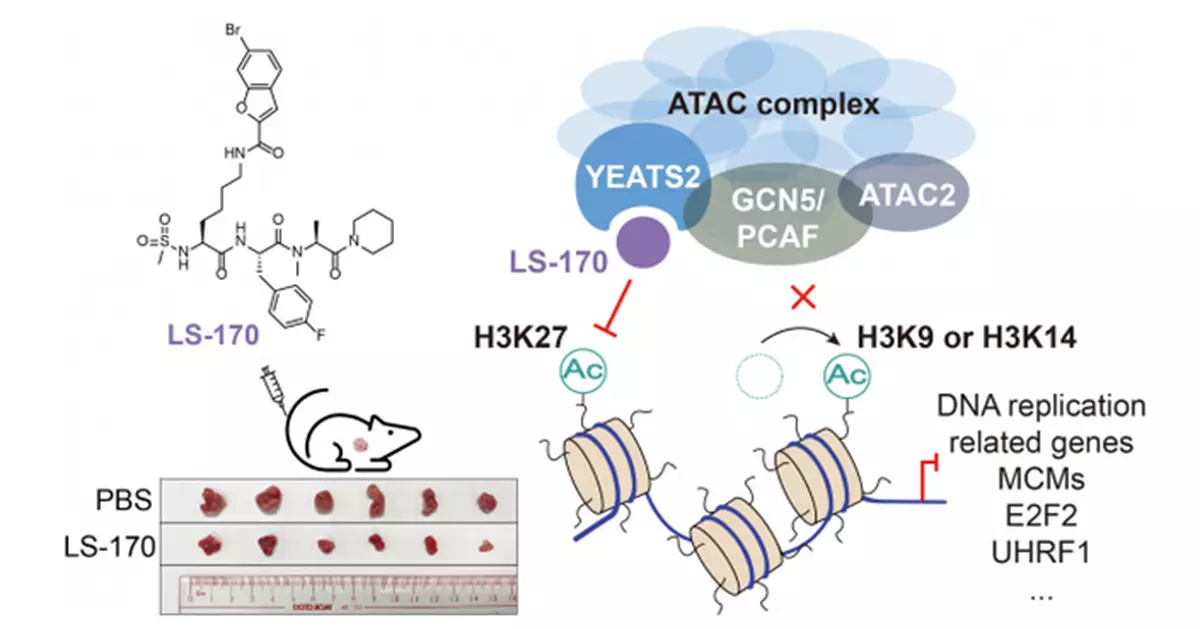
Using structure-guided design, the researchers developed a potent and highly selective inhibitor of YEATS2, named LS-170. This inhibitor specifically binds to the acetyl-lysine recognition domain of YEATS2, preventing it from anchoring the ATAC complex to chromatin. Consequently, the complex is displaced from its target genomic regions, leading to a significant reduction in local histone acetylation and the “off” switching of oncogenes in NSCLC.
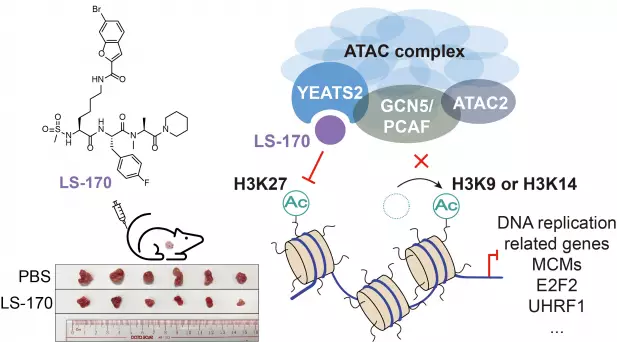
Tumour suppression in vivo — In animal models, LS-170 treatment significantly reduced tumour volume, demonstrating its strong anti-cancer potential. (Image adapted from the relevant journal.)

Tumour suppression in vivo — In animal models, LS-170 treatment significantly reduced tumour volume, demonstrating its strong anti-cancer potential. (Image adapted from the relevant journal.)

Strong Suppression of Tumour Growth and Metastasis

In NSCLC cell lines and animal models, LS-170 demonstrated strong efficacy in suppressing tumour growth and metastasis. Notably, the YEATS2 gene is frequently amplified in multiple solid tumours—including lung, ovarian, and pancreatic cancers—suggesting that this targeted strategy may hold broader therapeutic potential beyond lung cancer.

This study represents the first chemical approach to precisely decode the function of a specific HAT complex, revealing ATAC's distinct role in maintaining gene expression programs in cancer. It also offers new insights for developing other complex-specific epigenetic drugs for human diseases.

“In this work, we didn’t just create a potent and highly specific inhibitor that can suppress tumours, we also uncovered a novel strategy to target just one epigenetic complex out of several that share the same enzyme core. This approach opens up exciting possibilities for developing highly selective, complex-specific drugs that could potentially revolutionise treatments for human diseases,” said Professor Xiang Li, one of the corresponding authors of the paper.

About the Research Team:

The interdisciplinary collaboration was led by Professor Xiang David LI (HKU Chemistry), together with Professor Weiping WANG (HKU Pharmacology and Pharmacy), Researcher Xin LI (Shenzhen Bay Laboratory), and Professor Haitao LI (Tsinghua University). Co-first authors included Dr Sha LIU, Dr Yin Qiao WU, Dr Jinzhao LIU, and Dr Xinyi YAO.
The University of Hong Kong (HKU) and Lindau Nobel Laureate Meetings co-hosted "The Nobel Heroes Forum: Shaping Science and Future" recently, convening six Nobel laureates for thought-provoking discussions on how fundamental research drives progress in science, technology, health, and the global economy. Held at the Grand Hall of the Lee Shau Kee Lecture Centre on the Centennial Campus, the forum drew an audience of over 800 participants, fostering interdisciplinary exchange among some of the world’s most distinguished scientific minds.

Held at the Grand Hall of the Lee Shau Kee Lecture Centre on the Centennial Campus, the forum drew an audience of over 800 participants.. Photo source: HKU

Held at the Grand Hall of the Lee Shau Kee Lecture Centre on the Centennial Campus, the forum drew an audience of over 800 participants.. Photo source: HKU

The forum convened an extraordinary assembly of Nobel laureates: Professor Robert C. Merton, Nobel Prize in Economic Sciences laureate (1997); Professor Louis J. Ignarro, Nobel Prize in Physiology or Medicine laureate (1998); Professor Tim Hunt, Nobel Prize in Physiology or Medicine laureate (2001); Professor Kurt Wüthrich, Nobel Prize in Chemistry laureate (2002); Professor Konstantin Novoselov, Nobel Prize in Physics laureate (2010); and Professor Ferenc Krausz, Nobel Prize in Physics laureate (2023) and HKU Chair Professor of Laser Physics. Distinguished attendees included Professor Xiang Zhang, President and Vice-Chancellor of HKU; Dr Peter Wong, Chairman of the HKU Council; Mr Eric Kwok-ki Chan, Chief Secretary for Administration of the Government of the Hong Kong Special Administrative Region; Professor James Tang, Secretary-General of the University Grants Committee; and Mr Nikolaus Turner, Executive Director of the Lindau Nobel Laureate Meetings.

Professor Xiang Zhang, President and Vice-Chancellor of HKU, delivers welcome remarks. Photo source: HKU

Professor Xiang Zhang, President and Vice-Chancellor of HKU, delivers welcome remarks. Photo source: HKU

Professor Xiang Zhang remarked, “In today’s world, working together in science to achieve shared goals and promote global prosperity is increasingly challenging. We hope that, through the insights of six Nobel laureates, we can learn how to advance fundamental science, translate discoveries into practical applications, and benefit humanity, while navigating different challenges. HKU is committed to playing an important role in bridging international research collaborations. Ultimately, we believe that through mutual cooperation, science can transcend divisions, driving innovation and societal progress for the benefit of all.”

Mr Eric Kwok-ki Chan, Chief Secretary for Administration, delivers his speech at the forum. Photo source: HKU

Mr Eric Kwok-ki Chan, Chief Secretary for Administration, delivers his speech at the forum. Photo source: HKU

Mr Eric Chan praised the forum’s role in advancing the Hong Kong’s innovation landscape, “Today’s dialogue is more than an academic event. It is a powerful convergence of the world’s finest scientific minds, right here in a city that is determined to play its part in global innovation. Hong Kong’s mission is clear and unwavering: to become a premier international innovation and technology centre. A hub where top scientists, scholars and entrepreneurs can thrive, collaborate and serve the world. To achieve this, the Government is fully committed. We are building a world-class ecosystem and nurturing the talent to power it.”

Mr Nikolaus Turner, Executive Director of the Lindau Nobel Laureate Meetings, delivers his remarks. Photo source: HKU

Mr Nikolaus Turner, Executive Director of the Lindau Nobel Laureate Meetings, delivers his remarks. Photo source: HKU

Mr Nikolaus Turner highlighted the collaboration’s global impact, “We are delighted to bring the Nobel Heroes to Hong Kong. In 2026, we will celebrate the 75th anniversary of our meetings in Lindau, Germany. Each year, we welcome outstanding young scientists from Hong Kong—bright minds shaping the future of research. We hope to attract even more talent from Hong Kong while building partnerships to sustain the unique intergenerational exchanges between young researchers and Nobel laureates.”

The first panel discussion, ‘Building the Future: From Molecules to Materials’, was moderated by Professor Xiang Zhang. Photo source: HKU

The first panel discussion, ‘Building the Future: From Molecules to Materials’, was moderated by Professor Xiang Zhang. Photo source: HKU

The forum featured two in-depth panel discussions moderated by HKU’s senior leadership. The first, ‘Building the Future: From Molecules to Materials’, was led by Professor Xiang Zhang and explored how fundamental discoveries in physics and chemistry unlocked new possibilities at the atomic and molecular levels. Panellists included Professors Krausz (Physics, 2023), Novoselov (Physics, 2010), and Wüthrich (Chemistry, 2002), who discussed topics ranging from visualising ultrafast atomic processes to engineering revolutionary materials with transformative applications.

The second discussion, ‘Decoding Complexity: Regulating Systems from the Cell to the Global Economy’, moderated by Professor Richard Wong, HKU Provost and Deputy Vice-Chancellor. Photo source: HKU

The second discussion, ‘Decoding Complexity: Regulating Systems from the Cell to the Global Economy’, moderated by Professor Richard Wong, HKU Provost and Deputy Vice-Chancellor. Photo source: HKU

The second discussion, ‘Decoding Complexity: Regulating Systems from the Cell to the Global Economy’, moderated by Professor Richard Wong, HKU Provost and Deputy Vice-Chancellor, examined universal principles governing complex systems across biology and finance. Professors Ignarro (Physiology/Medicine, 1998), Merton (Economic Sciences, 1997), and Hunt (Physiology/Medicine, 2001) highlighted striking parallels in how feedback mechanisms maintain stability—whether in cellular processes or financial markets.

Professor Xiang Zhang and six Nobel Laureates. Photo source: HKU

Professor Xiang Zhang and six Nobel Laureates. Photo source: HKU

The Forum underscored HKU’s commitment to advancing knowledge for the betterment of society, while reinforcing the vital role of basic research in addressing global challenges. The Forum was also made possible through the support of Laureates City Holdings Limited, Red Carpet Investments Limited, and Sunwah Kingsway Capital Holdings Limited, whose contributions were instrumental in bringing this prestigious event to fruition.

Distinguished guests and the Nobel Laureates. Photo source: HKU

Distinguished guests and the Nobel Laureates. Photo source: HKU

Recommended Articles