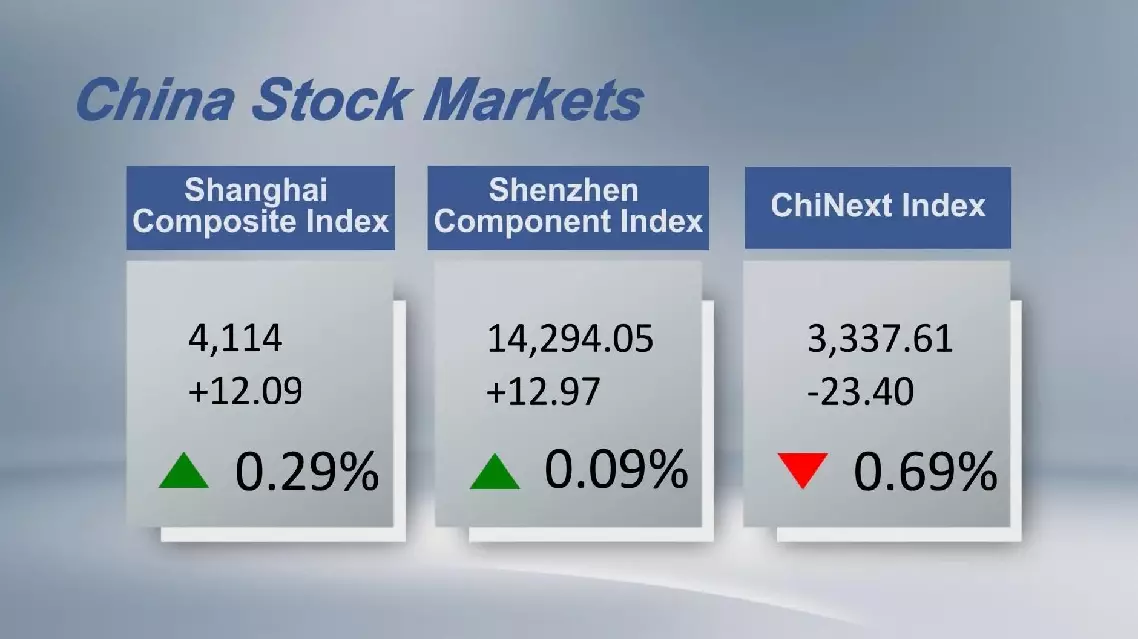
Chinese stocks closed higher on Monday, with the benchmark Shanghai Composite Index up 0.29 percent to 4,114 points.
The Shenzhen Component Index closed 0.09 percent higher at 14,294.05 points.
The combined turnover of these two indices totaled 2.71 trillion yuan (about 386.86 billion U.S. dollars), down from 3.03 trillion yuan on the previous trading day.
Hotel, tourism and aircraft manufacturing stocks led the gains, while the electronic information and financial sectors suffered major losses.
The ChiNext Index, tracking China's Nasdaq-style board of growth enterprises, lost 0.69 percent to close at 3,337.61 points Monday.
The STAR Composite Index, which reflects the performance of stocks on China's sci-tech innovation board, closed 0.21 percent lower at 1,851.07 points on Monday.
Chinese shares close higher Monday
Soaring oil prices triggered by escalating tensions in the Middle East have heightened U.S. inflation pressures, with analysts warning that households face hundreds of dollars in extra costs if crude climbs further.
Data released on Tuesday by the American Automobile Association (AAA) showed that the national average price of regular gasoline in the United States has risen 18.64 percent compared with Feb. 26. The AAA data also indicated that the national average price of diesel on Tuesday was up 22.85 percent from a week earlier.
Mark Zandi, chief economist at global ratings agency Moody's, warned that U.S. consumers are being threatened by a sharp rise in fuel prices. He said that if international oil prices climb by another 10 U.S. dollars per barrel, annual spending for an average U.S. household would increase by about 450 dollars.
Zandi noted that a surge in oil prices would intensify inflationary pressure in the United States, eroding consumers' purchasing power and weighing on consumption, economic growth, and employment.
Tensions sharply escalated across the Middle East on Feb 28 when the United States and Israel launched large-scale joint airstrikes on Iran. The Iranian side has responded with multiple waves of missile and drone attacks targeting Israel and U.S. assets across the region, hitting many countries in the Gulf.

Escalating Middle East tensions drive up energy prices, squeezing US consumers

Escalating Middle East tensions drive up energy prices, squeezing US consumers