Davide Cerato will play a major role in skiing and snowboarding events at the upcoming Olympics, but he won't be competing.
The Italian snowmaking expert is responsible for perfecting several of the courses that will feature in the 2026 Milan Cortina Winter Games, and he takes his job seriously.
“It’s the most important race of their life,” Cerato said. “Our duty is to give them the best, to deliver the best courses where they can perform their best after training so hard.”
Cerato oversees operations at venues where new snowmaking systems were installed, including in Bormio for Alpine ski racing and ski mountaineering, and in Livigno for freestyle skiing and snowboarding events. He has been working with the International Ski and Snowboard Federation and the International Olympic Committee since the 2014 Sochi Olympics.
These days, manufactured snow — “technical snow” as Cerato calls it — is a way of life in ski racing, so much so that Olympic athletes don’t think twice about competing on it. Above all else, they want a course that will hold up over multiple training runs and the races themselves without becoming too mushy or rutted.
Mother Nature can’t always provide for that, and with climate change affecting winter sports in particular, snowmaking has become essential.
The organizing committee said Friday that it has produced nearly 1.6 million cubic meters (2 million cubic yards) of technical snow for all the venues, which is less than forecasted. Cerato oversaw the work to carve out new high-elevation water reservoirs to store water for snowmaking.
At the Livigno Snow Park, they built a basin capable of holding about 200 million liters (53 million gallons) of water. It's now one of the biggest reservoirs on the Italian side of the Alps, Cerato said. They added more than 50 snow guns there to produce about 800 million liters (211 million gallons) of snow in roughly 300 hours.
In Bormio, Cerato said they constructed a lake at an elevation of 2,300 meters (2,515 yards) to hold 88 million liters (23 million gallons) of water. They also added 75 snow guns for Alpine skiing and ski mountaineering.
“We brought the Bormio slope to a new level,” he said, comparing it to a “Ferrari with new gears.”
By making snow, organizers can control a slope's quality and hardness, preparing it according to FIS requirements and ensuring consistent conditions, Cerato said.
He said it's easier to work with technical snow because it's compact and is safer because it doesn't deteriorate as quickly, whereas natural snow requires more work. They can inject water deep into the snowpack, which will freeze and create a more stable race surface.
“We can deliver better, safer and fair courses,” he said. “That is the difference — a fair course from bib No. 1 to bib No. 50.”
Cerato and his team are using state-of-the-art sensors to monitor the snow depth. If there’s a gap, snow guns go to work. If there’s too much, they are turned off.
“It automatically adjusts everything, each snow gun, so you can control with just one person sitting in the office, all the mountain,” Cerato said.
In Bormio, snow groomers are also equipped with GPS systems to help monitor the snow quality and levels, saving time, energy and water.
The snow groomer knows exactly where to push the snow and how much snow is needed. And at the same time, "you produce the minimum amount of snow that you need,” Cerato said. “This is a powerful tool.”
Preparing a slope for elite competition isn't the same as doing it for commercial use. For the latter, natural snow is precious, he said. Personally, he prefers skiing in powder.
“I was born on the mountain," he said. “I love snow.”
The Associated Press’ climate and environmental coverage receives financial support from multiple private foundations. AP is solely responsible for all content. Find AP’s standards for working with philanthropies, a list of supporters and funded coverage areas at AP.org.

FILE - This photo shows the snowboarding and freestyle skiing events which will take place during the upcoming Milan Cortina Winter Olympics in Livigno, Italy, Saturday, Dec. 27, 2025. (AP Photo/Gabriele Facciotti, File)

FILE - Olympic rings are displayed in the snow at the Stelvio Ski Center, venue for the alpine ski and ski mountaineering disciplines at the 2026 Milan Cortina Winter Olympics in Bormio, Italy, Jan. 16, 2025. (AP Photo/Luca Bruno, File)

FILE - A snow gun sprays artificial snow at the Stelvio Ski Center, venue for the alpine ski and ski mountaineering disciplines at the 2026 Milan Cortina Winter Olympics, in Bormio, Italy, Jan. 16, 2025. (AP Photo/Luca Bruno, File)
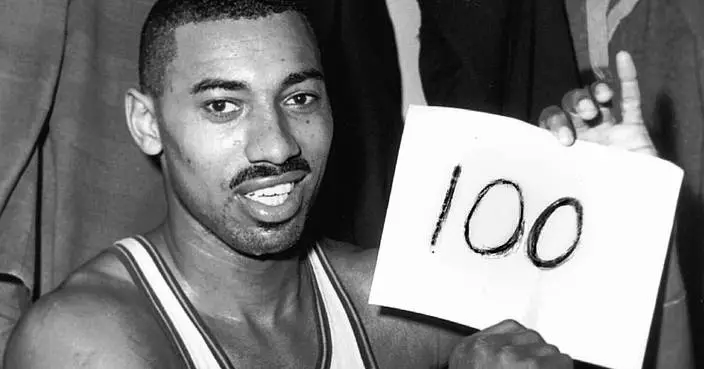
EDITOR'S NOTE: When Kobe Bryant scored 81 points for the Los Angeles Lakers on Jan. 22, 2006, against the Toronto Raptors, it was the second-most points scored by a player in NBA history. The record was set by Wilt Chamberlain, who scored 100 points on March 2, 1962, against the New York Knicks. Miami Heat forward Bam Adebayo scored 83 points Tuesday night against the Washington Wizards to pass Bryant on the list of most points scored in an NBA game. The Associated Press is republishing its story from Bryant's historic performance:
By JOHN NADEL
AP Sports Writer
LOS ANGELES — Kobe Bryant kept shooting, from all over the court and from every angle.
By halftime, he had 26 points — not a bad tally for most players. By the end of the game, he had put up the second-highest total in NBA history.
The Los Angeles Lakers’ star scored a staggering 81 points Sunday night against the Toronto Raptors in a 122-104 win. Only Wilt Chamberlain’s 100-point game stands ahead of him.
“It just happened, man,” Bryant said. “It really hasn’t, like, set in for me. It’s about the ‘W,’ that’s why I turned it on. It turned into something special.
“To sit here and say I grasp what happened, that would be lying. Not even in my dreams.”
The NBA’s leading scorer left to a standing ovation with 4.2 seconds remaining, having shot 28-of-46 from the floor, including 7-of-13 from 3-point range and 18-of-20 from the foul line.
With the fans at Staples Center chanting “MVP! MVP!” Bryant made two free throws with 43.4 seconds remaining for his final points. He scored 27 points in the third quarter, 28 in the fourth.
“It feels great to put on a great show here,” he said.
Chamberlain scored 100 points for Philadelphia against the New York Knicks at Hershey, Pa., on March 2, 1962, making 36-of-63 from the field and 28-of-32 from the foul line while playing all 48 minutes.
Chamberlain had 59 points in the second half — the only player with more points in a half than Bryant’s 55 after halftime in this game.
Chamberlain’s second-highest total was 78 against the Lakers in three overtimes on Dec. 8, 1961.
Elgin Baylor held the previous franchise record of 71 points at New York on Nov. 15, 1960. Lakers assistant Kareem Abdul-Jabbar, the NBA’s all-time leading scorer, saw that game, too.
“Elgin’s game was an incredible performance, also. I don’t think there’s any comparison. Elgin did it without 3-point lines. His game was attacking the hoop and hitting jumpers inside 20 feet. Kobe’s range is unreal, and he does it his way,” Abdul-Jabbar said.
“It was a real treat. His ability to shoot from long range and also attack the hoop, split the defense and get in close for opportunities near the basket is unique. He’s made a niche for himself and he deserves it.”
Michael Jordan’s career high was 69 points, and only four players had ever scored more than 70 — Chamberlain, Baylor, David Thompson and David Robinson.
The 27-year-old Bryant made it five. His previous career high was 62 points during a 112-90 victory over Dallas last month — he sat out the fourth quarter because of the one-sided nature of the game.
“I was just determined. I was just locked in, tuned into what was going on out there,” Bryant said. “These points tonight mattered. We needed them. The points I put in the basket were instrumental. It means a lot more.”
Bryant raised his scoring average to an NBA-leading 35.9 points this season.
“I never imagined I would see history like that,” said Devean George, a teammate of Bryant’s with the Lakers for 6 1/2 seasons. “I can’t tell you where that came from. He just kept attacking, attacking, attacking — every time he got the ball.”
Bryant played nearly 42 minutes, going the entire second half until being lifted by coach Phil Jackson.
Jackson coached Jordan and the Chicago Bulls to six championships in the 1990s and the Lakers, with Bryant and Shaquille O’Neal, to three more titles, from 2000-02.
“That was something to behold,” Jackson said. “It was another level. I’ve seen some remarkable games, but I’ve never seen one like that before.”
Bryant’s performance came on the same night the NBA had its highest-scoring game in 11 years when Seattle beat Phoenix 152-149 in two overtimes. The last 300-point game in the league came when Dallas beat Houston 156-147 in two overtimes on April 11, 1995, according to the Elias Sports Bureau.
“You’re sitting and watching, and it’s like a miracle unfolding in front of your eyes and you can’t accept it,” Lakers owner Jerry Buss said. “Somehow, the brain won’t work. The easiest way to look at it is everybody remembers every 50-point game they ever saw. He had 55 in the second half.”
Lamar Odom’s 3-pointer with 7:04 remaining gave the Lakers a 100-93 lead, and Bryant scored 30 seconds later to give him 61 points and his team a nine-point advantage. The Raptors didn’t pose a serious threat after that.
Bryant scored all but 15 of the Lakers’ 42 points in the third quarter, shooting 11-of-15 including 4-of-5 from 3-point range. Six of his points came during a 12-0 run to finish the period, giving Los Angeles a 91-85 lead.
The Lakers outscored the Raptors 38-14 to finish the third quarter to go ahead for good. They trailed by as many as 18 points early in the period, angering Bryant.
“He was ticked off,” Odom said.
When asked what Bryant said at that stage, Odom replied: “Nothing. That’s when it’s bad.”
Bryant scored 51 points after the Raptors took a 71-53 lead. It was 63-49 at halftime.
“The thing about him that is most amazing is that he is relentless,” Raptors coach Sam Mitchell said. “We played man-to-man, box-in-one and zone. We tried to put smaller guys on him to deny him the ball.
“I saw that game he had against Dallas where he scored 62, what more can you say?”
Smush Parker added 13 points and Chris Mihm had 12 points and six rebounds for the Lakers.
Mike James led Toronto with 26 points and 10 assists. Chris Bosh added 18 points and eight rebounds and Jalen Rose scored 17 points for the Raptors.
Notes: Bryant scored a season-low 11 points in the Lakers’ 102-91 victory over the Raptors in Toronto last month. He had 14 in the first quarter of this game. ... Bryant has led the Lakers in scoring in the last 21 games in which he’s played. He is averaging 45.5 points in 10 games since sitting out a two-game suspension. ... Toronto C Rafael Araujo, who has made 30 starts this season, missed his second straight game and third of the season because of a sore right shoulder. ... Bryant made his first five foul shots before missing late in the second quarter, snapping his streak of consecutive made free throws at 62. Michael Williams made an NBA-record 93 straight for Minnesota in 1993. ... Bryant received a technical foul with 10:44 left — shortly after being accidentally struck above the right eye.
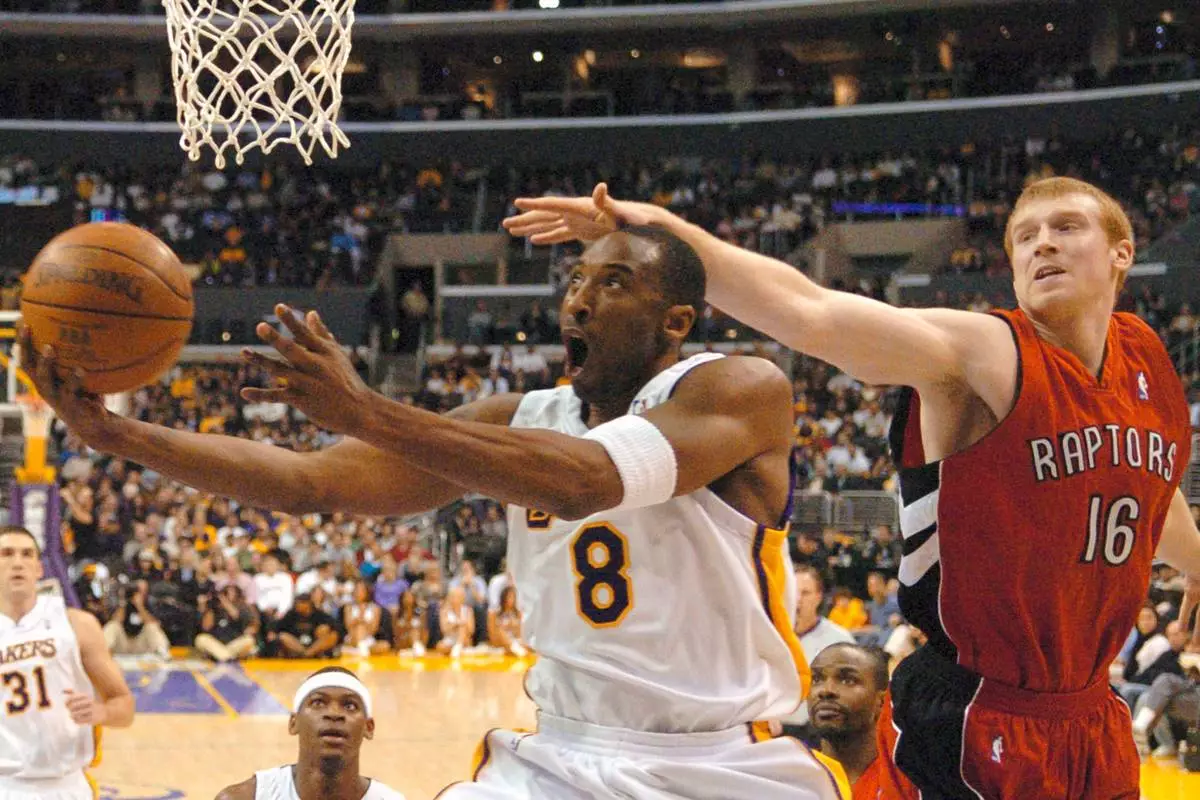
FILE - Toronto Raptors' Matt Bonner can't stop Los Angeles Lakers' Kobe Bryant from getting to the basket in the first half of NBA basketball game, Jan. 22, 2006, in Los Angeles. (AP Photo/Matt A. Brown, File)