ROME--(BUSINESS WIRE)--Feb 11, 2026--
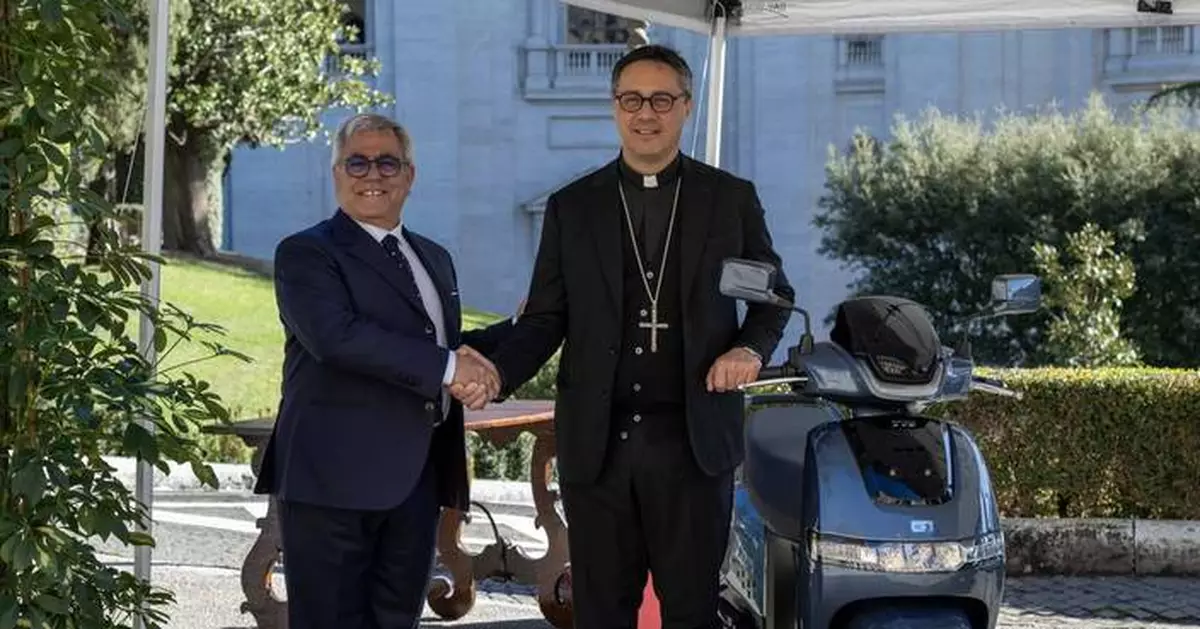
TVS Motor Company, a global leader in two and three-wheeler mobility, and Exelentia are strengthening their commitment to sustainable and responsible mobility by providing the Governorate of Vatican City State with two TVS iQube electric scooters.
This press release features multimedia. View the full release here: https://www.businesswire.com/news/home/20260210048491/en/
The official delivery, which took place on February 5th, is part of a consolidated collaboration between the Vatican and Exelentia – which is already active in projects focused on innovation and sustainability.
This initiative by Exelentia in a partnership of TVS Motor Italia marks a further concrete step in the ecological transition process already undertaken by the Governorate of Vatican City State. This process aims for zero-emission mobility solutions designed to meet the daily operational needs of a unique context like the Vatican, where efficiency, reliability, and respect for people and the environment are core values.
Emphasizing the importance of this occasion, Giovanni Notarbartolo di Furnari, General Manager of TVS Motor Italia, stated, “The deployment of TVS iQube electric scooters in a prestigious setting such as the Vatican validates our vision for urban electric mobility—anchored in reliability, intuitive usability, and world class quality.”
Giovanni Zappia, Founder & Owner of Exelentia, stated , “The partnership undertaken with the Governorate of the State of the Vatican City strengthens Exelentia’s commitment to contributing concretely to mature, reliable mobility fully suited to particularly sensitive urban and institutional contexts.”
TVS iQube: The Vanguard of Zero-Emission Mobility
The TVS iQube was selected for its blend of silent performance and cutting-edge tech, making it uniquely suited for the Vatican’s historic and high-sensitivity environment. With a range of up to 100 km in eco mode, it is a means of transport with superior comfort, characterized by intelligent connectivity developed thanks to the SmartXonnect system, accessible via TFT display and dedicated app.
Designed to simplify city mobility and short-range travel, the TVS iQube combines:
Designed to simplify mobility in the city and short-distance travel, TVS iQube combines riding comfort, ease of use, functional technology and total absence of emissions and noise.
TVS Motor Company was founded in India. It is currently present in over 90 countries and is recognized for producing reliable vehicles suited to the real, daily needs of millions of people.
Exelentia, a specialist partner in "last-mile" mobility, brings the TVS iQube electric scooter to its most mature expression within a vision of reliable, accessible, and urban mobility.
About TVS Motor Company
TVS Motor Company (BSE:532343 and NSE: TVSMOTOR) is a reputed two and three-wheeler manufacturer globally, championing progress through sustainable mobility with four state-of-the-art manufacturing facilities located in India and Indonesia. Rooted in our 100-year legacy of trust, value, and passion for customers, it takes pride in making internationally accepted products of the highest quality through innovative and sustainable processes. TVS Motor is the only two-wheeler company to have won the prestigious Deming Prize. Our products lead in their respective categories in the J.D. Power IQS and APEAL surveys. We have been ranked No. 1 Company in the J.D. Power Customer Service Satisfaction Survey for four consecutive years. Our group company Norton Motorcycles, based in the United Kingdom, is one of the most emotive motorcycle brands in the world. Our subsidiaries in the personal e-mobility space, Swiss E-Mobility Group (SEMG) and EGO Movement have a leading position in the e-bike market in Switzerland. TVS Motor Company endeavours to deliver the most superior customer experience across 90 countries in which we operate. For more information, please visit www.tvsmotor.com
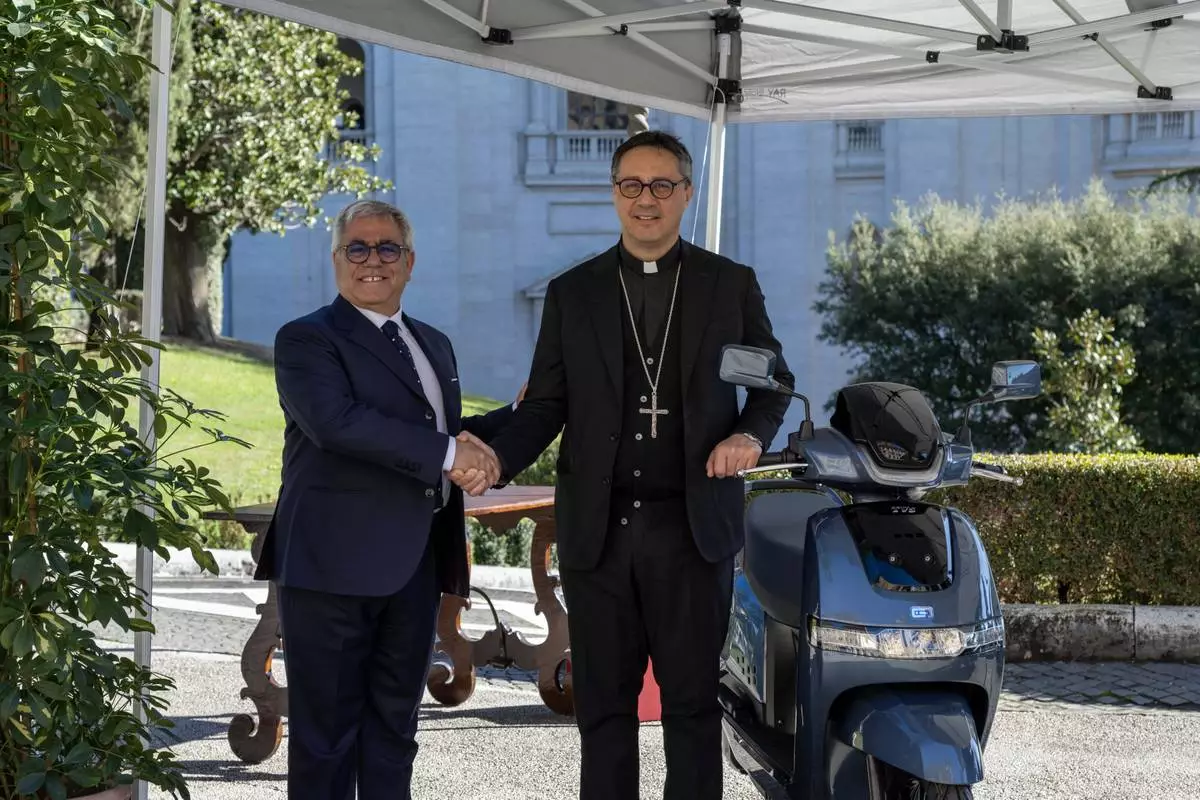
TVS iQube delivered to Governorate of Vatican State City
RALEIGH, N.C. (AP) — Hold on to those Thanksgiving turkeys! WKRP is coming to Cincinnati — for real this time.
“I cannot, by contract, tell you when. I cannot tell you who. But I can tell you, direct to the camera, WKRP, after 48 years, is coming to Cincinnati,” D.P. McIntire, who runs the media nonprofit that is auctioning the famous call letters, told The Associated Press. “Book it! It’s done!”
The call sign was made famous by “WKRP in Cincinnati,” a CBS television sitcom that ran from 1978 to 1982. It made stars of actors like Loni Anderson and Richard Sanders, whose bumbling newsman Les Nessman reported on a Thanksgiving promotion gone bad when live but flightless turkeys were dropped from a helicopter.
McIntire remembers watching the show’s first episode — featuring disc jockeys Dr. Johnny Fever (Howard Hesseman) and Venus Flytrap (Tim Reid) — in the living room with his parents and older sister.
“And at the end of the 30-minute episode,” he said, “I got up and I proclaimed, `I’m going to be in radio. And if I ever have the opportunity, I’m going to run a station called WKRP.’”
McIntire said he got his first on-air job at 13 as a news anchor at WNQQ “Wink FM” in Blairsville, Pennsylvania.
Fast forward to 2014, when his North Carolina-based nonprofit acquired the call sign from the Federal Communications Commission. Stations in Dallas, Georgia, and Alexandria, Tennessee, previously bore the letters.
McIntire laughs as he recalls his chat with a woman in the agency’s audio division.
He had two sets of call letters in mind. She told him he needed a third.
“Being the jokester that I am, I said, `Well, if you need three, and if it’s available, we’ll take WKRP,’” he said. “And 90 seconds later, she came back and she said, `Mr. McIntire. Congratulations. You’re the general manager of WKRP in Raleigh, North Carolina.’”
WKRP-LP — 101.9 on the FM dial — went live Nov. 30, 2015. The LP stands for “low power,” a class of station created to serve more local audiences that didn’t want mass-market content.
“Our format is what radio used to be 35 years ago in small-town America,” he said. "There is Greats of the ‘80s, Sounds of the ’70s, '90s Rewind," as well as local news and “specialty programming.”
LPFM is restricted to nonprofit organizations like his Oak City Media, and it’s definitely local.
“Your broadcast capacity is limited to 100 watts,” McIntire said. “So, your average range is between, depending on your terrain and circumstances, 4 and 12 miles (6 and 19 kilometers) in any direction. Enough to cover a small town.”
And, by necessity, it’s a low-budget affair.
The transmitter is in a corner of McIntire’s garage, between a recycling bin and the cleaning supplies. The broadcast antenna sits atop a 25-foot (7.62-meter) metal flagpole in the backyard. The studio — microphones and a mixing board hooked up to a computer — is on the first floor of McIntire’s home.
Like the WKRP of television, McIntire and his partners set out to be “irreverent.” One of their offerings is a two-hour show called “Weird Al and Friends,” focusing on the satirical works of Weird Al Yankovic.
They even had an annual Thanksgiving turkey giveaway. But don’t call the American Society for the Prevention of Cruelty to Animals — they hand out gift certificates to a local grocery store.
“We don’t toss them out of helicopters,” he said with a laugh.
This news comes hot on the heels of the decision to shutter CBS News Radio after nearly a century in operation. After more than a decade on the air, the 56-year-old McIntire decided it was time to pass the reins.
“We’re in a position where the older members like me who started the station are turning the leadership over to younger members,” he said. “They’re not interested in radio.”
They put out a call for bids to use the call letters on FM and AM radio, as well as television and digital television.
They intend to use the proceeds for a new nonprofit venture called Independent Broadcast Consultants. He said IBC will be “geared specifically toward helping these new broadcasters get up and running, get the consulting that they need in order to be, hopefully, more successful than we have been.”
Oak City Media was all set to hand off the television-related suffixes — WKRP-TV and WKRP-DT — when another group defaulted on the agreement, McIntire said. But he said the Cincinnati deal is in the bag, he just can’t legally discuss it.
“It will be radio,” he said. “But that’s all I can tell you at this time.”
Robert Thompson, who uses a season 2 episode of “WKRP” in his TV history class at Syracuse University, said it’s telling that people see real value in a fictional station whose call letters invoke the word “crap.”
“The value comes from the love of the characters for each other,” he said. “And now by buying this thing, the value comes from our love of the characters themselves.”
Whatever they do with the call sign, McIntire hopes they will be true to the show that inspired it.
“It has a special place in the hearts of an awful lot of people,” he said. “And we have been very, very, very proud to have been a steward of that legacy.”
This story has been updated to correct that the studio is on the first floor of the home, not the basement.
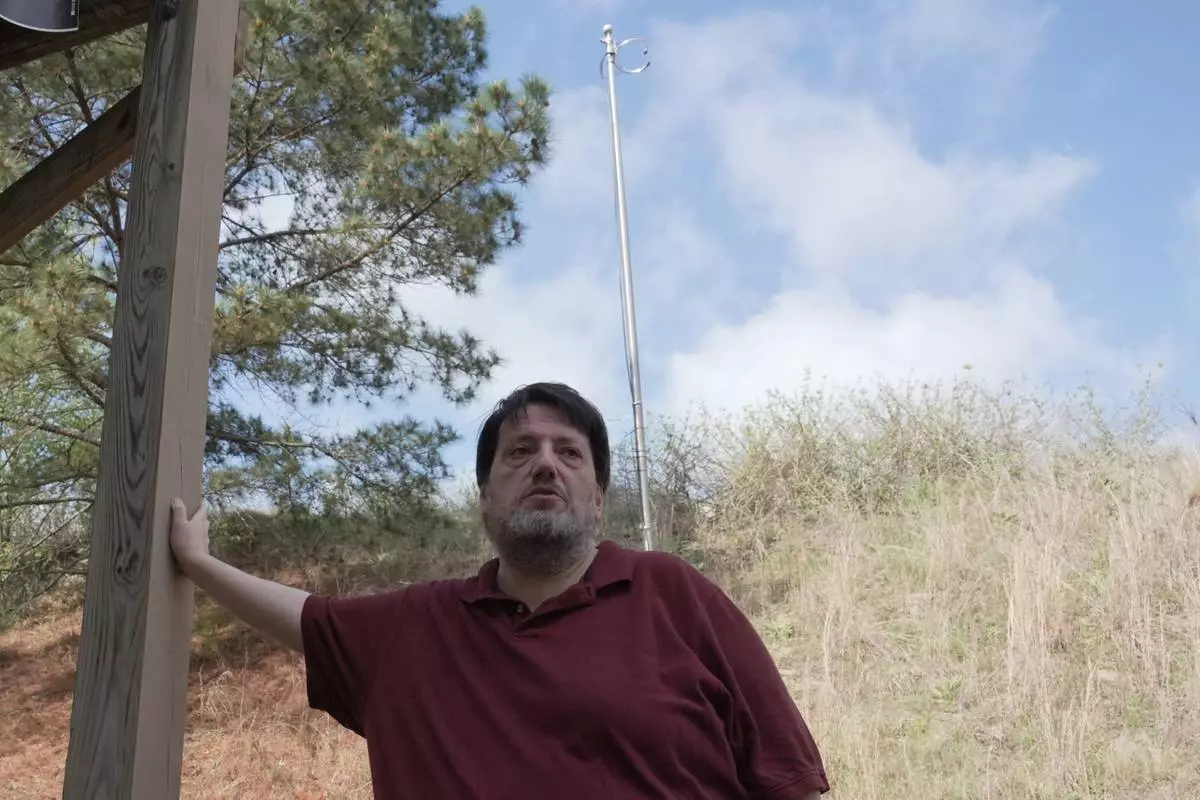
D.P. McIntire leans against a deck beneath the WKRP radio antenna in the backyard of his home in Raleigh, N.C., on Thursday, April 2, 2026. (AP Photo/Allen G. Breed)
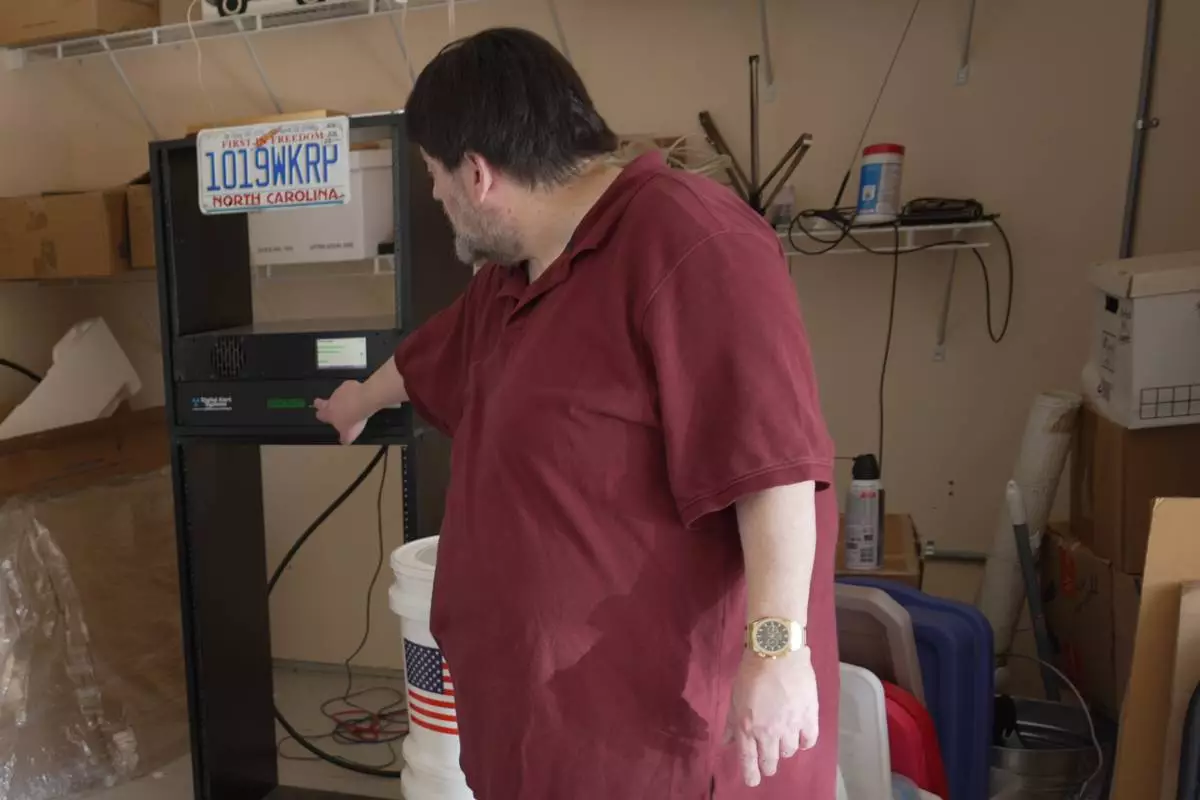
D.P. McIntire points to the transmitter for WKRP radio in a corner of his garage in Raleigh, N.C., on Thursday, April 2, 2026. (AP Photo/Allen G. Breed)
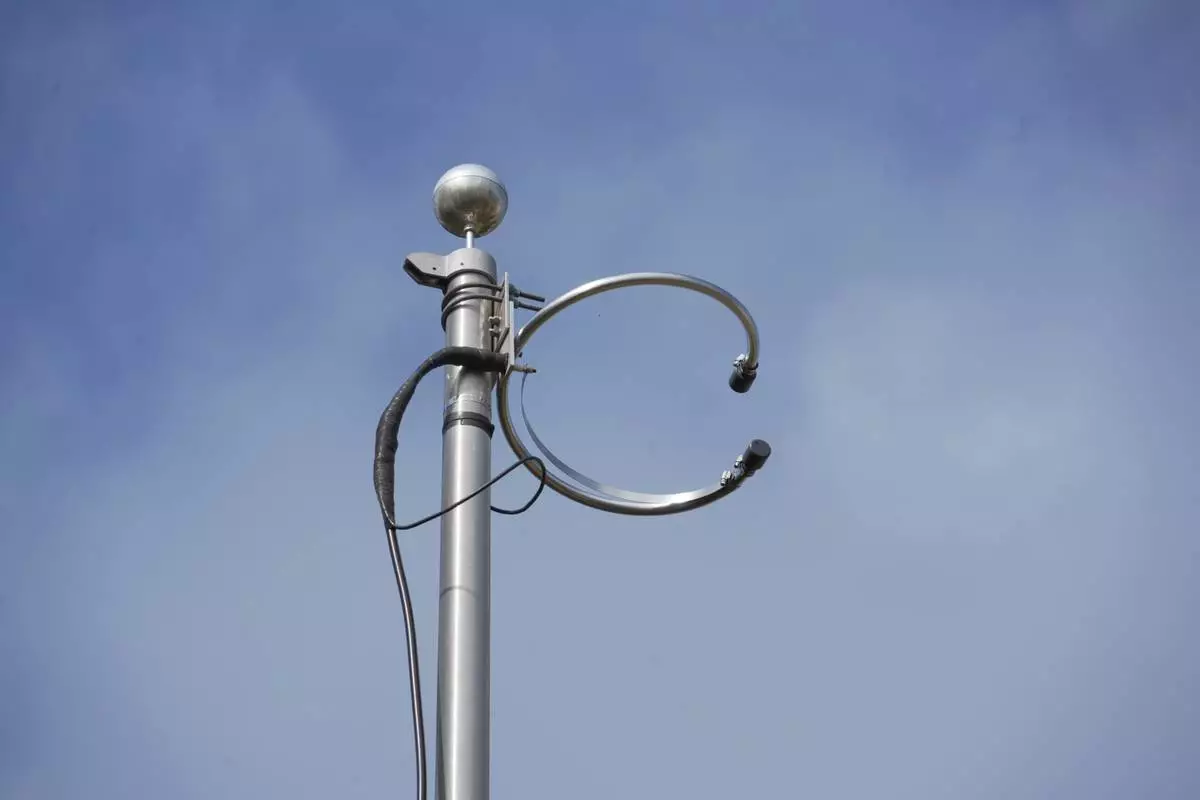
The WKRP radio antenna sits atop a 25-foot flagpole behind D.P. McIntire's home in Raleigh, N.C., on Thursday, April 2, 2026. (AP Photo/Allen G. Breed)
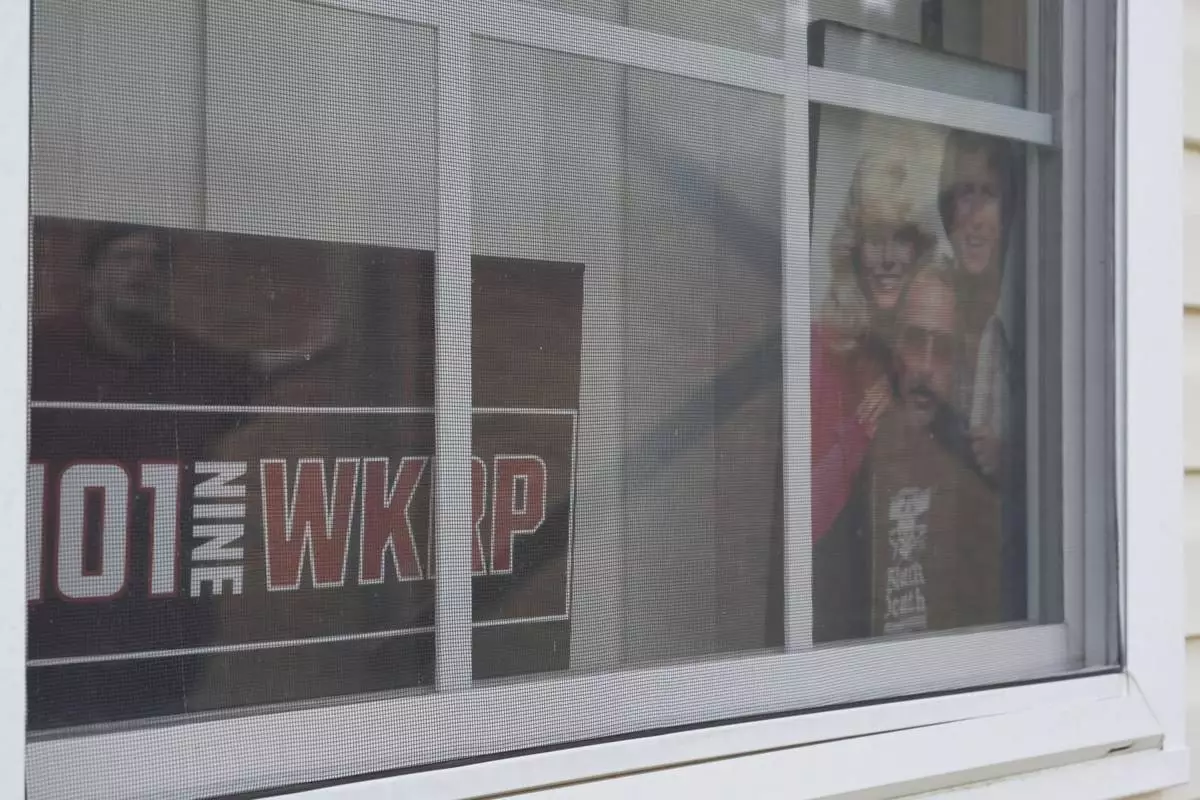
A photo of the cast members of the sitcom "WKRP in Cincinnati" sits in a window at the home of D.P. McIntire in Raleigh, N.C., on Thursday, April 2, 2026. (AP Photo/Allen G. Breed)
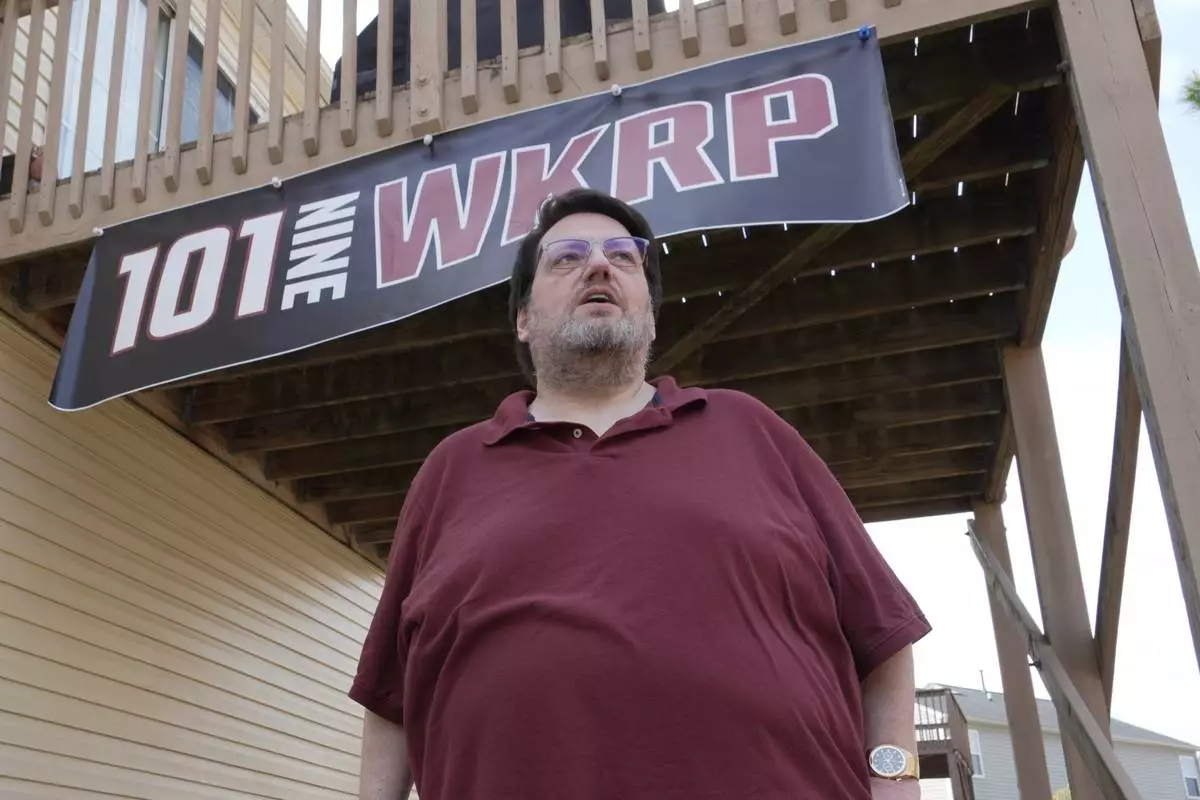
D.P. McIntire stands beneath a WKRP banner in the backyard of his home in Raleigh, N.C., on Thursday, April 2, 2026. (AP Photo/Allen G. Breed)