ORLANDO, Fla. (AP) — Florida lawmakers this week approved renaming the international airport in West Palm Beach after President Donald Trump, just days after the Trump family company filed to trademark the use of the president’s name on airports.
The legislation to switch the name of the Palm Beach International Airport to the President Donald J. Trump International Airport awaits the signature of Florida Gov. Ron DeSantis after it passed the state Senate on Thursday. If the Republican governor signs it into law and it's approved by the Federal Aviation Administration, the name change will take effect in July.
When asked if the governor planned to sign the legislation, his press secretary, Molly Best, said Friday that DeSantis hadn't yet received the bill. When he does, “he will review it in its final form," she said.
Here's what to know about the airport's renaming.
The legislation gives the power to name large commercial airports in Florida to the state. In doing that, lawmakers kept the names of Florida's six other major commercial airports the same, while changing the one in West Palm Beach, which is nearby Trump's Mar-a-Lago home in Palm Beach.
The legislation also specifies that the state's airport names are “branding designations” only, without the need to create new legal entities. The changing of the West Palm Beach airport's name is expected to cost as much as $5.5 million for new signage, branding and other updates.
The approval of the airport name change came just days after the Trump Organization filed applications with the federal trademark office seeking exclusive rights to use the president’s name on airports and dozens of related things found there, from buses shuttling passengers to umbrellas and flight suits.
The Trump Organization said that the first-of-their-kind applications were triggered by the Florida bill and that it didn’t seek any profit — only protection against “bad actors” given that the Trump name is the “most infringed trademark in the world.”
Unlike past U.S. presidents, Trump isn't waiting for future generations to name things after him.
Trump’s handpicked board voted last year to rename Washington’s leading performing arts center as the Trump Kennedy Center. Congress originally named the center for President John F. Kennedy in 1964, after his assassination. Trump's allies also put his name on the U.S. Institute of Peace and a new class of battleships that’s yet to be built.
There are also the “Trump Accounts” for tax-deferred investments, the TrumpRx government website offering direct sales of prescription drugs and the “Trump Gold Card” visa that costs at least $1 million
Palm Beach County historically was a Democratic-dominated, liberal enclave. But in the past decade, its politics have swung to the right because of an influx of MAGA influencers and billionaires, especially in the town of Palm Beach, which is Trump's home, and surrounding wealthy communities. Palm Beach County voters in 2024 picked Democratic presidential nominee Kamala Harris over the Republican Trump by the narrowest of margins — less than 6,000 votes out of more than 748,000 votes cast.
GOP state Sen. Debbie Mayfield, who sponsored the Senate bill, said the new name was a good fit for the county since Trump had made it his home.
Calling the name change “misguided and unfair,” U.S. Rep. Lois Frankel, a Democrat whose district includes the airport, said the GOP-controlled Florida Legislature had ignored public input by pushing ahead with the name change without properly consulting local residents.
“Decisions about naming major infrastructure should wait until after an honoree’s service has concluded — and should include meaningful input from the local residents and communities most directly affected," Frankel said.
Follow Mike Schneider on the social platform Bluesky: @mikeysid.bsky.social.
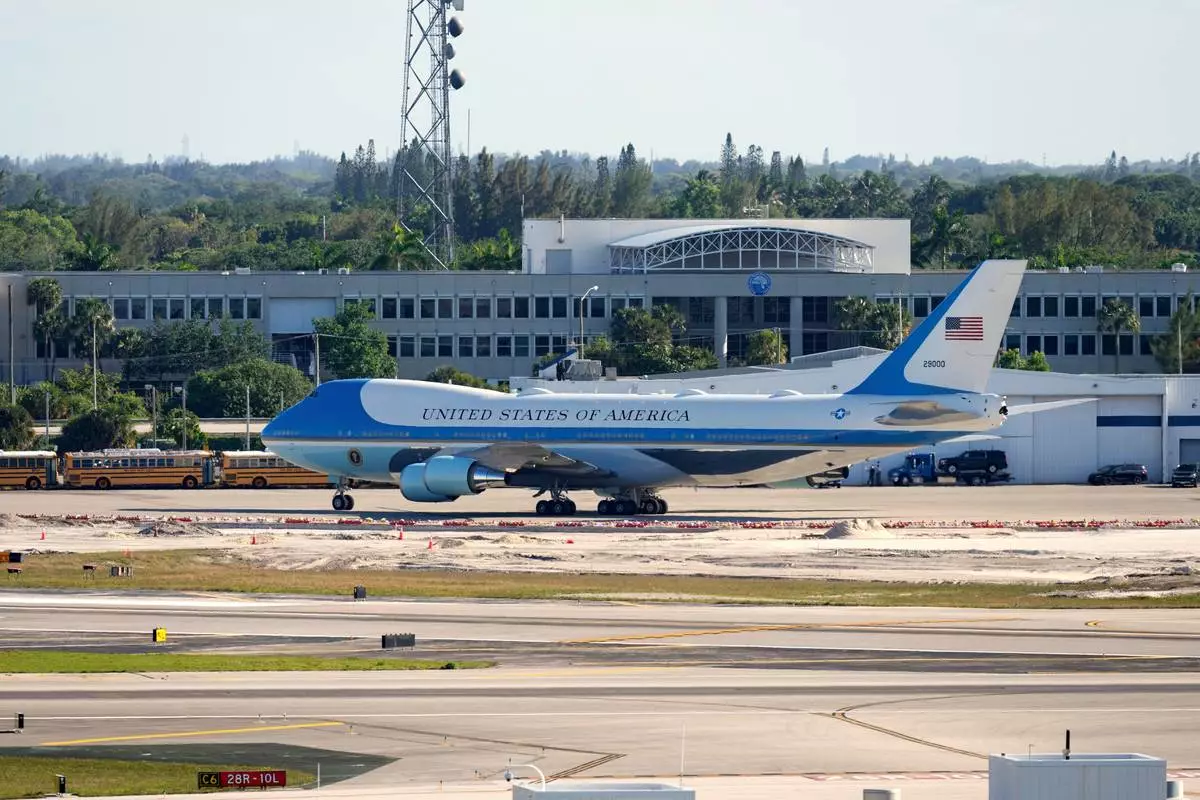
FILE - Air Force One with President Donald Trump on board departs from Palm Beach International Airport, April 6, 2025, in West Palm Beach, Fla. (AP Photo/Alex Brandon, File)
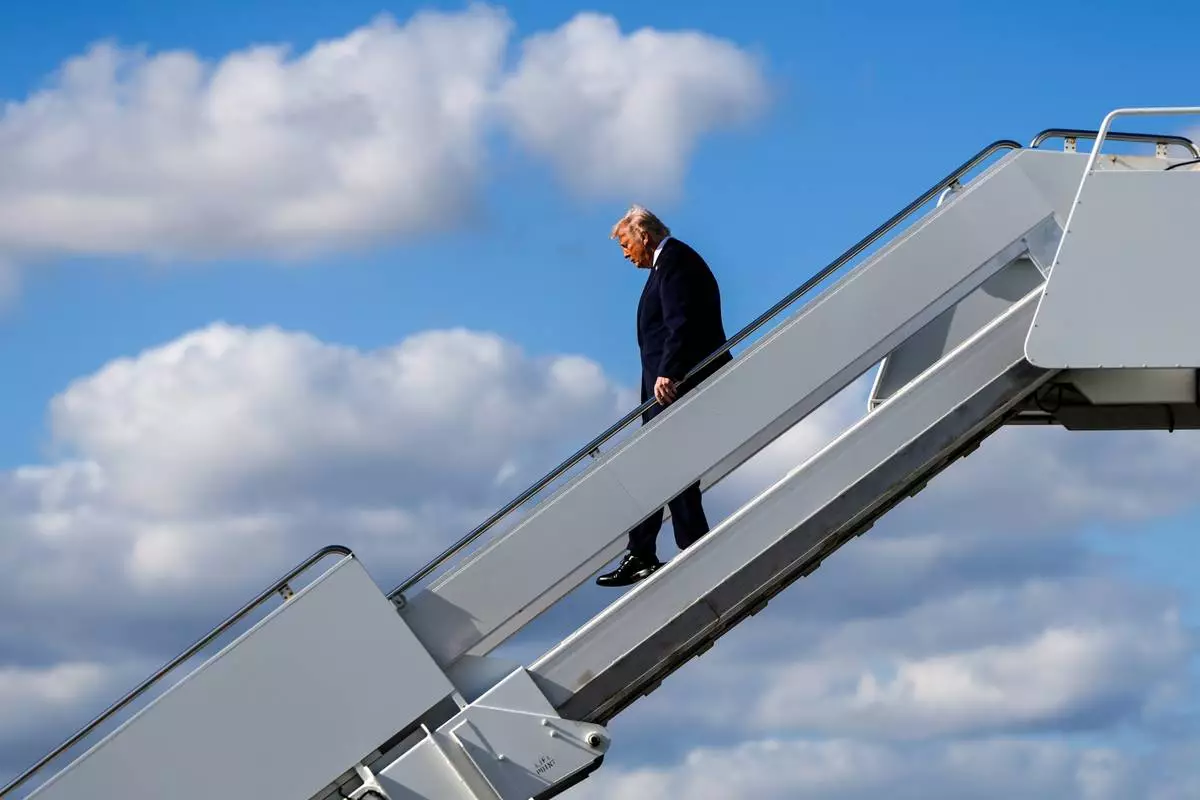
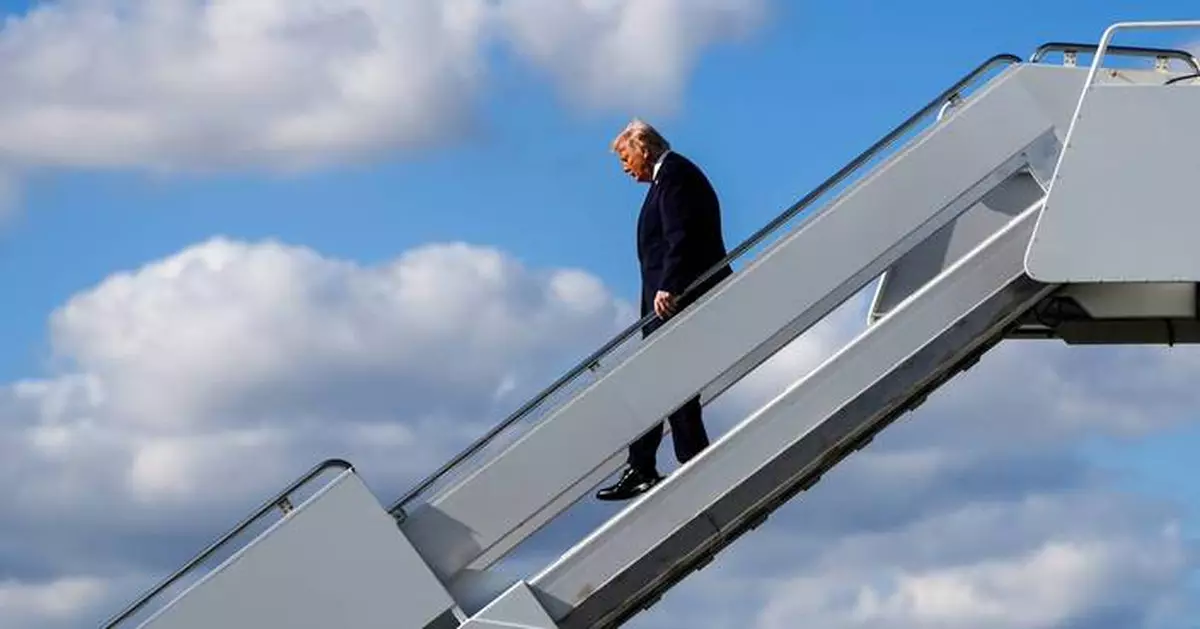
FILE - President Donald Trump disembarks Air Force One at Palm Beach International Airport, Jan. 16, 2026, in West Palm Beach, Fla. (AP Photo/Julia Demaree Nikhinson, File)
WASHINGTON (AP) — President Donald Trump paid a price for going it alone on tariffs — with the Supreme Court on Friday delivering a rare rebuke by ruling he lacked the power to declare an economic emergency and launch sweeping new taxes on imports.
Trump had made tariffs the bedrock of his economic pitch to voters going into the midterm elections, even describing tariffs as his “favorite word in the dictionary.” He promised that factories would relocate from overseas and bring jobs with them, and he warned that losing the tariffs could plunge the U.S. into a deep recession.
But Friday’s ruling will most likely prolong political and economic chaos over international trade through the election year.
Trump described the ruling as “deeply disappointing” and “ridiculous,” adding that he was “absolutely ashamed” of the six Supreme Court justices who ruled against him "for not having the courage to do what’s right for our country.”
“They’re just being fools and lap dogs for the RINOs and the radical left Democrats,” Trump said of the high court majority in an afternoon press briefing, referring to “Republicans in Name Only.” “They’re very unpatriotic and disloyal to our Constitution.”
He vowed to bypass Congress and impose new tariffs on his own under existing law.
Trump learned of the decision after being handed a note during a private meeting with several governors in the morning, according to two people with knowledge of the president's reaction who spoke on the condition of anonymity. Another person, who was briefed on the conversation, disclosed that Trump said he has “to do something about these courts.”
The meeting with the governors ended shortly after Trump learned of the decision.
Republican strategist Doug Heye said it was immediately clear that the president “is not going to be happy" about the decision.
“We’re starting to hear about how this is a massive blow, a massive repudiation," he said.
However, Heye said Trump will try to find another way to pursue his trade agenda.
“Are they going to be able to figure out how to use this as an opportunity or not?" he asked. "There are too many questions.”
The White House plans to use alternative laws to preserve his tariffs, but those policies will only prolong the debate and keep alive an issue that is largely unpopular with voters.
About 6 in 10 Americans said Trump had gone too far on imposing new tariffs on other countries, according to an AP-NORC poll from January.
Even more worrisome for a president elected on the promise of fixing Americans’ concerns about affordability, 76% said in a poll conducted last April that Trump’s tariff policies would increase the cost of consumer goods in the U.S.
Trump’s aggressive use of tariffs had left many Republican lawmakers uneasy, publicly and privately, forcing them to defend what were essentially tax increases on the American public and businesses.
At various points during Trump’s second term, at least seven senators from the president's party have voiced their concerns. Earlier this month, six House Republicans joined with Democrats to vote for a resolution against Trump’s tariffs on Canada.
Indeed, free trade had long been a central plank of the Republican Party before Trump's rise to power.
Kentucky Sen. Mitch McConnell described Trump's assertion that he can bypass Congress to implement tariffs as “illegal” in a statement praising the Supreme Court's decision.
“Congress’ role in trade policy, as I have warned repeatedly, is not an inconvenience to avoid,” the former top Senate Republican said. “If the executive would like to enact trade policies that impact American producers and consumers, its path forward is crystal clear: convince their representatives under Article 1” of the Constitution.
Former Vice President Mike Pence, who served during Trump's first term, cheered the ruling as a victory for the public, the separation of powers enshrined in the Constitution and free trade.
“American families and American businesses pay American tariffs — not foreign countries,” Pence wrote on social media. “With this decision, American families and businesses can breathe a sigh of relief.”
Democrats were quick to seize on the opportunity given to them by the Supreme Court, with Rep. Suzan DelBene, D-Wash., saying that Trump “is not a king” and his “tariffs were always illegal.”
“Republicans in Congress could have easily ended this economic crisis by standing up for their communities," said DelBene, chair of the Democratic Congressional Campaign Committee. “Instead, they chose to bend the knee to Trump while families, small businesses, and farmers suffered from higher prices.”
The ruling essentially allows Trump's critics to say that he broke the law and that middle class families suffered as a result.
But Trump has claimed that his tariffs were the difference between national prosperity and deep poverty, a pitch he made on Thursday night to voters in the swing state of Georgia.
The president used the word “tariff” 28 times in his speech Thursday at a Georgia steel company, Coosa Steel, which credited the import taxes as making its products more competitive with goods from China.
“Without tariffs, this country would be in such trouble right now,” Trump charged.
Trump also complained that he had to justify his use of tariffs to the Supreme Court.
“I have to wait for this decision. I’ve been waiting forever, forever, and the language is clear that I have the right to do it as president,” he said. “I have the right to put tariffs on for national security purposes, countries that have been ripping us off for years.”
By a 6-3 vote, the high court said no.
The president has consistently misrepresented his tariffs, claiming despite evidence to the contrary that foreign governments would pay them and that the revenues would be sufficient to pay down the national debt and give taxpayers a dividend check.
New research tied to one of America’s leading banks found on Thursday that tariffs paid by midsize U.S. businesses tripled over the course of the past year.
The additional taxes have meant that companies that employ a combined 48 million people in the U.S. — the kinds of businesses that Trump had promised to revive — have had to find ways to absorb the new expense, by passing it along to customers in the form of higher prices, employing fewer workers or accepting lower profits.
Trump’s tariffs — not all of which were overturned — were expected to generate $3 trillion in revenues over 10 years, according to the Congressional Budget Office. That sum is large, but it would insufficient to cover the costs of the projected deficits.
The Supreme Court has not ruled on how any refund process would work.
Associated Press writer Steven Sloan contributed to this report.
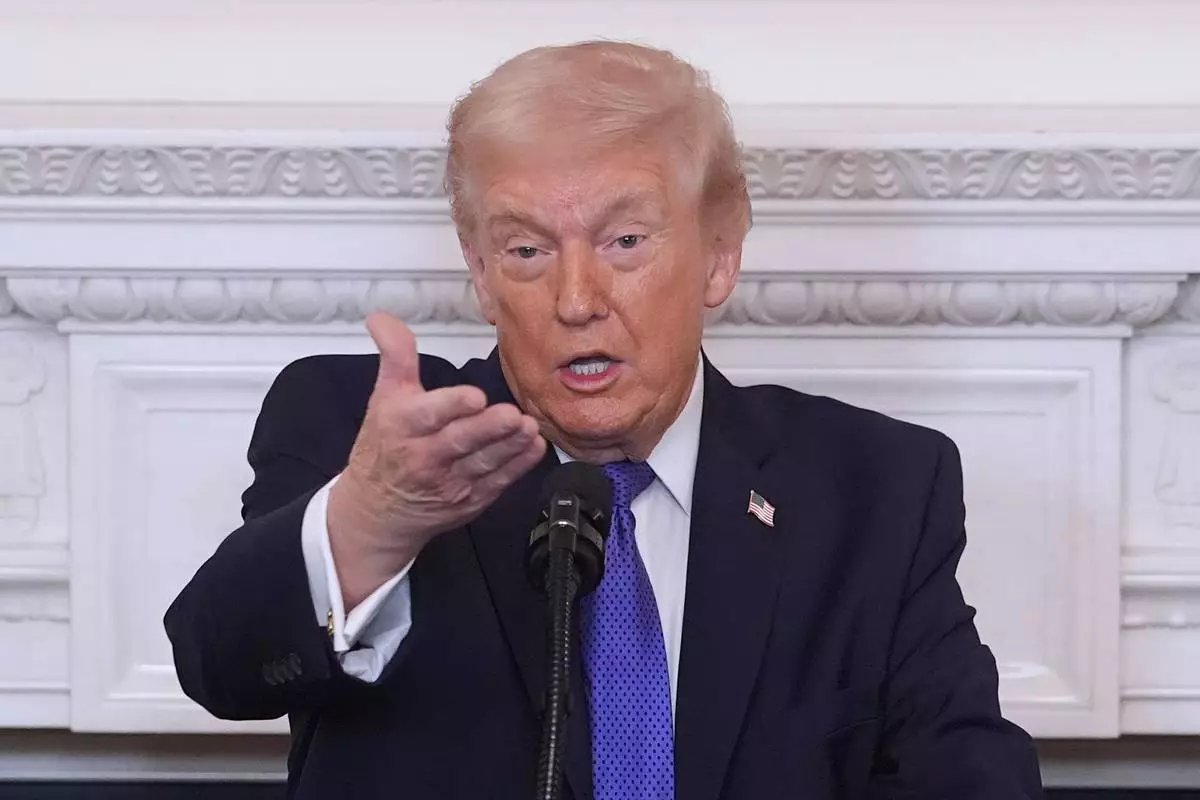
President Donald Trump speaks during a breakfast with the National Governors Association in the State Dining Room of the White House, Friday, Feb. 20, 2026, in Washington. (AP Photo/Evan Vucci)