The U.S. Supreme Court's Friday decision to strike down most of President Donald Trump's global tariffs has won immediate applause both at home and abroad.
Those hailing the Supreme Court ruling include the U.S. National Retail Federation, the chair of the European Parliament's International Trade Committee, and senior Canadian officials.
The Supreme Court, in a 6-3 ruling on Friday, determined that the executive branch exceeded its authority by using emergency powers to impose import taxes on most trading partners, officially striking down most of the global tariffs Trump has introduced since April 2025.
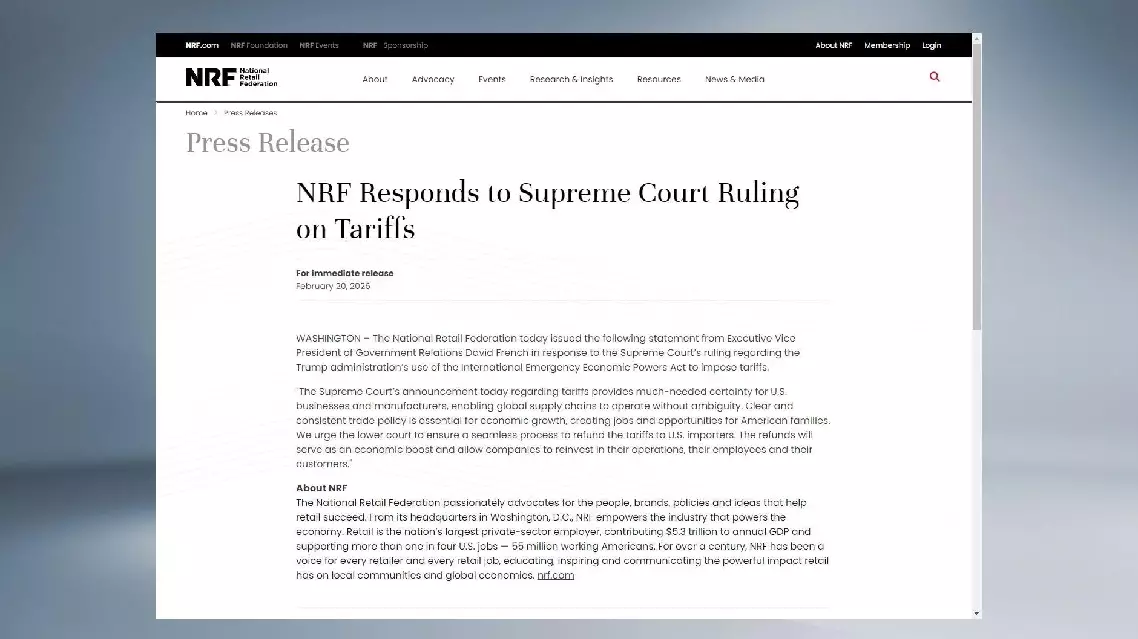
The U.S. National Retail Federation, in a statement released on its official website on Friday, said the ruling provides "much-needed certainty for U.S. businesses and manufacturers, enabling global supply chains to operate without ambiguity."
"Clear and consistent trade policy is essential for economic growth, creating jobs and opportunities for American families. We urge the lower court to ensure a seamless process to refund the tariffs to U.S. importers," said the statement.
Also on Friday, Bernd Lange, chairman of the European Parliament's International Trade Committee, said on social media X that the U.S. Supreme Court ruling sends "a positive signal for the rule of law."
"Judges have shown that even an U.S. president does not operate in a legal vacuum. Legal barriers have been set, the era of unlimited, arbitrary tariffs impossible by the President might now be coming to an end," Lange said.
Lange said that the European side "must carefully assess the ruling and its consequences."
He said that he had convened a meeting of the European Parliament's negotiating team on the EU-U.S. trade deal for the coming Monday to evaluate possible consequences for ongoing work, particularly ahead of the committee vote.
The European Parliament's Committee on International Trade is due to vote next Monday and Tuesday on two legislative proposals linked to implementing EU commitments stemming from the EU-U.S. political agreement reached by Trump and European Commission President Ursula von der Leyen in Turnberry, Scotland, on July 27, 2025.
Meanwhile, Canada-U.S. Trade Minister Dominic LeBlanc and Ontario Premier Doug Ford also welcomed the ruling in their respective posts on X on Friday.
LeBlanc said that the U.S. court's decision "reinforces Canada's position that the IEEPA (the International Emergency Economic Powers Act) tariffs imposed by the United States are unjustified."
While acknowledging that Canada maintains a strong trade partnership with the United States, LeBlanc noted that "critical work lies ahead" to support Canadian businesses and workers still affected by Section 232 tariffs on steel, aluminum and automotive sectors.
Commenting on the ruling, Ford said in his post: “Today’s U.S. Supreme Court decision is another important victory in the fight against President Trump's tariffs, but the battle isn't over yet. We need to watch how the White House reacts."
"We need to keep up the fight against tariffs on auto, steel, aluminum and forestry, which remain in place and continue to hurt our workers. I won't stop fighting until every last tariff against Canada is dropped so we can grow our economies and create jobs on both sides of the border," said the premier.
One day before the U.S. Supreme Court's ruling, the JPMorgan Chase Institute published a report which showed that tariff payments by midsize U.S. firms roughly tripled in 2025.
The report said that U.S. midsize firms' tariff payments began increasing sharply starting last April, the month that Trump unveiled his sweeping "Liberation Day" levies on numerous trading partners, reaching about three times the level seen before April in August 2025.
Tariff payments by these firms remained high through November, before declining slightly in December, according to the report.
Last week, the Federal Reserve Bank of New York also published a report on the impacts of Trump's global tariffs. Using data from the U.S. Census Bureau through November 2025, the report found that American consumers and firms paid for nearly 90 percent of the tariffs in 2025.
In response to Friday's ruling, Trump said at a press conference later in the day that his administration intends to introduce a new "10-percent global tariff" to replace the duties struck down by the Supreme Court.
US Supreme Court rejecting Trump's global tariffs wins applause at home, abroad