As people across China celebrate the Spring Festival, visitors are flocking to destinations where glowing lanterns and colorful folk parades fill the air with festive cheer, immersing holidaymakers in traditional cultural experiences.
In central China's Henan Province, Baligou Scenic Area, located at the southern foot of Taihang Mountain, has become a hub of festive activities, drawing large crowds of visitors.
A spectacular array of traditional performances was staged in the scenic area, including a parade with fish-shaped lanterns, lion dances, and the magical face-changing in Sichuan Opera, a century-old Chinese intangible cultural heritage.
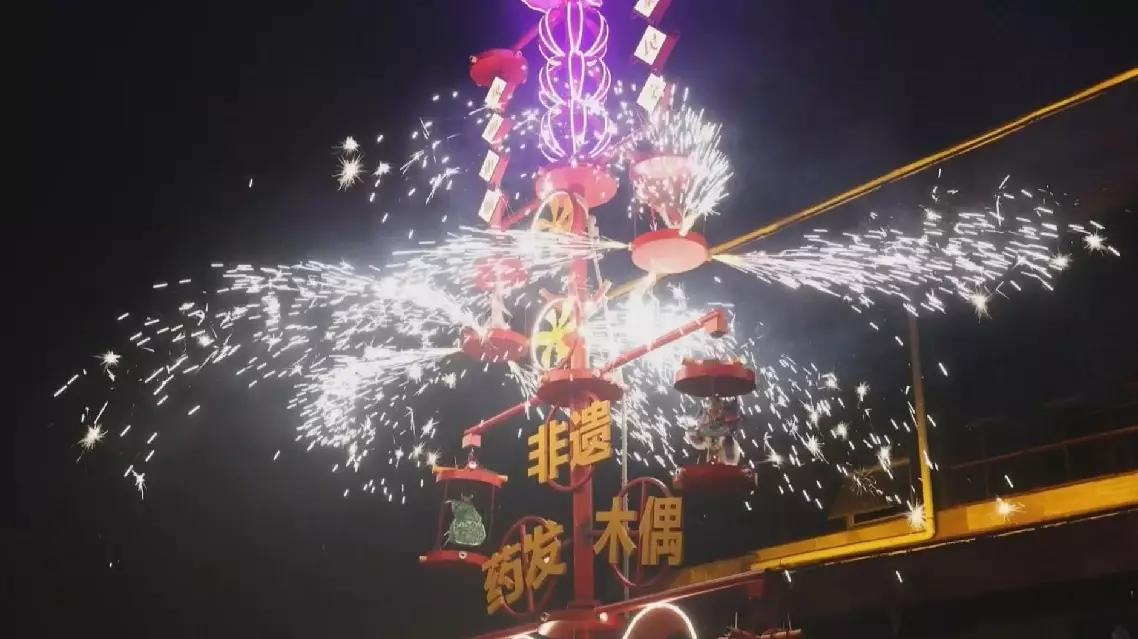
As night fell, the valley was illuminated by a dazzling light show, with a unique intangible cultural heritage performance highlighting the celebration.
Yaofa Puppetry, also known as Firework Puppetry, combines traditional Chinese fireworks with puppetry, creating a breathtaking spectacle in which puppets dance in the night sky amid cascading sparks and flames.
"I haven't seen this show anywhere else. It's very creative," said Che Shanshan, a visitor.
"Originally, gunpowder was used to spin the puppets. It was performed mainly during festivals for people to pray for blessings and the safety of their families," said Lou Yu, person in charge of the Yaofa Puppetry show.
In east China's Fujian Province, residents were celebrating the Spring Festival with a unique dragon dance, lighting up the village of Jihui with the centuries-old tradition.
The glowing dragon, stretching about 100 meters, was made of connected wooden planks, each fitted with two delicate lanterns. The fiery red dragon wound its way through the village lanes, with the villagers carrying the planks together.
The spectacle attracted numerous tourists, enjoying the charm of the Chinese New Year.
The Spring Festival, or the Chinese New Year, which fell on Feb 17 this year, is the most important traditional holiday for the Chinese people.
Traditional folk activities held across China to celebrate Spring Festival
The International Monetary Fund (IMF) has lowered its global economic growth forecasts for 2026 to 3.1 percent in the World Economic Outlook (WEO) report published on Tuesday, while keeping its projection for 2027 at 3.2 percent.
This marks a deceleration from the estimated 3.4 percent growth achieved in 2025. Before the outbreak of the Middle East conflict, the bottom-up forecasts for global growth would have been 3.4 percent in 2026 and 3.2 percent in 2027.
The forecast incorporates the impact of the war and assumes that it will be limited in duration, intensity and scope, with disruptions fading by mid-2026.
Under the reference forecast, global headline inflation is expected to increase to 4.4 percent in 2026 and decline to 3.7 percent in 2027.
If the conflict and the ensuing spike in oil prices last longer, global economic growth in 2026 will fall to 2.5 percent, while global inflation will climb to 5.4 percent, according to the report.
In extreme cases, global economic growth in 2026 could drop to two percent, the report warned.
To be specific, the U.S. economy is projected to grow by 2.3 percent in 2026 and 2.1 percent in 2027, although higher trade barriers introduced since April 2025 are expected to continue to weigh on activity.
In the euro area, growth is projected to decline from 1.4 percent in 2025 to 1.1 percent in 2026 before edging up to 1.2 percent in 2027. The forecasts for 2026 and 2027 are each 0.2 percentage point lower than those compared in the January 2026 WEO Update.
The 2026 growth forecast for emerging market and developing economies is revised down by 0.3 percentage point, to 3.9 percent, while the outlook for advanced economies remains broadly unchanged. With risks still tilted to the downside since the January 2026 WEO Update, the IMF suggested a comprehensive policy package combining domestic measures with coordinated international actions to strengthen resilience and foster adaptability.
It also stated in the report that "trade restrictions play a limited role in correcting imbalances but can worsen output," and urged countries to cooperate and take coordinated actions to restore stability to international economic relations.
IMF lowers global growth forecast for 2026 to 3.1 pct