OTTAWA, Ontario (AP) — ChatGPT-maker OpenAI said Thursday the shooter in one of the worst school shootings in Canada's history got around a ban on her problematic use of the service by having a second account.
The revelation came as the San Francisco tech company outlined in a letter to Canada's government some “immediate steps” it was taking in response to the killings, and that if these had been in place at the time, police would have been informed of the activity on the account.
OpenAI's vice president for global policy, Ann O’Leary, said the company only discovered the second account after Jesse Van Rootselaar’s name was announced by the Royal Canadian Mounted Police, who said Van Rootselaar killed eight people and then herself in Tumbler Ridge, British Columbia, on Feb. 10.
She said the shooter somehow evaded systems to prevent banned users from creating new accounts, and Van Rootselaar’s second account was shared with law enforcement upon its discovery.
The letter said OpenAI is committed to strengthening its detection systems to better prevent attempts to evade its safeguards and “prioritize identifying the highest risk offenders.”
The shooter’s first ChatGPT account was shut down in June 2025, the letter said, after a violation of its usage policy. The letter said OpenAI’s automated system detected the account, and it was then sent to human review to determine whether its policies were violated and whether the account warranted referral to law enforcement.
“Based on what we could see at that time the account was banned in June 2025, we did not identify credible and imminent planning that met our threshold to refer the matter to law enforcement,” O’Leary said.
Speaking to reporters on Thursday, British Columbia Premier David Eby said Sam Altman, the CEO of OpenAI, has agreed to meet with him.
Eby said his government was told by OpenAI that changes to the thresholds to its protocols would have resulted in police being informed about Van Rootselaar’s ChatGPT activity, had they been in place before the killings.
But this was “cold comfort” for the families of Tumbler Ridge, he said.
In her letter, O’Leary also said the firm will strengthen protocols about contacting police “when conversations cross the line into an imminent and credible risk.”
“With the benefit of our continued learnings, under our enhanced law enforcement referral protocol, we would refer the account banned in June 2025 to law enforcement if it were discovered today,” she said.
She said OpenAI will develop a direct point of contact with Canadian law enforcement.
“The events in Tumbler Ridge are an unspeakable tragedy, and our hearts remain with the victims, their families, and the entire community,” O’Leary said in the letter.
O’Leary thanked Canada's Artificial Intelligence Minister Evan Solomon for convening a meeting Tuesday to discuss how to help prevent similar tragedies in the future.
“In our meeting, you and the other Ministers stressed that no community should have to face this tragedy,” O’Leary said. “We agree.”
Solomon called OpenAI representatives to Ottawa to explain its safety procedures and decision-making processes.
Solomon said “all options are on the table” as the government develops a “suite of measures” to address online harms and other digital policy issues.
The RCMP said Van Rootselaar first killed her mother and stepbrother at the family home before attacking the nearby school. Van Rootselaar had a history of mental health contacts with police.
The motive for the shooting remains unclear.
The attack was Canada’s deadliest rampage since 2020, when a gunman in Nova Scotia killed 13 people and set fires that left another nine dead.
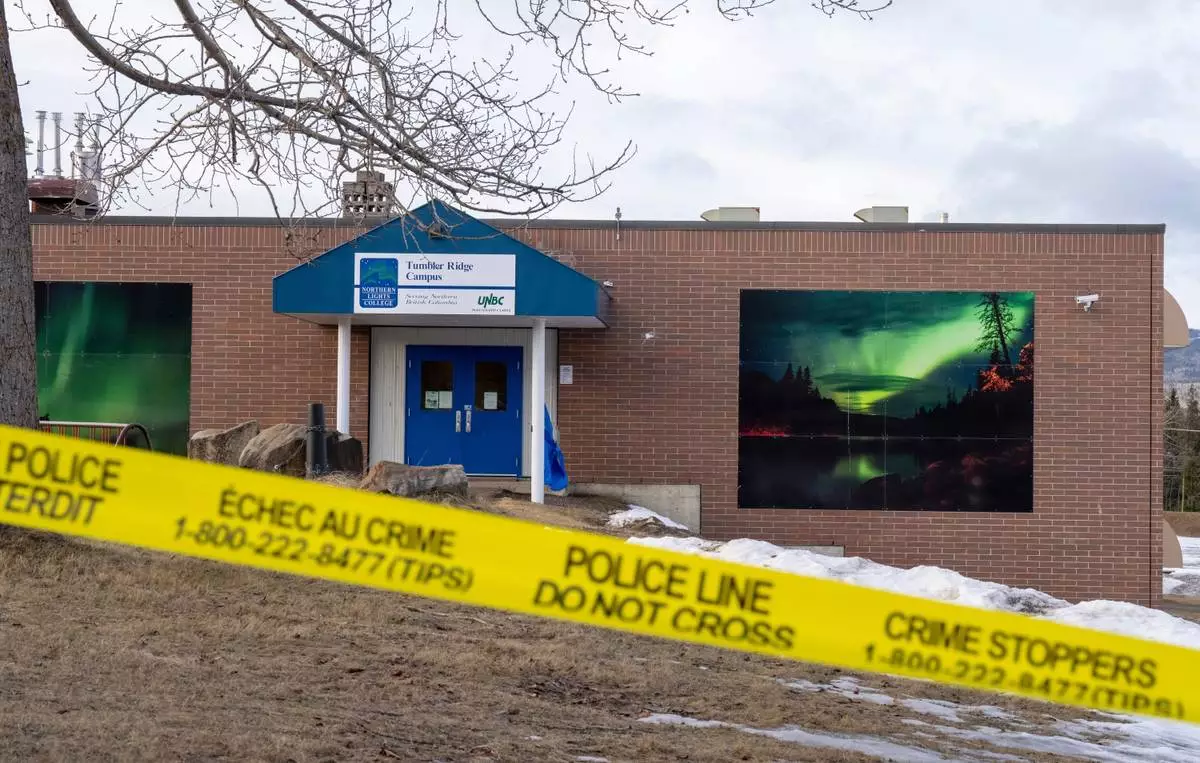
FILE - Police tape surrounds a school in Tumbler Ridge, British Columbia, Canada, Feb. 12, 2026, two days after a mass shooting. (Christinne Muschi/The Canadian Press via AP, File)