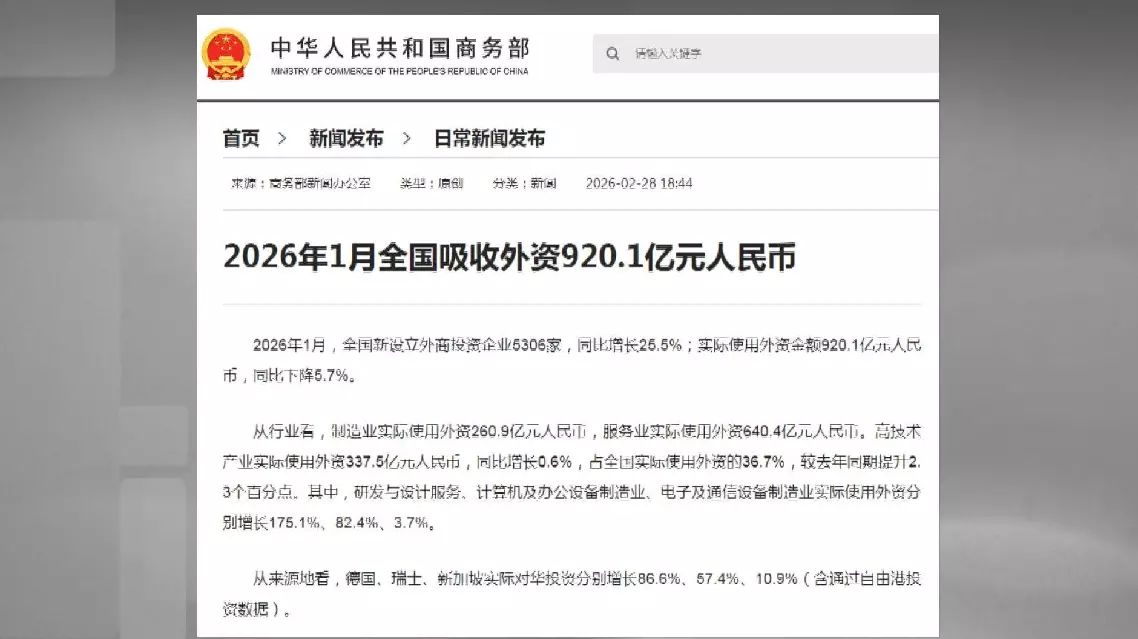
China added 5,306 foreign-invested companies in January, marking a year-on-year increase of 25.5 percent, with the actual amount of foreign investment used reaching 92.01 billion yuan (over 13 billion U.S. dollars), according to the data released by the Ministry of Commerce on Saturday.
Specifically, the actual investment from Germany, Switzerland, and Singapore in China increased by 86.6 percent, 57.4 percent, and 10.9 percent, respectively.
The actual amount of foreign investment used by the manufacturing industry reached 26.09 billion yuan, while for the service industry, that figure stood at 64.04 billion yuan.
The actual amount of foreign investment used by the high-tech industry totaled 33.75 billion yuan, up 0.6 percent year on year, accounting for 36.7 percent of the national total and marking an increase of 2.3 percentage points from the same period last year.
Specifically, for research and development and design services, manufacturing of computers and office equipment, and manufacturing of electronic and telecommunications equipment, the actual use of foreign investment rose by 175.1 percent, 82.4 percent, and 3.7 percent, respectively.
"In January this year, China's efforts to attract and utilize foreign investment demonstrated a new momentum. The investment structure continued to improve, with the share of the actual amount of foreign investment used by the high-tech industry rising by 2.3 percentage points compared with the same period last year. Foreign enterprises have become more confident in investing in China. Since the beginning of the year, executives of foreign companies have visited China frequently, and investment from countries including Germany in China has grown substantially," said Yuan Qian, researcher at the Institute of Foreign Economic Research.
China sees double-digit rise in foreign-invested companies in Jan
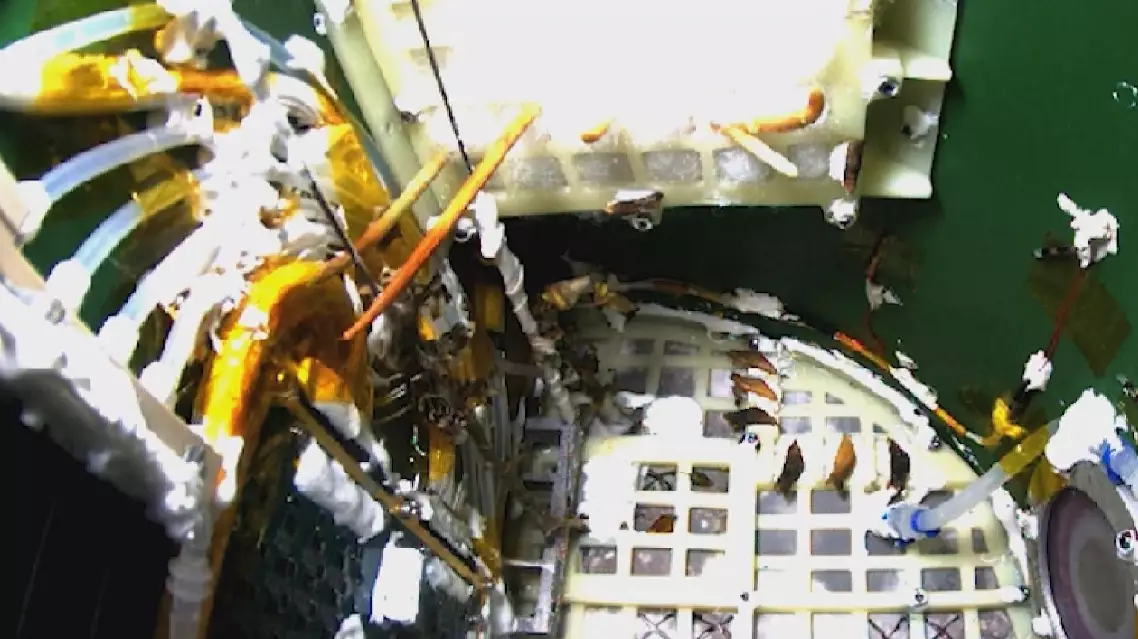
Researchers at China's Chongqing University recently announced that a butterfly has successfully emerged from its pupa while orbiting Earth, yielding valuable data on biological survival in the harsh microgravity environment of space.
The butterfly chrysalis was sealed inside a small experimental space ecosystem payload developed by the university's research team and carried into space aboard the Kuaizhou-11 Y8 carrier rocket on Dec. 13, 2025.
Photos taken in space show the emerged butterfly moving inside the capsule, resting on leaves, and fluttering its wings, demonstrating notable adaptation to microgravity.
In order to witness the emergence of butterflies from their chrysalises in space, Professor Xie Gengxin of Chongqing University led a research team to conduct multiple rounds of screening and ultimately selected Swallowtail butterflies as the test subjects.
The selected butterfly species take approximately one to two weeks to transition from larvae to pupae and then to adult butterflies, which aligns with the duration of this on-orbit experiment. Additionally, the chrysalis's structure must withstand the various shocks encountered before and during launch.
"On the day of the launch, there will be intense vibrations. Therefore, when selecting the animals, we had to choose a species capable of enduring the two-week period of darkness and stillness before the launch while also being able to withstand the impact. In the end, we discovered that butterfly chrysalises were a relatively ideal target," said Qiu Dan, deputy chief engineer of the butterfly experiment payload.
The research team's payload, "Shennong Kaichu 2," serves as the "space home" for the butterfly chrysalises. It has a total mass of 8.3 kilograms and an internal usable space of 14.2 liters. In addition to the butterfly chrysalises, the research team also placed a chili plant, soil, water, and other materials inside the payload.
"With leaves on the chili plant, when sunlight shines in, it can carry out photosynthesis and produce oxygen for the little butterfly. We also introduced some microorganisms into the soil. On one hand, they help improve the soil; on the other hand, they can regulate oxygen and carbon dioxide levels while also purifying the air," said Xie, who is also the chief engineer of the butterfly experiment payload.
Data frameshifted back from the space show that technical indicators inside the sealed cabin of the "Shennong Kaiwu-2" payload, including pressure, temperature, and humidity, have remained stable and normal.
The successful hatching and flight of the butterfly in a microgravity environment not only verified the resilience of life on Earth but also provided important reference for life-support technologies in future long-term deep-space exploration.
Chinese space experiment sees butterfly emerge from in orbit
Chinese space experiment sees butterfly emerge from in orbit