

The United States is putting on another masterpiece in global performance art. This time, Washington is using live ammunition to redefine exactly what "precision strike" and "human rights defender" mean in the modern era.
The Tomahawk cruise missile flies straight into a primary school. The President, meanwhile, flies straight into a parallel universe.
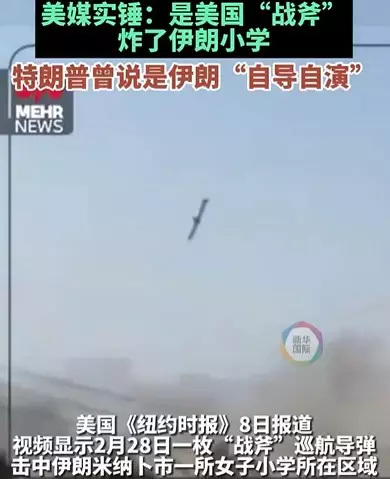
Exposed by US media: A US Tomahawk missile scores a precision hit on a primary school in Minab, Iran.
Consider the facts exposed by The New York Times and other outlets. On February 28, a US military Tomahawk missile scored a direct hit on a primary school in the Iranian city of Minab. The strike wiped out at least 165 people, and the overwhelming majority of those victims were young girls around ten years old.
The footage is visceral and horrifying. A missile roars into the frame, concrete structures pancake into dust, and the screams of bystanders pierce the billowing smoke. Make no mistake: not a Hollywood soundstage, but simply the daily reality of the US military executing its mandate to "maintain regional stability."
The Illusion of Denial
The New York Times did not just publish the video; they verified it using a mountain of compiled evidence, from satellite imagery to cross-referenced social media posts. The resulting report highlights one inescapable truth. In this specific conflict, there is only one force deploys Tomahawk missiles, and that force is the United States military.
Yet in Washington's alternate reality, President Trump is spinning a wildly different tale. He confidently declares that "Iran did this." In the President’s worldview, only Iranian hardware is shoddy enough to veer off course and obliterate civilian infrastructure. The Tomahawk in question—branded with US insignia, launched from a Navy warship, and tracked from space—is dismissed as nothing more than a collective hallucination.
Secretary of State Marco Rubio plays the innocent card perfectly, insisting “The United States would not deliberately target a school”. Meanwhile, the Pentagon rolls out its standard line about “looking into the matter”. It is a seamless, well-oiled machine of denial, delay, and blame-shifting. You could even call it a textbook triumph of crisis PR, provided you ignore the fact that the target was a school packed with children.
The Pentagon loves to brag about the Tomahawk. They market it as a premier "long-range, high-precision" weapon that can navigate autonomously for 1,600 kilometers before striking a programmed target. In Minab, the weapon certainly lived up to its elite billing. It precisely bypassed genuine military bases, precisely dodged official narratives, and precisely slammed into a primary school classroom. The accuracy required to execute an "aim for a school, hit a school" operation is truly staggering.
Two Standards, One Superpower
The reality is found in the breathtaking closed-loop logic of American foreign policy. When rivals harm civilians, Washington brands it a "barbaric atrocity." But when the US military flattens a school, the narrative immediately shifts to "unavoidable collateral damage." Demand a transparent investigation from an adversary, and it is framed as an international responsibility. Present the Pentagon with ironclad evidence of its own strikes, however, and suddenly it is a malicious frame-up.
This is the ultimate flex of American soft power. Washington maintains one set of rhetoric but deploys two entirely distinct sets of rules, switching between them without missing a beat.
For decades, the US has aggressively marketed itself as the global beacon of human rights. Politicians routinely weaponize the noble cause of "protecting women and children" to justify crippling sanctions, regime change, and outright warfare. Today, that very beacon has directed heavy artillery into the most densely populated gathering of children imaginable. The same politicians who wept over saving Afghan women, and the pundits who raged over Iran's nuclear ambitions, are now dead silent.
But the real issue is that this is not an accidental misfire. It is a feature, not a bug, of a systemic double standard. Foreign civilian casualties are framed as hard proof of tyranny, while domestic-driven casualties are simply written off as the tragic cost of doing business in war. When the Iranian Foreign Minister asks, "If not the US, then who?" the answer is already baked into the biased global consensus. The effectiveness of gunfire entirely dictates who sits in the defendant's chair and who wields the judge's gavel.
The End of the Disguise
Not even an Oscar-winning screenwriter could script a tragedy with this level of cognitive dissonance.
This latest scandal rips away Washington’s final diplomatic fig leaf. The much-touted "rules-based international order" reveals itself as mere window dressing for a "might makes right" philosophy. The noble concept of "humanitarian intervention" is exposed as nothing more than a convenient excuse for high-stakes geopolitical games. When that Tomahawk missile detonated, it obliterated the school walls, but it also vaporized the moral high ground the United States has spent decades constructing.
It breaks my heart to know, that this absurd drama keeps rolling on. We are left looking at children's schoolbags scattered among the wreckage on one side, and listening to the White House spin doctors on the other. The international community might issue condemnations, but the artillery fire will not stop. History will log the facts, yet the vicious cycle of violence just keeps repeating.
This spectacle of double standards should be permanently etched into the minds of anyone still operating with a conscience. In the cold logic of global hegemony, human rights are never the end goal. They are, and always have been, just another weapon in the arsenal.
Beacon Institute
** 博客文章文責自負,不代表本公司立場 **