The US government's sanction antics have expanded our perspective once more. Simply put, they joined forces with Israel to bomb Iran, sparking tensions in Middle East oil supplies and sending oil prices soaring. With gasoline prices at home skyrocketing and public fury mounting, Washington rushed to announce a temporary waiver on sanctions against Iranian oil, shamelessly claiming it aimed to 'use Iranian oil to strike Iran.' This kind of twisted logic, calling a deer a horse, is nothing less than 'performance art' on the global political stage.
Act One: Setting fire to your own house, then rushing to put it out — sanctions boomerang back
At the root of it all is the United States itself. Since late February, when the US and Israel launched military strikes against Iran, the vital global oil transit route, the Strait of Hormuz, faced serious threats. This sent international oil prices surging. US gasoline prices followed, driving inflation higher and clouding Federal Reserve policy and economic recovery prospects. In short, the US military action first hit its own wallet and electoral chances hard.
Act Two: The 30-day reprieve — calculated but clumsy
Under growing pressure, on March 20 the US Treasury issued a 30-day 'general license' allowing sales of Iranian oil already loaded on ships before that date, estimated to release about 140 million barrels to the market. Sounds sizable? But compared to a potential daily supply shortfall measured in millions of barrels, it’s a mere drop in the bucket. More awkwardly, according to Reuters and other foreign media, Iran responded coolly, saying it has no large idle offshore oil reserves, implying the US move offers more psychological comfort than real impact. The Wall Street Journal also analyzed that this step mainly aims to calm market sentiment and prevent oil prices from spinning out of control.
Act Three: The Treasury Secretary’s “Divine Logic”: Easing Sanctions Means Intensifying Pressure?
The most striking aspect is the so-called “divine logic” used by U.S. Treasury Secretary Scott Bessent to justify this move. On the X platform, he claimed, “In essence, we will be using Iran’s crude to oppose Tehran and push oil prices down.” In other words, sanctioning you is hitting you—but now temporarily lifting sanctions and buying your oil is also hitting you. This rhetoric repackages the desperate need to address the domestic energy crisis as a shrewd strategy against the enemy. It elevates double standards to a new level, leaving many Western commentators baffled.
Act Four: The Sanctions Toolbox in Disarray and the Reality Behind “America First”
This is actually the third temporary waiver the U.S. has issued within two weeks. Earlier, Washington quietly loosened some restrictions on Russian oil transactions and eased sanctions on Venezuela.
Together, these moves reveal a harsh truth: when sanctions seriously harm the U.S. economy, so-called principles quickly fall aside. Every action has one clear goal—pushing oil prices down, easing domestic inflation, and boosting electoral prospects. The talk of “hitting Iran” is merely a fig leaf.
Act Five: The Market Isn’t Buying It, and Allies Are Shaking Their Heads
Despite the United States’ frequent moves, international oil prices have not dropped significantly because the underlying geopolitical risks remain fully intact.
Meanwhile, the US approach of “when sanctioning, the whole world follows me; when easing, I look out only for myself” leaves its European, Asian, and other energy-importing allies feeling powerless and wary. Bloomberg has analyzed that this further erodes the credibility of US sanctions, exposing their instrumental and opportunistic nature.
At its core, this ironic farce is the US waving the sanction stick to spark fires everywhere, then getting burned by the flames it ignited itself — only to scramble in panic, grab the opponent’s bucket (Iranian oil), and claim that action deals a heavy blow to the bucket’s owner.
This so-called “flexible” logic and “pragmatic” double standard are truly eye-opening and stand out as one of the year’s biggest international absurdities.
Beacon Institute
** 博客文章文責自負,不代表本公司立場 **
An extraordinary story where "military technology" and "social fitness" collide — A French naval officer, aiming to showcase his running achievements on the fitness app Strava, unintentionally broadcast the exact real-time location of France’s only nuclear-powered aircraft carrier, the Charles de Gaulle, to 120 million users worldwide. Such a privileged young man deployed to a Middle Eastern battlefield is likely quite inexprienced in real combat, much like typical Western politicians who circle around just to check in and boost their visibility.
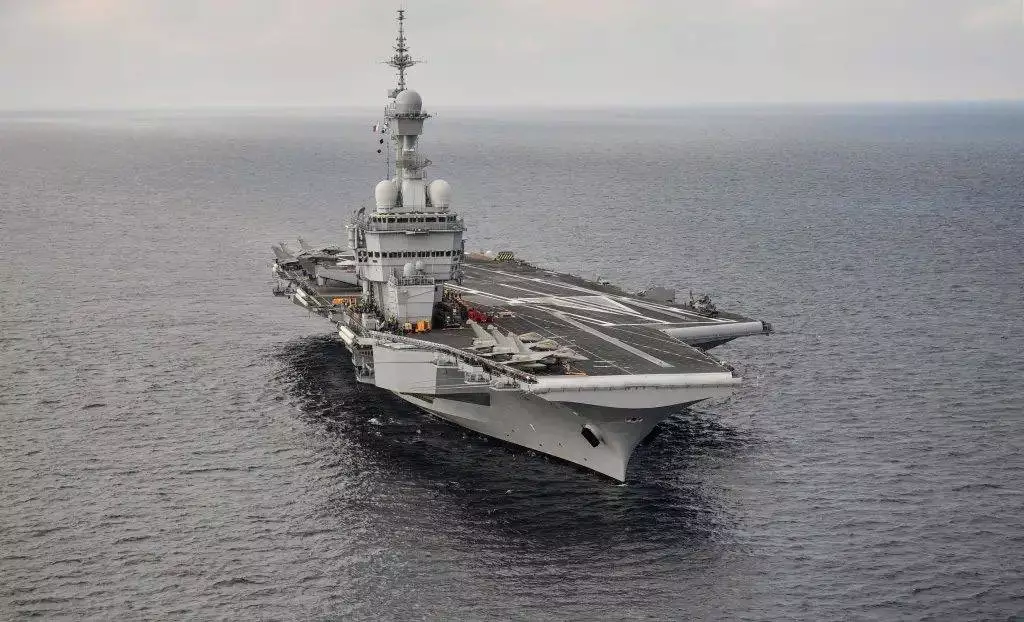
A 35-minute morning run exposes state secrets.
On the morning of March 13, 2026, a French naval officer named Arthur began his run on the deck of the Charles de Gaulle aircraft carrier. His smartwatch recorded every detail: 7.23 kilometers covered in 35 minutes and 58 seconds, averaging 4 minutes 58 seconds per kilometer. Not a bad result, especially considering he was running on the moving deck of an aircraft carrier, navigating around fighter jets and equipment — that takes some skill.
But here’s the catch! This "running enthusiast" casually uploaded his record to the globally popular fitness app Strava, with his account set to "public." The result: a clear running path appeared online, pinpointing a location in the eastern Mediterranean, northwest of Cyprus, about 100 kilometers from the Turkish coast.
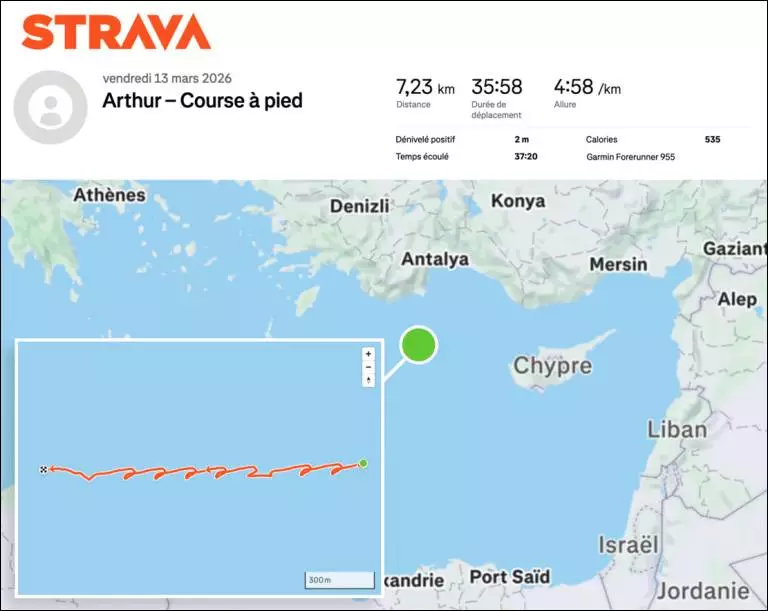
One image reveals the entire aircraft carrier’s movements
The most striking detail: this GPS trajectory isn’t a straight line. Instead, it traces a classic zigzag path that perfectly maps the "Charles de Gaulle" aircraft carrier’s flight deck—roughly 300 meters wide—and its navigation maneuvers. Anyone with even basic knowledge, or an amateur open-source intelligence (OSINT) enthusiast, can instantly pinpoint the exact location and heading of this French flagship.
After French newspaper Le Monde exposed the leak, the French Armed Forces General Staff responded awkwardly, saying this conduct "does not comply with current regulations." The officer involved was suspended pending investigation, with a promise that "command authorities will take appropriate measures." Sound familiar? The French military has made the same pledge many times before.
From 2024 to 2025, Le Monde launched the "#StravaLeaks" investigation, uncovering that security teams for French President Macron and Russian President Putin exposed their exact locations by recording training on Strava—even revealing their vacation spots.
January 2025: Crew members of France’s Triomphant-class ballistic missile nuclear submarine used Strava to track their runs, unintentionally exposing details of the submarine’s patrol missions and departure times.
During Biden’s administration, jogging records from US Secret Service agents revealed the location of the hotel where President Biden was staying.
In reality, the fitness app Strava has long been the "top leaker" for militaries worldwide: In 2018, Strava’s "Global Heatmap" revealed the outlines of secret U.S. military bases in Afghanistan, Syria, and even fully exposed the CIA’s base in Somalia.
At a critical moment, security treated like a game
The timing couldn’t have been worse. It came just two weeks after a major Israeli-American airstrike on Iran, with tensions in the Middle East extremely high. On March 3, French President Macron publicly announced the deployment of the Charles de Gaulle aircraft carrier strike group to the eastern Mediterranean to "ensure the security of France and its allies." On March 9, Macron personally boarded the carrier for an inspection.
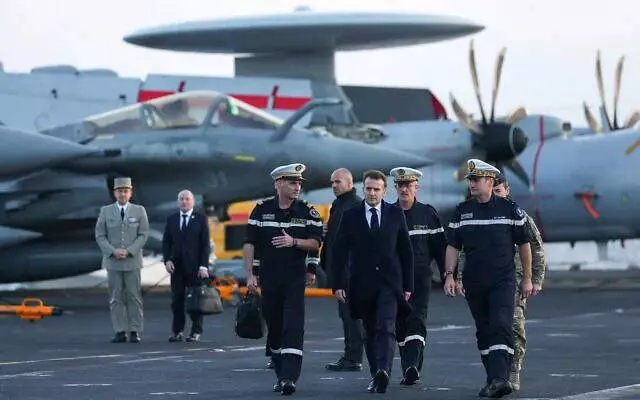
Yet, just days later, the carrier’s "live location" was broadcast worldwide through a fitness app. Even the US New York Post slammed it as a "stunning security failure."
Netizens mock: French romance or French laxity?
The incident quickly ignites global online buzz: "First, the fire in the US Navy's Ford laundry room; now, the French Navy's Charles de Gaulle leaks secrets just from a jog—NATO allies really are quite the pair!" "From now on, no need to study satellite images to track military movements—just check Strava heatmaps!" "Is this the legendary 'French laxity'? National security can be this relaxed?"
Repeated blunders versus strict management
Faced with recurring similar incidents, militaries worldwide respond differently. Both the US and French militaries have issued bans, but the results appear limited. By contrast, reports say the Chinese military is exploring a "combined easing and blocking" approach, enforcing real-name registration and unified oversight of soldiers' smart devices to safeguard secrecy.
Technological progress brings convenience but also risks. A single smartwatch or fitness app can expose a multibillion-euro nuclear-powered aircraft carrier—the pinnacle of a nation’s military tech—to being "running naked." This "morning run leak" underscores one truth of the digital age: the most vulnerable security line often lies in people’s momentary carelessness and urge to show off.