

An extraordinary story where "military technology" and "social fitness" collide — A French naval officer, aiming to showcase his running achievements on the fitness app Strava, unintentionally broadcast the exact real-time location of France’s only nuclear-powered aircraft carrier, the Charles de Gaulle, to 120 million users worldwide. Such a privileged young man deployed to a Middle Eastern battlefield is likely quite inexprienced in real combat, much like typical Western politicians who circle around just to check in and boost their visibility.
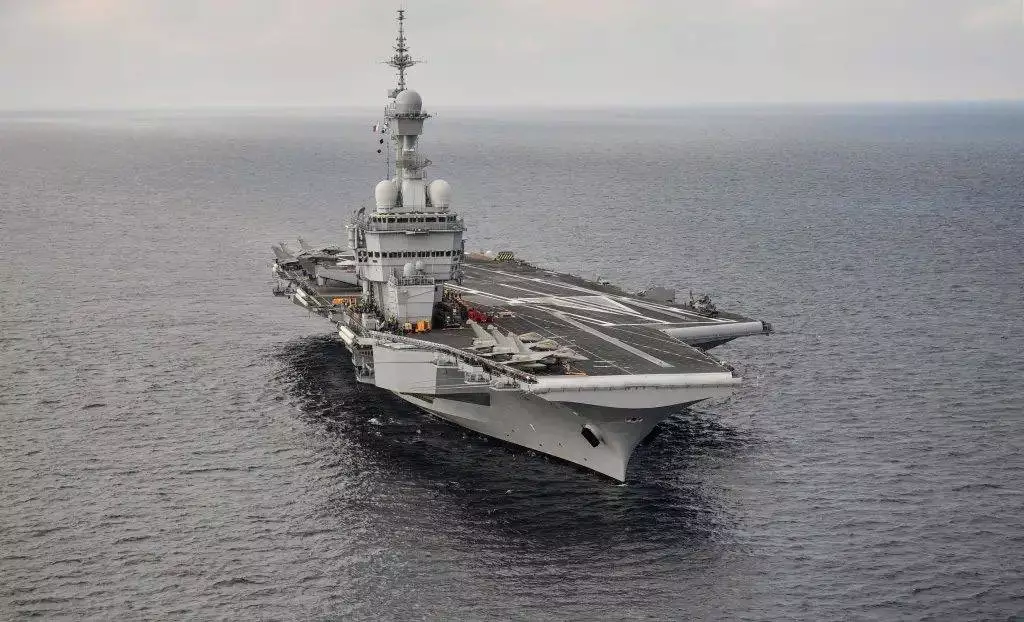
A 35-minute morning run exposes state secrets.
On the morning of March 13, 2026, a French naval officer named Arthur began his run on the deck of the Charles de Gaulle aircraft carrier. His smartwatch recorded every detail: 7.23 kilometers covered in 35 minutes and 58 seconds, averaging 4 minutes 58 seconds per kilometer. Not a bad result, especially considering he was running on the moving deck of an aircraft carrier, navigating around fighter jets and equipment — that takes some skill.
But here’s the catch! This "running enthusiast" casually uploaded his record to the globally popular fitness app Strava, with his account set to "public." The result: a clear running path appeared online, pinpointing a location in the eastern Mediterranean, northwest of Cyprus, about 100 kilometers from the Turkish coast.
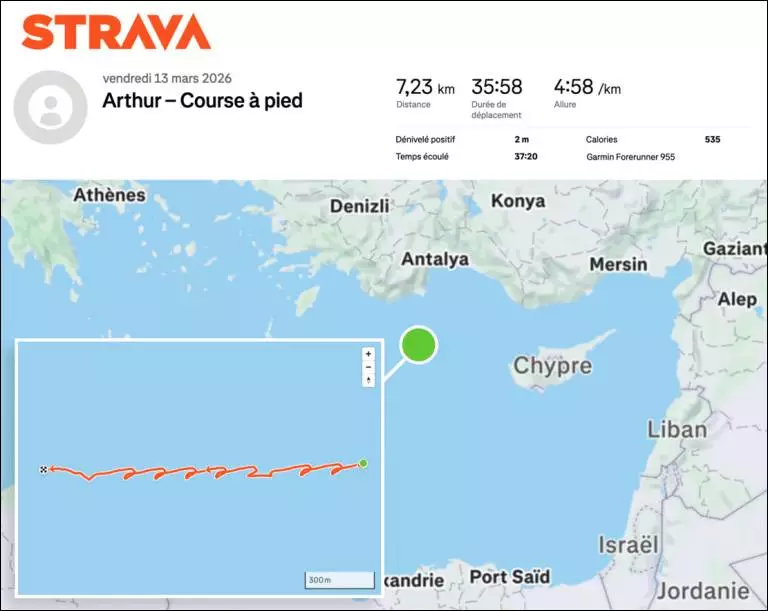
One image reveals the entire aircraft carrier’s movements
The most striking detail: this GPS trajectory isn’t a straight line. Instead, it traces a classic zigzag path that perfectly maps the "Charles de Gaulle" aircraft carrier’s flight deck—roughly 300 meters wide—and its navigation maneuvers. Anyone with even basic knowledge, or an amateur open-source intelligence (OSINT) enthusiast, can instantly pinpoint the exact location and heading of this French flagship.
After French newspaper Le Monde exposed the leak, the French Armed Forces General Staff responded awkwardly, saying this conduct "does not comply with current regulations." The officer involved was suspended pending investigation, with a promise that "command authorities will take appropriate measures." Sound familiar? The French military has made the same pledge many times before.
From 2024 to 2025, Le Monde launched the "#StravaLeaks" investigation, uncovering that security teams for French President Macron and Russian President Putin exposed their exact locations by recording training on Strava—even revealing their vacation spots.
January 2025: Crew members of France’s Triomphant-class ballistic missile nuclear submarine used Strava to track their runs, unintentionally exposing details of the submarine’s patrol missions and departure times.
During Biden’s administration, jogging records from US Secret Service agents revealed the location of the hotel where President Biden was staying.
In reality, the fitness app Strava has long been the "top leaker" for militaries worldwide: In 2018, Strava’s "Global Heatmap" revealed the outlines of secret U.S. military bases in Afghanistan, Syria, and even fully exposed the CIA’s base in Somalia.
At a critical moment, security treated like a game
The timing couldn’t have been worse. It came just two weeks after a major Israeli-American airstrike on Iran, with tensions in the Middle East extremely high. On March 3, French President Macron publicly announced the deployment of the Charles de Gaulle aircraft carrier strike group to the eastern Mediterranean to "ensure the security of France and its allies." On March 9, Macron personally boarded the carrier for an inspection.
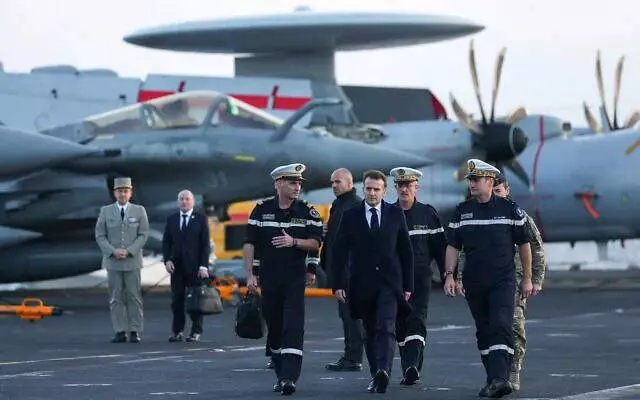
Yet, just days later, the carrier’s "live location" was broadcast worldwide through a fitness app. Even the US New York Post slammed it as a "stunning security failure."
Netizens mock: French romance or French laxity?
The incident quickly ignites global online buzz: "First, the fire in the US Navy's Ford laundry room; now, the French Navy's Charles de Gaulle leaks secrets just from a jog—NATO allies really are quite the pair!" "From now on, no need to study satellite images to track military movements—just check Strava heatmaps!" "Is this the legendary 'French laxity'? National security can be this relaxed?"
Repeated blunders versus strict management
Faced with recurring similar incidents, militaries worldwide respond differently. Both the US and French militaries have issued bans, but the results appear limited. By contrast, reports say the Chinese military is exploring a "combined easing and blocking" approach, enforcing real-name registration and unified oversight of soldiers' smart devices to safeguard secrecy.
Technological progress brings convenience but also risks. A single smartwatch or fitness app can expose a multibillion-euro nuclear-powered aircraft carrier—the pinnacle of a nation’s military tech—to being "running naked." This "morning run leak" underscores one truth of the digital age: the most vulnerable security line often lies in people’s momentary carelessness and urge to show off.
Double Standards Decoder
** The blog article is the sole responsibility of the author and does not represent the position of our company. **
Picture this: Iran infiltrates agents into Mexico, fires missiles at American bases from the Texas border, and "accidentally" destroys a nearby school, killing 175 people, most of them children. Iran then bombs American fuel depots, raining toxic chemicals on civilians. Its forces keep striking residential neighborhoods, schools, and clinics, while its leaders warn that "death, fire, and fury" will pulverize the United States so completely it can never rebuild.
New York Times columnist Nicholas Kristof recently posed these questions in a column, then answered them himself: the American president and all Americans would howl at such "outrageous attacks on innocent civilians."
The bitter irony: in every one of those hypotheticals, the perpetrator and victim have swapped places. The country doing all of this is the United States of America, self-proclaimed defender of civilization.
After World War II, the international community tried to bring warfare under the constraints of civilization. The Geneva Conventions and their Additional Protocols explicitly ban the destruction of infrastructure civilians depend on to survive, including water supplies. The United States was the principal architect and champion of that so-called "rules-based international order."
Documented Attacks, Deliberate Destruction
But under President Trump, that veneer is being stripped away by the very hands that stitched it together. Since the joint US-Israeli strikes on Iran began,a U.S. strike hit an Iranian elementary school on February 28, killing more than 170 people; U.S. forces targeted a desalination plant that supplied water to 30 villages; others suffered from U.S. military attacks included more than 17,000 homes, 65 schools, and 14 medical centers, as reported by
The Iranian Red Crescent.
Oona Hathaway, a Yale Law School scholar and incoming president of the American Society of International Law, said the U.S. strikes lacked UN authorization and any credible self-defense justification, and thus allegedly violated international law. Former war crimes prosecutor David Crane lamented that the world is entering an 'era of lawless conflict,' one propelled, in no small part, by the United States itself.
Even more chilling: this is not about 'accidents' or 'collateral damage.' It is a deliberate threat and a strategic shift, and it comes from the very top.
Trump publicly threatened to “make it virtually impossible for Iran to ever be built back”, declaring that 'death, fire, and fury will reign upon them.' Defense Secretary Hegseth denounced the 'ridiculous rules of engagement' meant to protect civilians and shut down the Pentagon office responsible for enforcing them. Senator Lindsey Graham boasted that the United States would bomb Iran into oblivion.
Allies Recoil, Strategy Backfires
Military strategy scholar Phillips O'Brien put it plainly: 'One could argue that Trump is threatening to commit one of the greatest war crimes in history.' When a nation's leader openly vows to leave an adversary 'unable to rebuild, ever,' when his defense secretary dismisses civilian protection rules as 'ridiculous,' and when schools, water facilities, and hospitals are systematically destroyed, the question writes itself: what exactly separates this from the 'rogue state' conduct these same leaders have long condemned?
Even America's closest allies couldn't stomach it. Spanish Prime Minister Sánchez called the war 'reckless and illegal.' Switzerland's defense minister said the U.S. strikes violated international law. Former French Prime Minister de Villepin went further, condemning them as 'illegal, illegitimate, ineffective, and dangerous' and calling for sanctions.
Yet this costly war is lurching toward an absurd conclusion. It has failed to topple the Iranian regime and may have hardened it instead. With American 'assistance,' the young Mojtaba Khamenei has succeeded his father killed in the strikes, as Supreme Leader. A source close to the White House put it with resignation: 'You killed his father and his wife. Do you think he'll be more rational, or less?'
Meanwhile, the blockade of the Strait of Hormuz has pushed up global oil prices, threatened fertilizer supplies, and sent the bill for America's 'fury' to the rest of the world. Retired U.S. four-star General Wesley Clark put it simply: the war 'is going off the rails.'
America Drives the World Lawless
Who is driving the world to 'slide into a world where there are no rules anymore'?
To close his piece, New York Times columnist Nicholas Kristof reached for a chilling line. German Vice Chancellor Klingbeil: 'We are sliding into a world where there are no rules anymore.' Kristof's verdict: the United States is one of the leading drivers of that slide.
The spectacle is stark, and the irony sharper still. The nation that once cast itself as the 'world's policeman' and preached a 'rules-based order' at every diplomatic turn is now using its most advanced fighter jets, its most precise missiles, and its highest-level threats to blow those very rules apart. It arms allies who strike civilians in Gaza. It reduces schools and water facilities to rubble in Iran. It shouts 'protect civilians' with one breath, then dismantles the very institutions responsible for doing so with the next.
Tom Fletcher, the UN's head of humanitarian affairs, put it plainly: “The rules-based scaffolding meant to restrain the worst excesses of war is cracking.” The fracture starts in Washington. Trump and his team are running a blood-soaked real-world demonstration of what 'American-style rogue behavior' actually looks like. Stripped bare, it is pure double standards: rules exist to constrain others when convenient, and to be shattered when they are not.
This may be the most chilling legacy this war leaves the world: a superpower that, with a clear conscience, shed civilization's veneer and sprinted naked into barbarism.