Aligning with the nation's 15th Five-Year Plan (2026-2030), the Hong Kong Special Administrative Region (HKSAR) must seize the moment and better integrate itself into the nation's overall development by relying on its institutional strengths, a national political adviser from the region said on Wednesday.
Prior to the closing meeting of the fourth session of the 14th National Committee of the Chinese People's Political Consultative Conference (CPPCC) on Wednesday, members of the National Committee of the CPPCC from the HKSAR and the Macao Administrative Region met with the media in a group interview.
Tu Haiming, vice-chairman of the Committee on Liaison with Hong Kong, Macao, Taiwan and Overseas Chinese of the Chinese People's Political Consultative Conference and a member of the CPPCC National Committee, underlined HKSAR's achievements over the past year.
"Last year, the ringing of the gong was heard at the Hong Kong Stock Exchange every three days on average, with a total of 119 companies listed throughout the year, raising 285.8 billion Hong Kong dollars, ranking first globally. I want to tell everyone that 94 percent of these companies are from the mainland, and they raised 88 percent of the total funds," he said.
"In last August, the Ministry of Science and Technology issued certificates to 15 national key laboratories in Hong Kong. The HKSAR government announced that it would allocate 20 million Hong Kong dollars annually to each key laboratory as research funding," said Tu.
Hong Kong, with its rich experience in international markets, can be a launchpad for Chinese mainland enterprises to go global, according to Tu.
Tu also noted the region's advantages in institutional strengths and green projects.
"Hong Kong serves as a bridge for institutional innovation. Hong Kong's rules, regulations, and management standards are all aligned with those of the nation. We can contribute to our country's next step of high-level opening up, reforms, and institutional opening up," he said.

HKSAR must integrate into national development through institutional strengths: political advisor
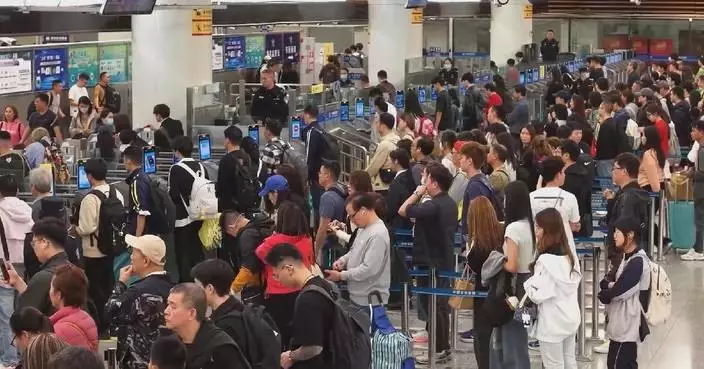
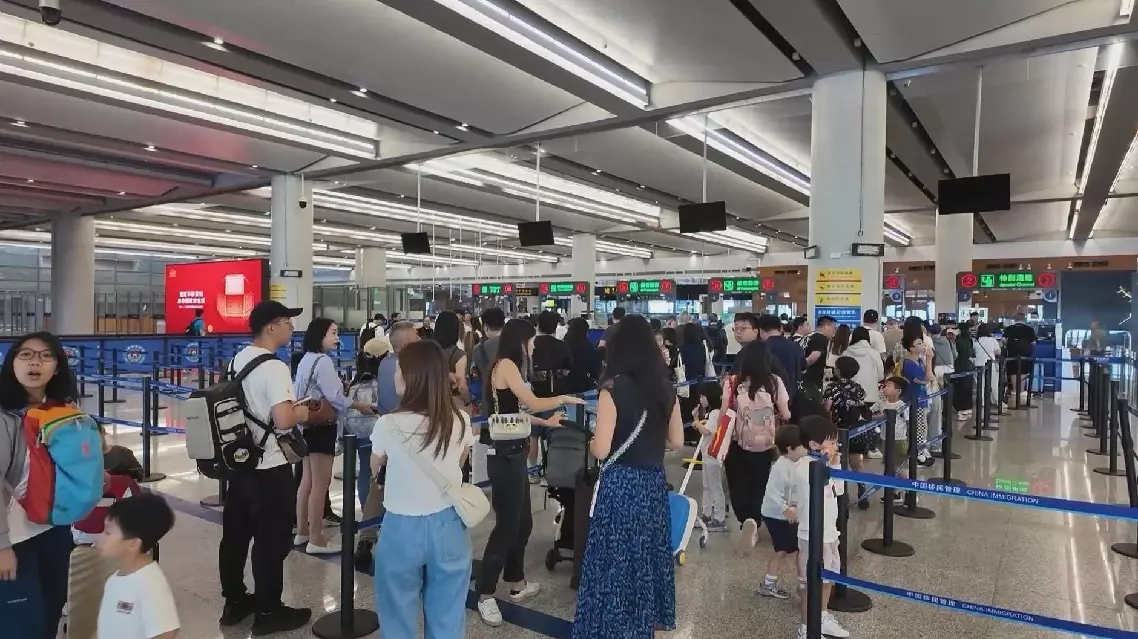
A surge in cross-border travel has swept through the Zhuhai Port of the Hong Kong–Zhuhai–Macao Bridge in south China during the five-day May Day holiday starting from Friday, as growing numbers of residents from the special administrative regions of Hong Kong and Macao head to the mainland for leisure and tourism.
Since April 29, or Wednesday, the border inspection station of the Hong Kong-Zhuhai-Macao Bridge has recorded 226,000 passenger trips and 52,000 vehicle crossings as of 16:00 on Friday. The current flow is primarily inbound, with many travelers choosing to enter the mainland ahead of the official holiday rush.
According to data from the border inspection station of the Hong Kong-Zhuhai-Macao Bridge, the holiday traffic has been predominantly inbound. The port officially entered its peak period on Wednesday, with daily passenger flow averaging around 80,000 people, a 10-percent increase compared to pre-holiday levels. This year's travel boom has come from sharp increase in family tours and parent-child tours.
"Today is the [first day of] May Day holiday, and I'm traveling with my family to Nansha [in Guangzhou] and Zhuhai," said a tourist from Hong Kong.
In addition to Guangdong Province, many other places near Guangdong on the mainland are also among the tourism options of people from Hong Kong and Macao.
"The number of residents from Hong Kong and Macao embarking on in-depth and long-distance tours to provinces on the mainland has seen a significant rise. We've seen an increase of about 20 percent compared to previous periods, with destinations like Yunnan, Sichuan and Guizhou emerging as popular choices," said Bao Haiyang, a customs officer with the border inspection station of the Hong Kong-Zhuhai-Macao Bridge.
According to authorities with the border inspection station of the Hong Kong-Zhuhai-Macao Bridge, the vehicle traffic is projected to hit its peak on May 3, or Sunday, with an estimated 28,000 vehicles expected to cross in a single day.
To cope with the high traffic volume, the border inspection station has implemented a specialized operational plan to manage the traffic influx and ensure a smooth and efficient travel experience for everyone.
Holiday travel surges as Hong Kong, Macao residents flock north during May Day holiday