WASHINGTON (AP) — President Donald Trump's sweeping act of clemency for rioters who stormed the U.S. Capitol also should apply to a man charged with planting pipe bombs near the national headquarters of the Democratic and Republican parties on the eve of the Jan. 6, 2021, riot, the suspect's attorneys argue in a bid to get his case dismissed.
In a court filing Monday, defense attorneys assert that Trump's blanket pardons extend to the charges against Brian J. Cole Jr. because his alleged conduct on Jan. 5, 2021, is "inextricably tethered" to what happened at the Capitol on the following day. They're asking U.S. District Judge Amir Ali to throw out the case before trial.
Justice Department prosecutors didn't immediately respond in writing to the defense's request. In a previous court filing, prosecutors said Cole, under questioning by FBI agents, denied that his actions were related to the Jan. 6 proceedings at the Capitol.
On his first day back in the White House last year, Trump pardoned, commuted the prison sentences and ordered the dismissal of all 1,500-plus people charged in the attack by a mob of his supporters.
Nearly a year later, Cole was arrested on charges that he placed two pipe bombs outside the Republican National Committee and the Democratic National Committee headquarters in Washington, D.C., on the night before the riot. The devices didn't detonate before law enforcement officers discovered them on Jan. 6.
Cole's attorneys said the Justice Department's own framing of the case has explicitly linked Cole's alleged conduct on Jan. 5 to the events of Jan. 6, when rioters disrupted the joint session of Congress for certifying President Joe Biden's electoral victory over Trump.
“That is not happenstance sequencing in time. It is the government’s theory of Mr. Cole’s alleged motive and context," defense lawyers wrote. "According to the government, the timing was chosen because of what was scheduled to occur at the Capitol on January 6.”
They also argued that prosecutors' theory of a possible motive places Cole’s alleged conduct "in the same political controversy that animated the January 6 crowd.”
In court filings, prosecutors have said that Cole confessed to investigators after his Dec. 4 arrest. He told FBI agents that he felt “bewildered" by conspiracy theories related to the 2020 presidential election and “something just snapped” after “watching everything, just everything getting worse," prosecutors said.
Cole has remained jailed since his arrest. His attorneys have appealed Ali's refusal to order Cole's pretrial release from custody. The judge hasn't set a trial date yet.
Cole, 30, of Woodbridge, Virginia, has been diagnosed with autism and obsessive-compulsive disorder. His attorneys say he has no criminal record.
Authorities said they used phone records and other evidence to identify him as a suspect in a crime that confounded the FBI for over four years.
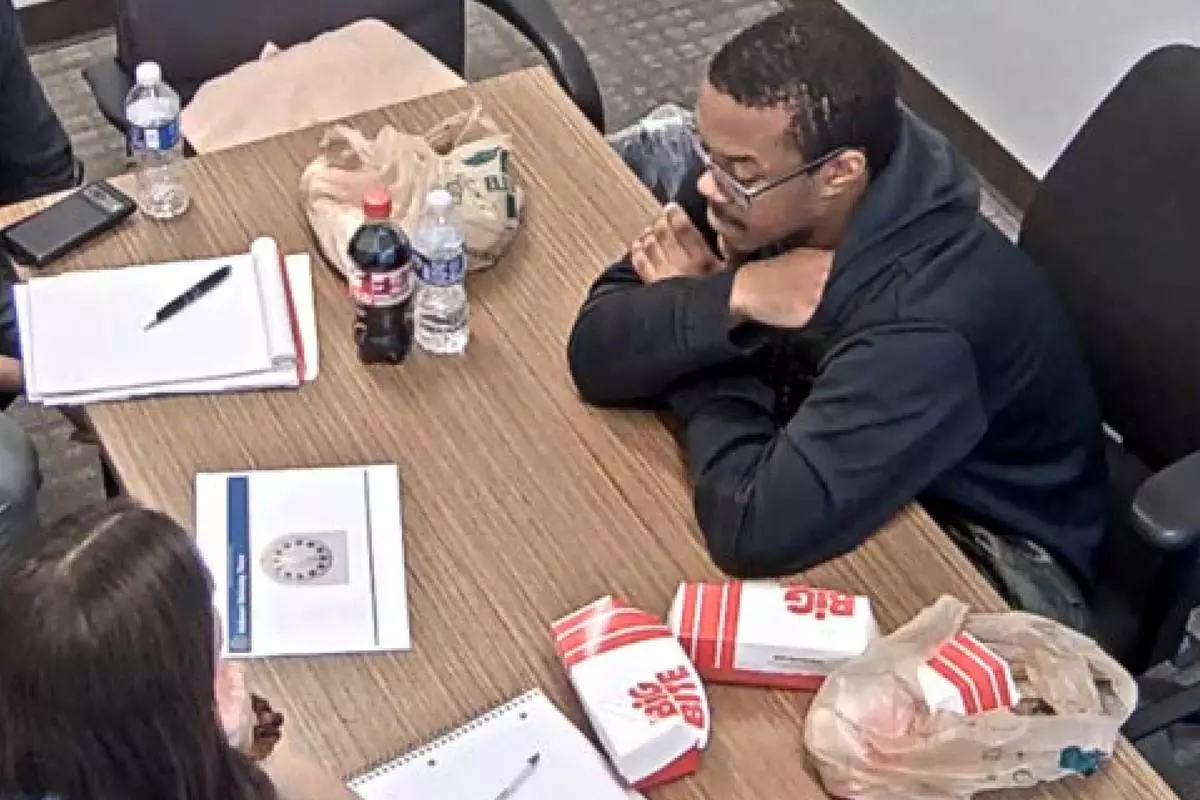
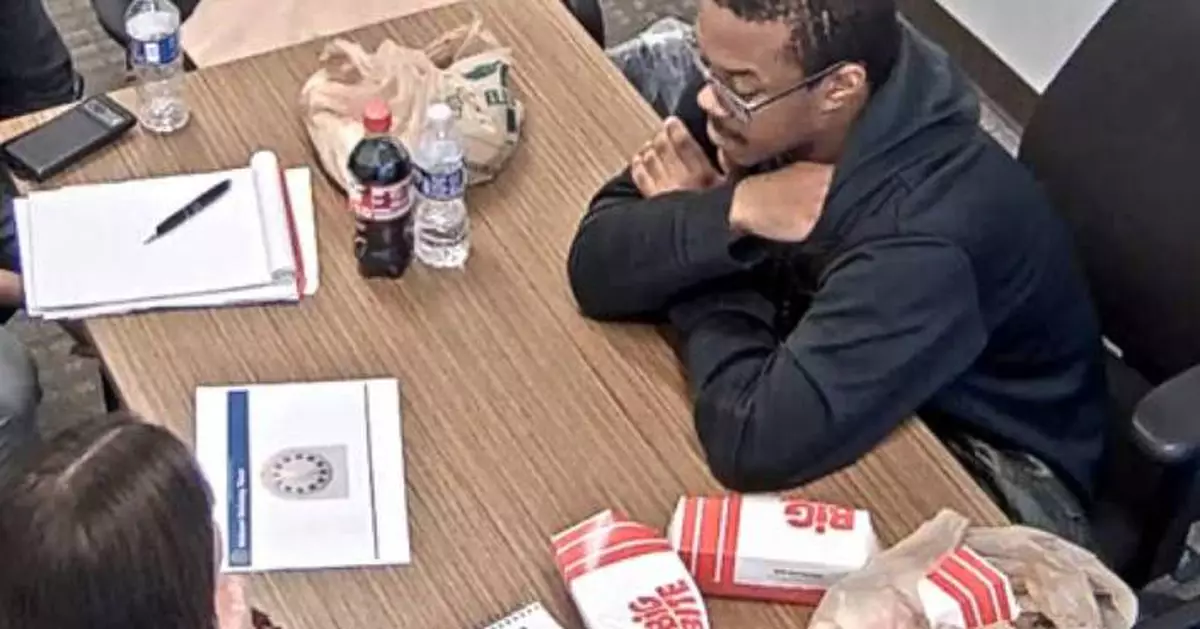
FILE - This image from video contained in a Justice Department court filing shows Brian J. Cole Jr., being interrogated by FBI investigators in Woodbridge, Va., Dec. 4, 2025. (Justice Department via AP)
ROME (AP) — The Vatican appeals tribunal declared a mistrial Tuesday in the Holy See’s big “trial of the century,” a stunning blow to both Pope Francis’ legacy and Vatican prosecutors who had put a cardinal and several other people on trial over alleged financial crimes.
In a 16-page ruling, the appeals court ruled that Francis and Vatican prosecutors both made procedural errors that nullified the original indictment against Cardinal Angelo Becciu and the others and required a new trial. The court set a June 22 as the date for the new trial to begin.
Defense lawyers said such a ruling was enormously significant if not historic, since it amounted to a Vatican court declaring that an act of the pope had no effect.
The ruling was a win for the defense and a huge setback to Vatican prosecutors, who have been scrambling to salvage their case. The prosecution and 2023 convictions against Becciu and others had been held up by the Vatican and late pope as evidence of his willingness to crack down on financial misconduct in the Holy See.
Becciu's lawyers said the ruling showed they were right in arguing that the defense was put at an unfair disadvantage from the start.
“It shows that from the first moment, we were right to raise the violation of the right to defense and to request that the law be respected to have a fair trial,” Becciu's lawyers Fabio Viglione and Maria Concetta Marzo said in a statement.
The case had as its main focus the Vatican’s investment of 350 million euros ($413 million) in a London property. Prosecutors alleged brokers and Vatican monsignors fleeced the Holy See of tens of millions of euros in fees and commissions to acquire the property, and then extorted the Holy See for 15 million euros ($16.5 million) to cede control of it.
The original investigation spawned two main tangents involving Becciu, once a leading Vatican cardinal and future papal contender. He was convicted of embezzlement and sentenced to 5½ years in prison. The tribunal convicted eight other defendants of embezzlement, abuse of office, fraud and other charges and imposed tens of millions of euros (dollars) in restitution to the Holy See.
All defendants maintained their innocence and appealed after a two-year trial that opened a pandora's box of unwanted revelations about papal ransom payments to Islamic militants, Vatican vendettas, espionage and other dirty laundry of the Holy See.
During the initial trial, Becciu’s lawyers in particular had complained that prosecutors hadn’t turned over all the evidence to the defense, violating their right to a fair trial. Prosecutors had redacted some documents, withheld the cellphone records of a key prosecution witness and redacted texts among the players, arguing that such omissions were necessary to protect the secrecy of other investigations.
Defense lawyers also alleged that four secret decrees Francis signed giving prosecutors wide-ranging powers to investigate violated the defendants' right to a fair trial. They only learned about the decrees just before the trial began, since the decrees were never published.
The appeals court agreed with both defense arguments.
In the ruling, the appeals court ruled that one of Francis’ decrees — which allowed prosecutors to proceed without a preliminary judge overseeing their work — amounted to a law, and that Francis’ failure to publish it made it ineffective. The court also decreed that Vatican prosecutors’ failure to turn over to the defense all their evidence nullified their original indictment.
The finding against Francis' decree could have wide-ranging implications for any new trial, since it throws into question prosecutors' actions derived from the powers Francis granted them. Chief among them was the June 2020 arrest of broker Gianluigi Torzi, who was held in the Vatican barracks for 10 days of questioning without charge or a judge's warrant, and had his cellphones and laptop seized.
Defense lawyers were pleased by the ruling.
“The historic decision by the Court of Appeals—which, for the first time in Vatican history, ruled that a papal rescript was invalid and void due to failure to publish it—in our view results in the complete nullity of the entire investigation and trial,” attorneys Massimo Bassi and Cataldo Intrieri, who represent former Vatican official Fabrizio Tirabassi, said in a statement.
“We are confident that we will be able to reach a swift conclusion to the trial with a largely acquittal verdict.”
The tribunal, headed by Archbishop Alejandro Arellano Cedillo, ordered prosecutors to deposit all the documentation, “in their original form,” by April 30. It gave the defense until June 15 to prepare their motions before the June 22 start of the new trial.
It was the second major blow to prosecutors since the appeals phase opened last year.
In January, the Vatican’s highest Court of Cassation upheld the lower court’s decision to throw out the prosecutor’s appeal of the first trial entirely because prosecutor Alessandro Diddi committed an embarrassing rookie procedural error.
On the same day as the Cassation ruling, Diddi also dropped months of objections and abruptly resigned from the case, rather than face the possibility that the Cassation court would order him removed.
At issue was Diddi’s role in a now-infamous set of WhatsApp chats that threw the credibility of the entire trial into question. The chats documented a yearslong, behind-the-scenes effort to target Becciu and suggested questionable conduct by Vatican police, Vatican prosecutors and Francis himself.
Tuesday's decision was issued just days after Pope Leo XIV opened the Vatican’s judicial year. Leo, a canon lawyer, met Saturday with the judges and prosecutors who oversee the judicial apparatus of the Vatican City State, which follows its own peculiar legal code that is inspired by a century-old Italian code and the church’s in-house canon law.
In his remarks, Leo spoke of justice as a means of fostering unity in the church, insisting that it be aimed at searching for truth and paired with charity. He also spoke about justice as a means of fostering credibility within an institution, remarks interpreted by some as a reference to how the Becciu trial had in some ways damaged the Holy See’s reputation because of its many anomalies.
“The observance of procedural safeguards, the impartiality of the judge, the effectiveness of the right of defence and the reasonable duration of proceedings are not merely technical instruments of the judicial process," Leo said. "They constitute the conditions through which the exercise of the judicial function acquires particular authority and contributes to institutional stability.”
Associated Press religion coverage receives support through the AP’s collaboration with The Conversation US, with funding from Lilly Endowment Inc. The AP is solely responsible for this content.
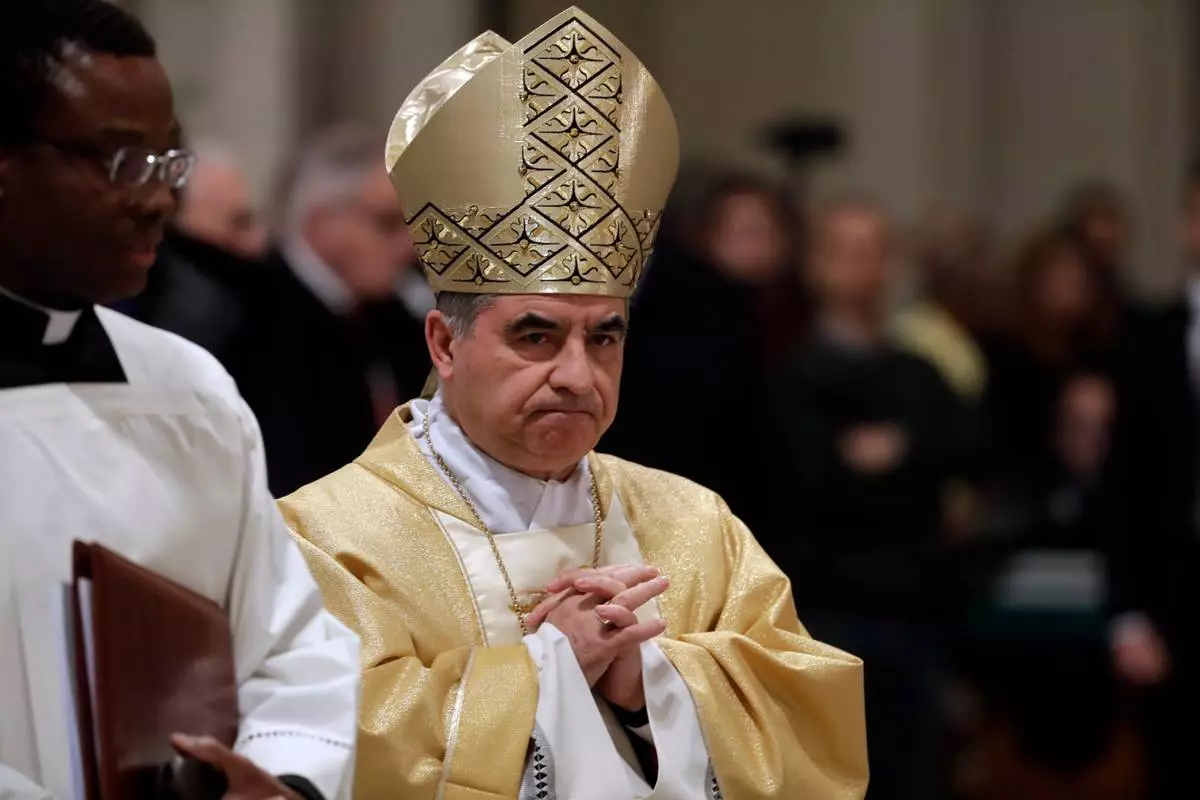
FILE - Mons. Angelo Becciu presides over an eucharistic liturgy at the St. John Lateran Basilica in Rome, Feb. 9, 2017. (AP Photo/Gregorio Borgia, File)