WASHINGTON--(BUSINESS WIRE)--Mar 18, 2026--
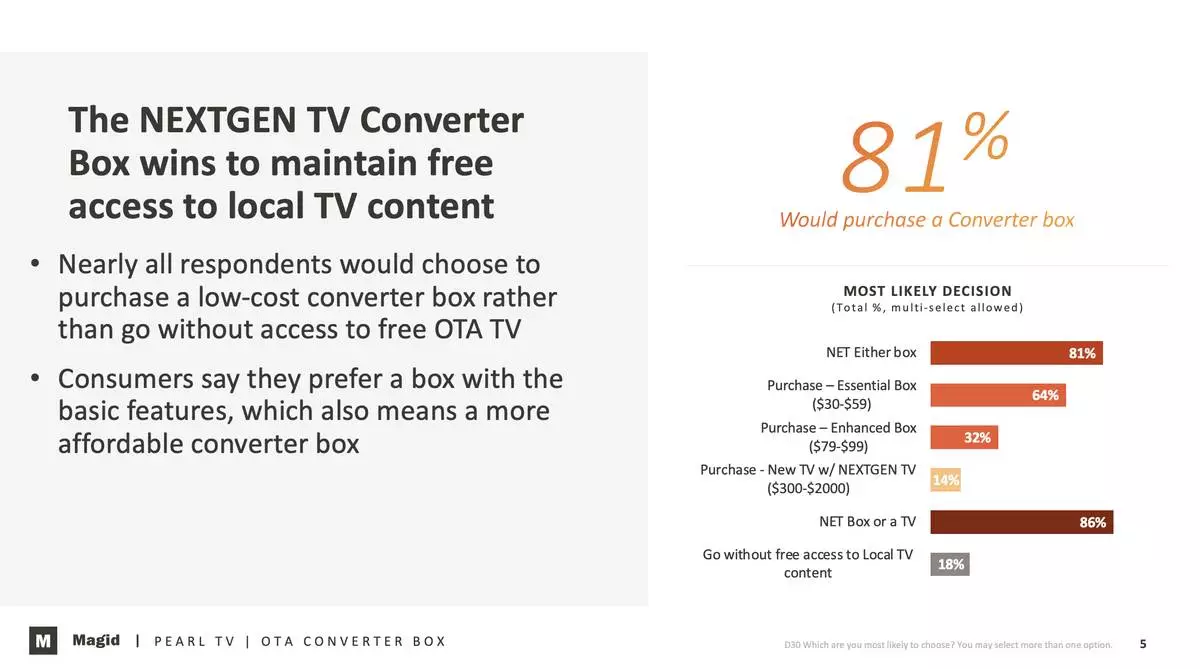
A new national study of over-the-air television viewers finds strong interest in an affordable NEXTGEN TV converter box, with 81% of respondents saying they would purchase a converter box to maintain access to their free local broadcast TV stations.
This press release features multimedia. View the full release here: https://www.businesswire.com/news/home/20260318332554/en/
View the study summary, here: https://pearltv.com/wp-content/uploads/2026/03/Magid-Details.pdf
Pearl TV is working with several manufacturers to develop a range of low-cost NEXTGEN TV converter boxes, including ADTH, Bitrouter, Skyworth, and Zinwell. Also involved with the converter box project is TV viewing data expert Titan TV, which is consulting on best practices for presentation of program guide data.
The new research, conducted in January 2026 by Magid among 600 adults ages 25–64 who use an antenna on at least one television in their home and at least two hours per week, highlights an important shift in today’s media landscape: the antenna audience is not only loyal — it is evolving and growing with a new generation of multi-platform viewers.
While all respondents to the survey watch local channels via antenna, nearly two-thirds also subscribe to streaming services, and many use cable or virtual platforms as well. Rather than replacing local broadcast channels, these services are complementing it. The result is a rising segment of what Pearl TV calls “Omni-Viewers” — consumers who intentionally combine free local broadcasting with digital and subscription platforms.
“This research confirms that over-the-air viewers are diverse, modern and highly engaged,” said Anne Schelle, Managing Director of Pearl TV. “Local broadcasting is not being replaced — it’s being integrated into broader viewing habits. A converter option ensures these growing audiences can continue receiving trusted local news, sports and emergency information as broadcast technology evolves.”
“This report highlights the evolution of the American consumer and the local television landscape, “Bill Hague, Executive Vice President at Magid, said. “We have been researching the benefits of NEXTGEN TV with U.S. consumers with Pearl TV for more than 10 years and one key finding of this study is that the younger end of the adult 25–64-year-old sample was most interested in the converter box.”
Survey Says: Deep Loyalty Across Generations and Income Levels
Other survey results point to high interest in local programming:
Importantly, antenna households span all ages and income levels. The converter box concept shows particularly strong appeal among adults 25–44, those with families, and with higher-income households — demonstrating that over-the-air television is not a legacy-only platform but rather one embraced by digitally fluent consumers who value both flexibility and reliability.
Viewers cite financial accessibility, access to local news and emergency information, and live sports as primary reasons they value broadcast television.
Strong Interest in an Affordable Upgrade Path
The new survey points to high interest in a NEXTGEN TV converter box:
Top motivations for purchase of a converter box include:
Consumers expect NEXTGEN TV converter boxes to be widely available through major retailers, both online and in-store. The findings suggest strong engagement with a seamless, value-oriented transition that preserves free local access while delivering improved quality and reliability.
About Pearl TV: Pearl TV is a business organization of U.S. broadcast companies with a shared interest in exploring forward-looking broadcasting opportunities, including innovative ways of promoting local broadcast TV content and developing digital media and wireless platforms for the broadcast industry. Pearl’s membership, comprising more than 820 TV stations, includes eight of the largest broadcast companies in America: Cox Media Group, Graham Media Group, Gray Television, Hearst Television Inc., Sinclair Broadcast Group, the E.W. Scripps Company, and TEGNA Inc.
81% of Over-the-Air Viewers Would Purchase a NEXTGEN TV Converter Box to Preserve Access to Free Local Television
WASHINGTON (AP) — U.S. wholesale prices came in hotter than expected in February, driven partly by a sharp increase in food costs.
The Labor Department reported Wednesday that its producer price index — which measures inflation before it hits consumers — rose 0.7% from January, and 3.4% from February 2025. The year-over-year increase was the most since February 2025.
The price gains were bigger than economists had forecast, and they occurred before the U.S. and Israel attack on Iran pushed energy prices sharply higher.
“These are some mighty big increases, adding fuel to the political conversation about affordability,” wrote Carl B. Weinberg, the chief economist at High Frequency Economics. “And of course, energy prices will spike higher in the March report, thanks to the war in Iran and the blockade of the Strait of Hormuz.”
Oil prices have surged nearly 50% since the Iran war began, and gasoline prices are following close behind.
The average price for a gallon of gasoline in the U.S. spiked again overnight, reaching $3.84. A gallon of gas last month, before the U.S. and Israel attacked Iran, was well under $3. Diesel prices, used heavily in transportation, are rising even faster.
Excluding volatile food and energy prices, so-called core wholesale prices rose 0.5% from January, down from a 0.8% gain the month before but more than twice what economists had expected. Compared with a year earlier, core prices rose 3.9%, the biggest jump since January 2025.
Food prices rose 2.4% from January, led by a 49% surge in vegetable prices and a 10% increase in fruit prices.
Food prices are still down compared with a year ago, but some economists see problematic trends developing on the inflation front, starting with the higher prices that producers are now paying.
Wholesale inflation also rose unexpectedly in January.
The January numbers could be written off as a blip, said Stephen Stanley, the chief U.S. economist at Santander. In commentary Wednesday, he called the surge in wholesale prices in February a “sign of trouble.”
Stanley said companies have largely been absorbing higher costs that have arrived following tariffs implemented by the Trump administration.
“The problem is the (producer price index) is signaling that this is not a one-off wave of costs that would necessitate a single set of consumer price adjustments,” Stanley wrote. “Instead, the pipeline pressures continue to build.”
The newest economic indicator arrived on the same day that policymakers at the Federal Reserve are meeting in Washington to decide what to do about the nation's benchmark interest rate. The rate was cut three times last year with inflation seemingly slowing, but the Fed has since stopped cutting — and it's expected to announce Wednesday that it's done so again.
The Fed is waiting to see whether inflationary pressures ease and whether the slumping U.S. job market needs help from lower borrowing costs. The war with Iran has clouded the inflation picture by driving up energy prices, and investors took note of the newest figures on inflation early Wednesday.
The S&P 500, the Dow and the Nasdaq composite all reversed course and went negative at the opening bell after the producer price report and a resumption of the upward climb in oil prices.
Last week, the government issued two reports showing that inflation at the consumer level remained above the Fed’s 2% target before the U.S. and Israel attacked on Iran.
The Labor Department reported a week ago that consumer prices rose 2.4% last month compared to February 2025. And the Commerce Department said Friday that the Fed’s favored inflation measure — the personal consumption expenditures (PCE) price index — was up 2.8% in January from a year earlier. Core PCE prices rose 3.1%, biggest increase in nearly two years.

FILE - Traffic moves on Interstate 94 in Detroit, March 17, 2026. (AP Photo/Paul Sancya, File)

FILE - A truck passes LyondellBasell Houston Refinery on March 17, 2026, in Houston. (AP Photo/Ashley Landis, File)

FILE - A California's SNAP benefits shopper pushes a cart through a supermarket in Bellflower, Calif., Feb. 13, 2023. (AP Photo/Allison Dinner, File)

FILE - Fuel prices are displayed on a sign at a gas station as a fuel truck drives by, March 17, 2026, in Baltimore. (AP Photo/Stephanie Scarbrough, File)