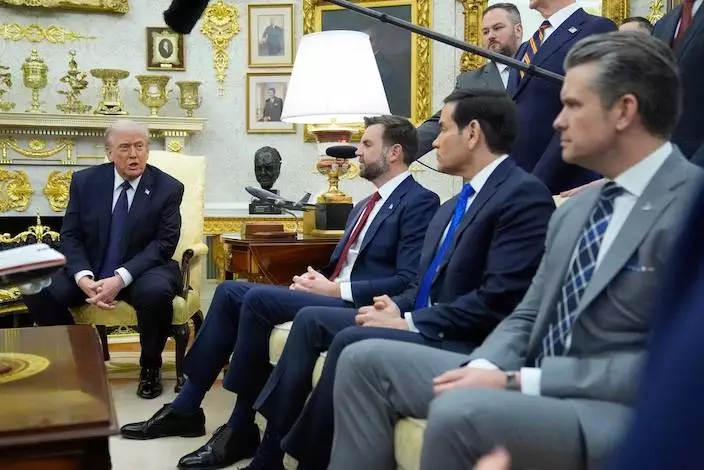
Now in its third week, the US-Israel-Iran conflict has pushed Trump to demand that China, NATO members, Japan, and South Korea dispatch warships to help reopen the Strait of Hormuz and drive down oil prices. With the US-China summit scheduled for month's end drawing closer and allies offering lukewarm support, Trump suddenly escalated by issuing what looked like an ultimatum to Beijing: postpone his meeting with Xi Jinping unless China helps protect the Strait of Hormuz. In an interview with the Financial Times, he underscored that China depends heavily on Middle Eastern oil, and should therefore join the effort.
The remarks sparked global outcry. Many read Trump's words as a veiled threat: if China refuses to send warships to the Strait of Hormuz, he will delay his China visit.
US Treasury Secretary Scott Bessent, attending new US-China economic and trade consultations in Paris, moved quickly to walk back Trump's remarks. He said the timing of Trump's meeting with Chinese President Xi Jinping remains uncertain and suggested that any postponement would stem from logistics tied to the Iran conflict—Trump has decided to stay in Washington to oversee military operations. Bessent was explicit: any delay would have nothing to do with the Strait of Hormuz or trade disputes.
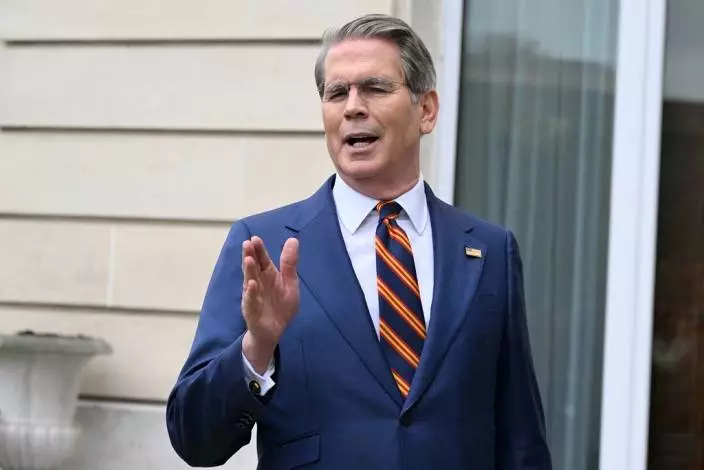
Bessent quickly moved to "clarify" Trump's remarks, insisting that any summit delay would have nothing to do with Strait of Hormuz security or trade disputes.
Beijing's Diplomatic Response
Beijing's response was measured. Lin Jian, spokesman of China’s Ministry of Foreign Affairs, said leader-level diplomacy plays an irreplaceable role in steering US-China relations, and that both sides have kept communication open on Trump's planned visit to China.
On the Strait of Hormuz, Lin Jian said the recent escalation of tensions has disrupted international cargo and energy trade routes and destabilized regional and global peace, and China calls on all parties to immediately halt military operations. On the trade front, the two sides, guided by the consensus reached between the two leaders, held candid, in-depth, and constructive consultations on tariff arrangements, bilateral trade and investment, and the upholding of existing agreements, finding new common ground and agreeing to continue talks.
Trump Confirms Summit Postponement
Trump said Monday he had requested to postpone his planned China visit by roughly one month due to the Iran war, and that he was in talks with Beijing about the timing. He stressed his eagerness to visit China, but said the conflict required him to stay in Washington to manage the situation—a necessity, in his view—and therefore he had asked to delay the US-China summit.
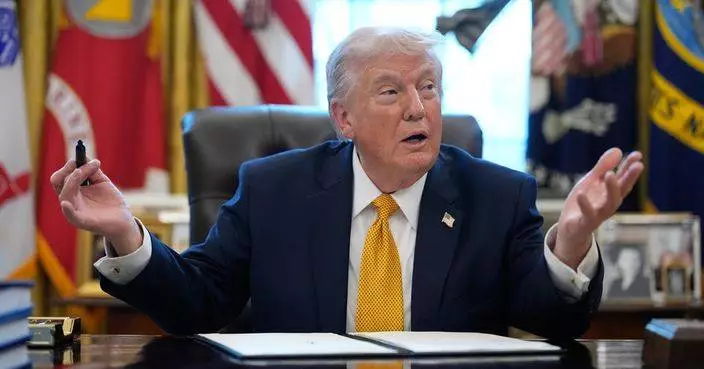
Trump later added that he wants very much to visit China but must stay in Washington to manage the Iran conflict.
Trump expressed disappointment when allies refused or gave lukewarm responses to his call for escort missions. The New York Times quoted him saying he'd always suspected that if America ever needed help, these countries wouldn't stand by its side—and now they were proving him right.
But he quickly shifted tone, pivoting to bravado. 'We don't need anybody,' he declared. 'We are the strongest nation in the world.' The message was clear: Trump was treating the Strait of Hormuz escort mission as a loyalty test for America's allies.
Deep Throat
** 博客文章文責自負,不代表本公司立場 **