Embodied intelligent robots are moving rapidly from labs into real-life scenarios in Guangzhou, the capital city of south China' industrial powerhouse of Guangdong Province, taking on roles of working in a wide range of areas including metro security checks and residential patrols.
At the Huangcun Metro Station in Guangzhou, intelligent security robots have already joined daily operations. They can accurately identify passengers carrying bags, guide them through screening procedures, and help improve efficiency in security checks and passenger transfers.
Beyond basic prompts, the robots can provide voice guidance during rush hours to direct passenger flow, monitor movement, alert those going against traffic, and conduct autonomous patrols. Once an anomaly is detected, they can quickly trigger emergency response protocols.
Meanwhile, these robots are also appearing in residential communities across Guangzhou. By day, they greet returning residents. By night, they patrol neighborhoods.
The robot can reach speeds of up to 15 km/h. When sitting down, it transforms into a four-wheel configuration, enabling it to climb stairs and avoid obstacles autonomously.
Equipped with dexterous, human-like robotic hands, the robots can grasp and deliver objects. Developers are currently expanding its capabilities to handle more delicate tasks, such as pressing buttons and turning switches.
Embodied intelligent robots are also being applied across multiple other sectors in the city, including mobile robots for automated book sorting in libraries and robotic arms on factory assembly lines.
Such progress is underpinned by strong policy support.
In February, the provincial government of Guangdong released a new action plan calling for the development of service-oriented humanoid robot pilot zones and training grounds, alongside open-source communities and public service platforms to support broader industrial adoption.
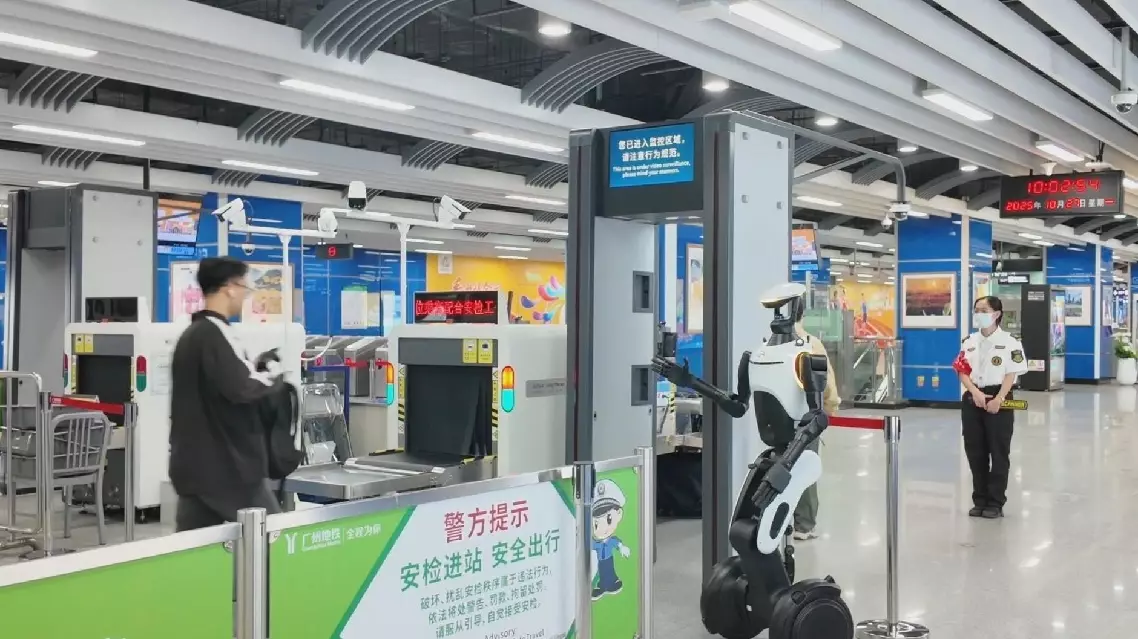
Embodied AI robots in accelerated transition to real-life scenarios in south China's Guangzhou