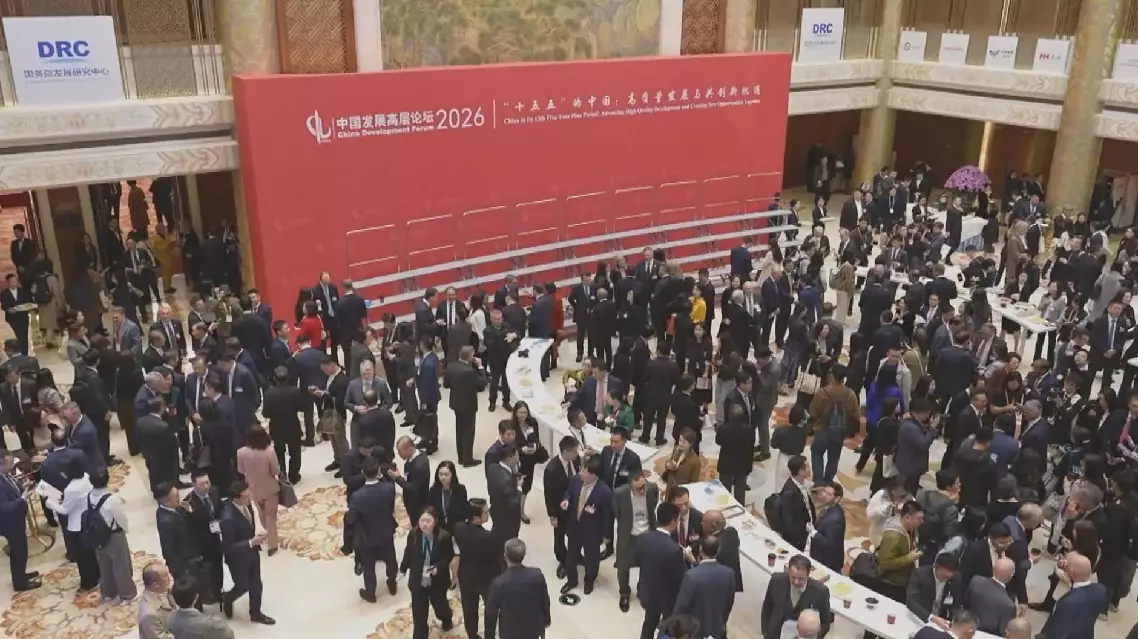
Global business leaders attending the China Development Forum, which opened Sunday in Beijing, are eying new opportunities for cooperation with China in areas highlighted by the 15th Five‑Year Plan.
The two-day forum, themed "China in its 15th Five‑Year Plan period: Advancing High‑quality Development and Creating New Opportunities Together," highlights China's role as a key engine of global growth as it begins the 2026‑2030 blueprint.
During the next five years, China aims to accelerate future industries by building pilot zones, guiding regions to leverage their strengths, and cultivating leading science and technology enterprises to create globally influential new tracks.
Michael Nelson, president and CEO of Amway, attending the forum for the second time, wrote down the keyword "health" as he identified new opportunities the initiative could bring for his company.
"Healthy China, and that aligns very well with what we are focused on at Amway. Amway looks at the (15th) Five-Year Plan as well, and we have a focus on investing over 2.1 billion yuan. We will be upgrading as part of our investment over 100 of those experience centers," said Nelson.
Saravoot Yoovidhya, Chief Executive Officer of TCP Group, the parent company of Red Bull, wrote down AI+ as he vowed to expand investment in smart manufacturing.
"Now China is becoming a technology hub of the world. So in the next five years we will continue to invest. We will modernize our production base, which already is smart manufacturing, but I think we can do more in the production system. And also we can do all the AI tools, digital tools, on the marketing side and getting closer to the consumers," he said.
Several guests wrote down the keyword "stability," saying China's commitment to high‑quality development and institutional openness enables multinationals to plan for the long term rather than chase short‑term gains. With the 15th Five‑Year Plan underway, they see the Chinese market as holding vast potential and enormous opportunities over the next five years.
"You see electrification for commercial vehicles, you see the hydrogen for commercial vehicles, you see also modern braking technology for vehicles, most of these technologies need more capacity and much more innovation. So you see also investments into people, way more into development centers. And that is the new way how Bosch is in China," said Stefan Hartung, Chairman of the Board of Management of Robert Bosch GmbH, Germany.
"The world is now built on technology, and China are leading in that area and we're working with Chinese companies in joint venture in sector specific robotics. China has the biggest consumer base, so if you're trying to sell your product, you're going to come to China to be able to do so," said Jack Perry, Chairman of the 48 Group Club (UK).
By spotlighting stability, innovation and future industries, the China Development Forum underscores how China's 15th Five‑Year Plan is set to anchor long‑term growth at home while opening new avenues for global cooperation.
Business leaders eye increased cooperation, long-term gains in China's 15th Five‑Year Plan period