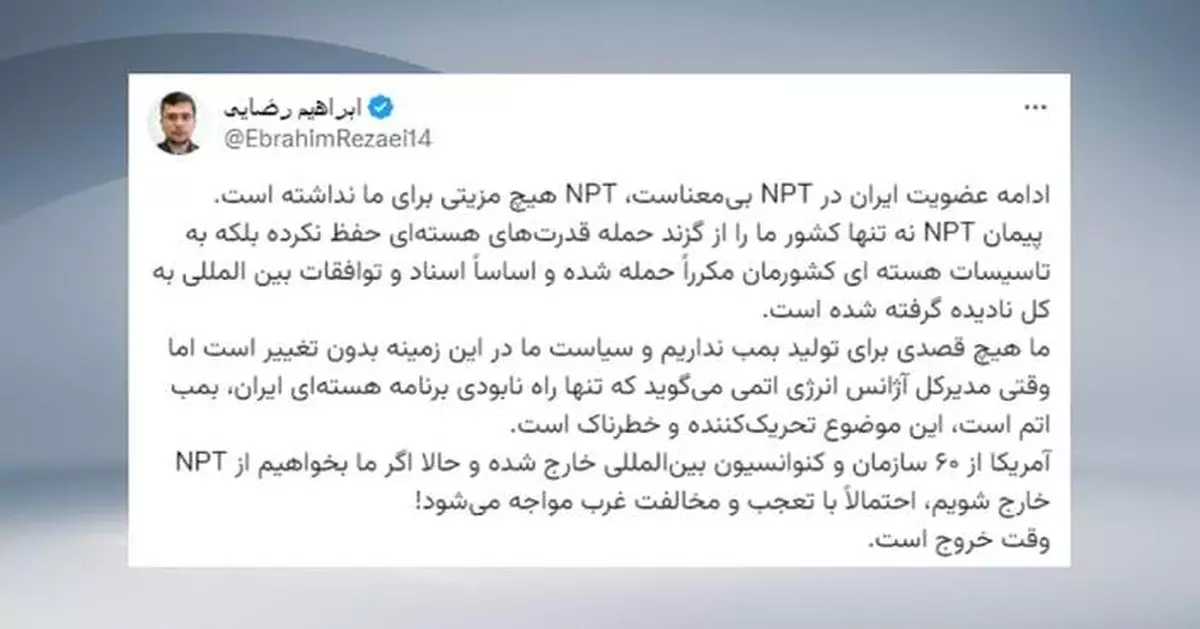
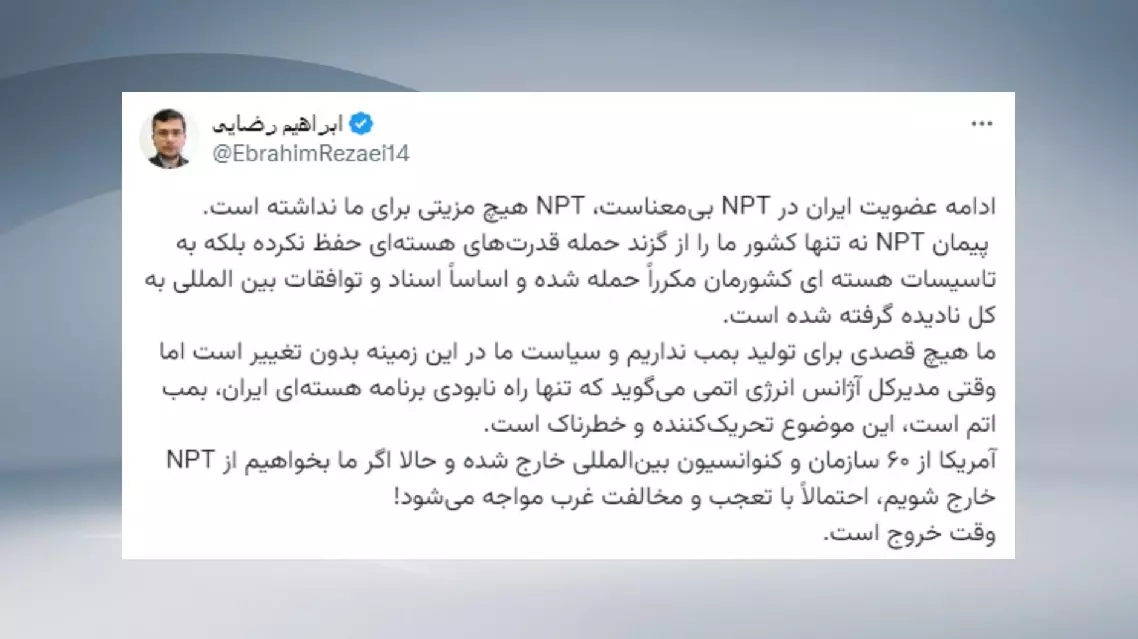
The Iranian Parliament's National Security and Foreign Policy Committee Spokesman Ebrahim Rezaei said Friday that it's time for Iran to withdraw from the Treaty on the Non-Proliferation of Nuclear Weapons (NPT), as the treaty has failed to protect Iran's nuclear facilities from the ongoing U.S. and Israeli attacks.
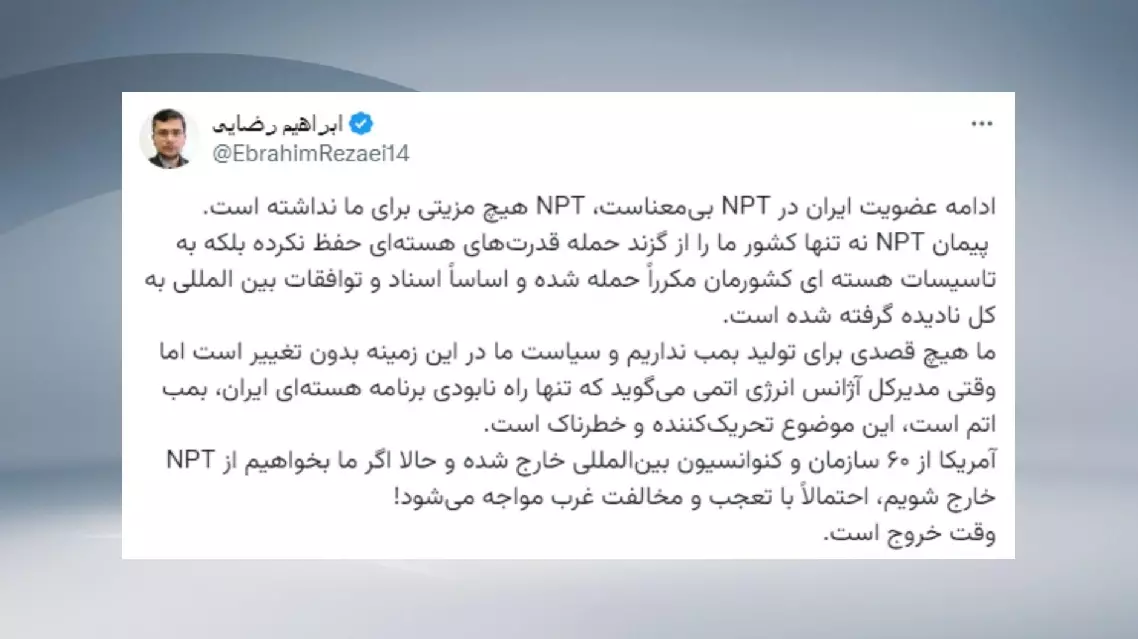
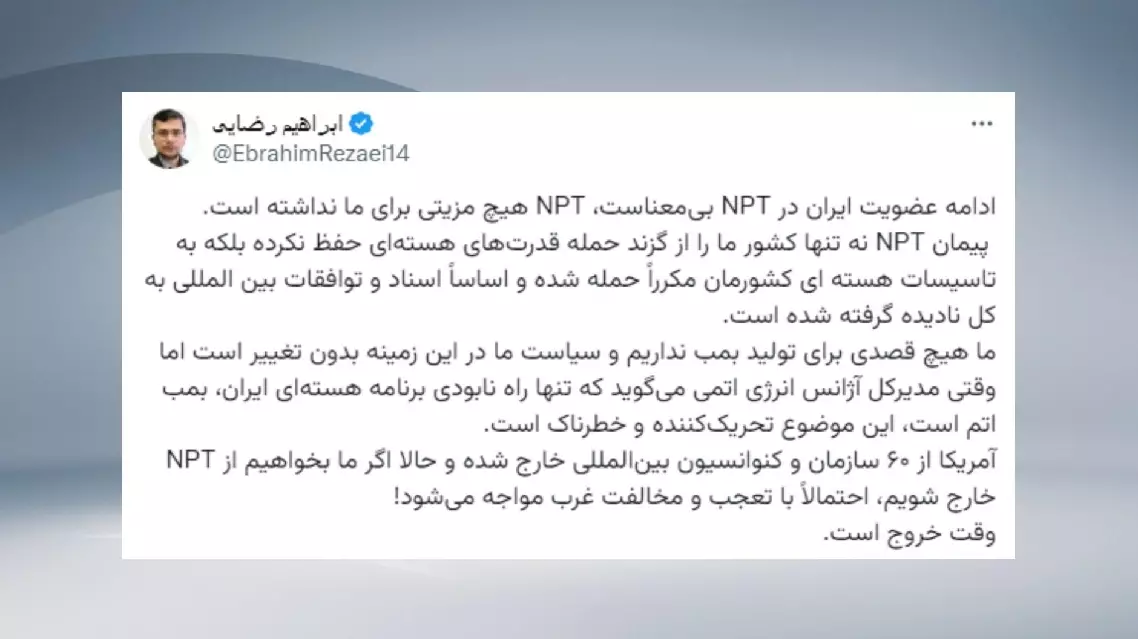
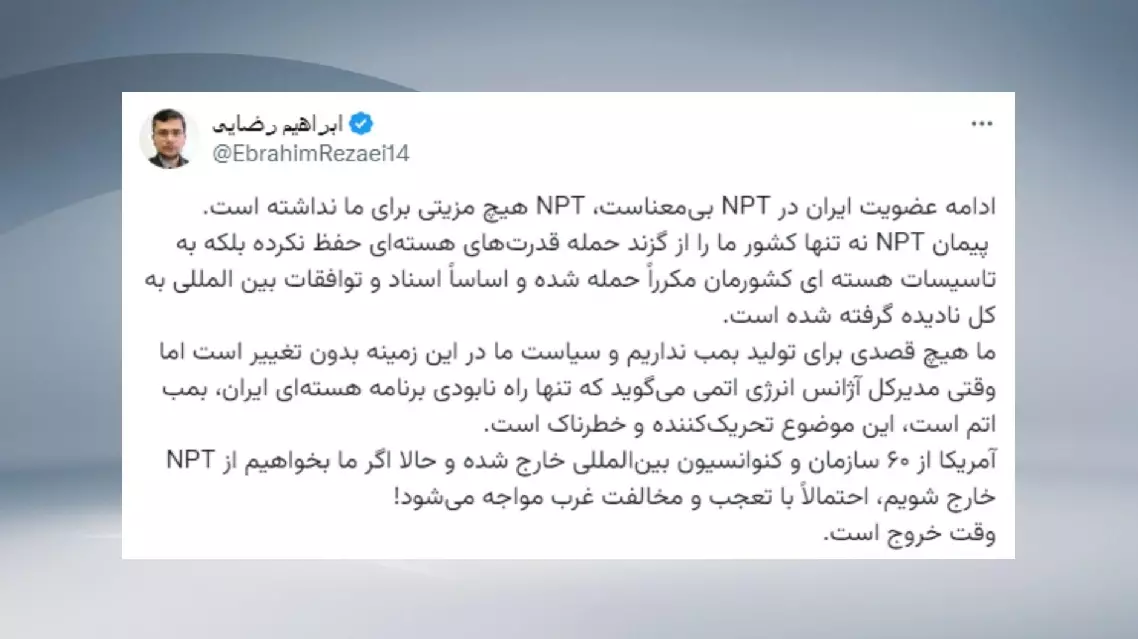
In a post on social media platform X, Rezaei said there is no benefit for Iran to remain part of the pact.
Click to Gallery
It's time for Iran to withdraw from NPT: spokesman
It's time for Iran to withdraw from NPT: spokesman
It's time for Iran to withdraw from NPT: spokesman
It's time for Iran to withdraw from NPT: spokesman
He noted that the treaty has failed to protect Iran's nuclear facilities from attacks, and that the relevant international documents and agreements have been completely ignored.
Rezaei reaffirmed that Iran has no intention of developing nuclear weapons and this policy has not changed.
The International Atomic Energy Agency (IAEA) has repeated its calls for restraint in the Middle East after Israel struck two Iranian nuclear facilities, including a uranium processing plant.
It's time for Iran to withdraw from NPT: spokesman
It's time for Iran to withdraw from NPT: spokesman
It's time for Iran to withdraw from NPT: spokesman
It's time for Iran to withdraw from NPT: spokesman
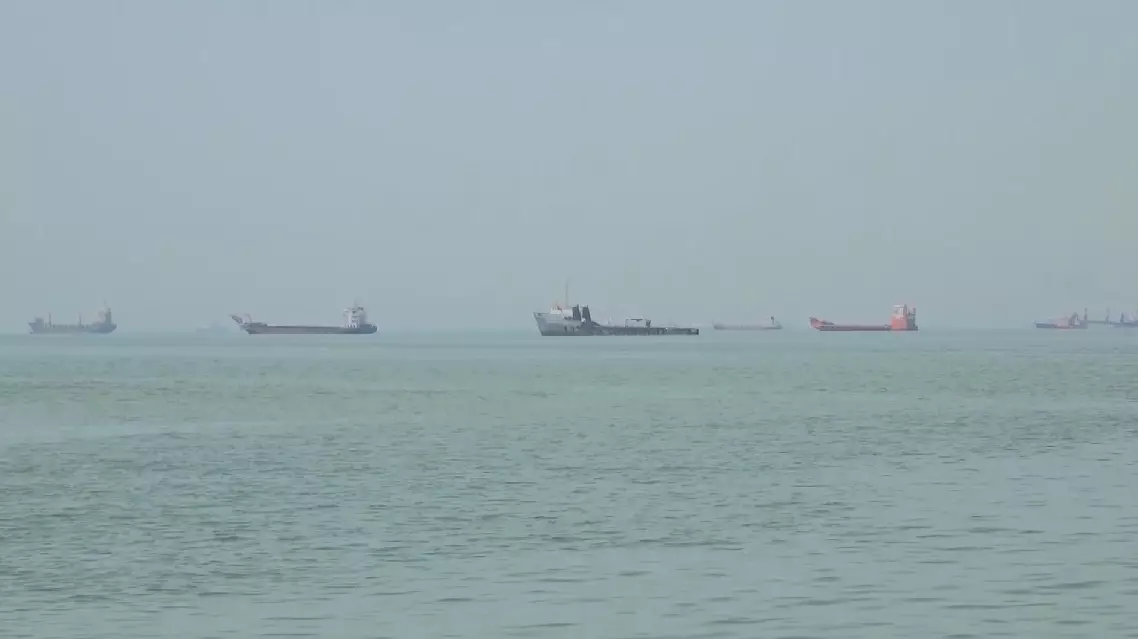
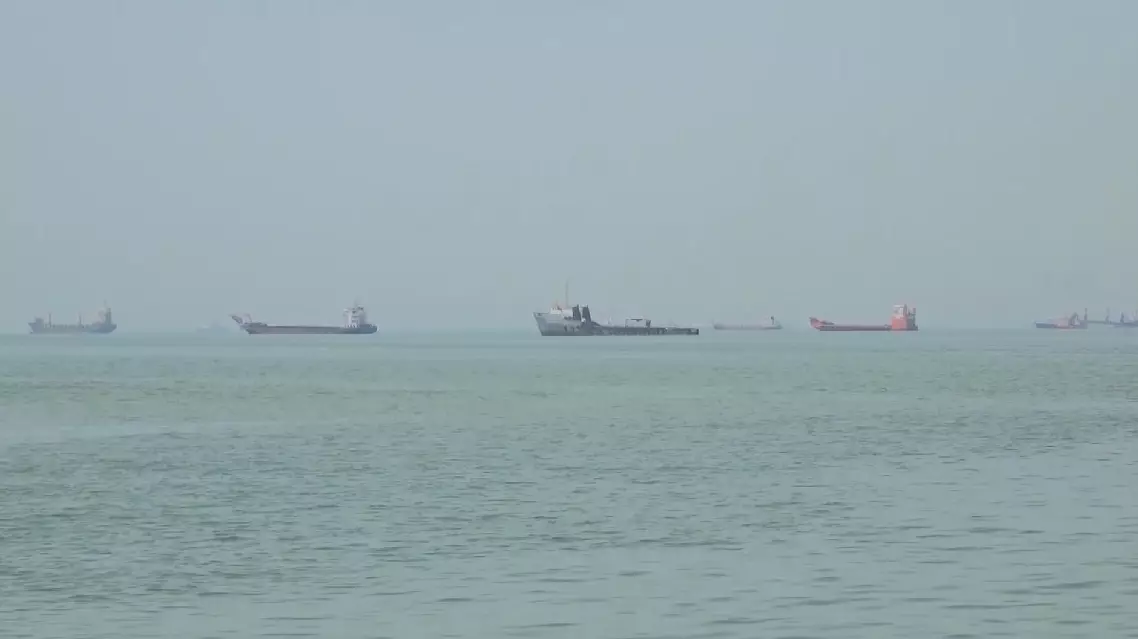
Iran's Islamic Revolution Guard Corps (IRGC) said in a statement on Monday that a super oil tanker, which was trying to cross the Strait of Hormuz via the "forbidden" route to the south of the strait, exploded after hitting naval mines.
Warnings about the dangers of this route had been issued previously, according to the statement published on the IRGC's official news outlet Sepah News.
In the statement, the IRGC Navy said that the Strait of Hormuz has been blocked and remains under Iran's "smart control".
Following U.S.-Israeli strikes on Iran on Feb. 28, Tehran restricted passage through the strategic waterway, while U.S. forces imposed a naval blockade targeting vessels traveling to or from Iranian ports.
Ship-tracking data showed that the daily number of vessels transiting through the strait dropped to single digits over the weekend, falling below the recent 10-day average of 14 vessels per day.
Four vessels, including a gas carrier, exited the strait over the weekend, while 10 cargo ships entered the waterway.
However, these figures do not include vessels that pass through the strait with their Automatic Identification System (AIS) switched off.
The Strait of Hormuz handles roughly 20 percent of the world's seaborne oil flows and significant shipments of liquefied natural gas (LNG) and fertilizers.
Before the U.S.-Israeli strikes, around 125 large commercial vessels would pass through the strait every day, including oil tankers, gas carriers, bulk carriers, and container ships.
Iran says oil tanker explodes after hitting naval mines in Hormuz, US denies Iran's claim
Iran says oil tanker explodes after hitting naval mines in Hormuz Strait