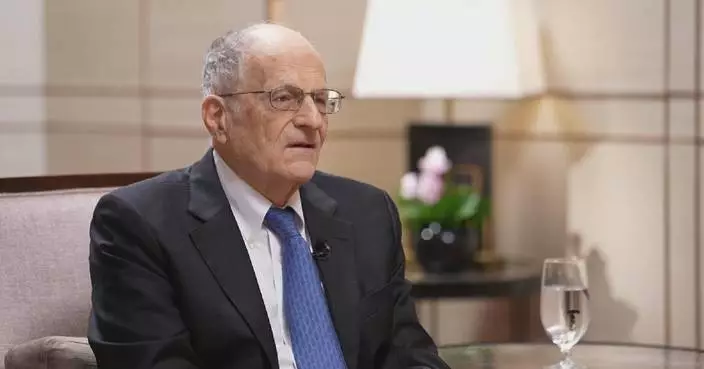
The United States is facing fiscal and social challenges, and addressing them will require credible policies and long-term stability, Nobel laureate in economics Thomas J. Sargent said.
In an exclusive interview with China Media Group (CMG), Sargent, who won the 2011 Nobel Prize in Economic Sciences, said policy uncertainty is a key driver of economic problems -- and one that is currently confronting the United States.
"You got it correctly. That's something that I wish the people in my government would read and remember. Expectations is about how you should forecast the future. The mathematical theory of forecasting was invented during World War II by [Norbert Wiener] and Co., by some people that we study. So one thing that we learned in these tools is: if you're trying to do monetary and fiscal policy, government policy, tax policies, how should you do that? And then the notion of commitment and stable rules, certain rules -- those are messages that just popped out of the math. I had a businessman tell me in the United States -- he's very upset about the uncertainty of Trump's policy. He said, 'Look, you tell me the rules. I can adapt to the rules. But if you don't tell me, you change them every day, I just don't know what (to do),'" said Sargent.
He said that, based on arithmetic logic, the conclusion is that the social security system of the U.S. will collapse within a foreseeable timeframe -- and when that moment arrives, government officials will have no choice but to confront the problem head-on.
"So, we have a fiscal situation in the United States. We have a social safety net. We have a public medical system, and they're very expensive. If you look at all the plans and the numbers that are in the books, they do not fit together, they violate arithmetic. For example, the social security system is going to go bankrupt in eight years. So that's the situation now. You could mathematically say what's going to happen -- that the United States is either going to have to default on some of its debts, or going to have to increase some taxes, default on some promises to recipients. The politicians can pretend that they're not going to fix it when they're in office, but it's going to be fixed," said Sargent.
He also said that most Americans do not understand this reality because the country's basic education system has failed to equip them with the essential mathematical skills needed to grasp it.
"Does the man in the street know that? Not in my country. STEM knowledge is not all that widespread. There was a poll. They asked, 'What is one half divided by one quarter?' And the most popular answer was, 'it's a trick question. You can't divide a fraction by a fraction.' Of course, you can. But that's just the whole thing -- the media thing -- Americans don't know math," he said.
Sargent suggested that central bank governors and fiscal policymakers around the world would do well to study how the Chinese government has approached economic development, calling it a valuable example to learn from.
"If you look at the central bank of China -- and they're going to say my advice better than I can say it -- they're going to want basically stable rules that people can understand. They're going to want basically to have policies where their government is collecting enough taxes to pay for its expenditures. They're going to have everyone's financial regulation. All the things that they've announced are basically within the framework that we like. And they want consistent rules over time," he said.
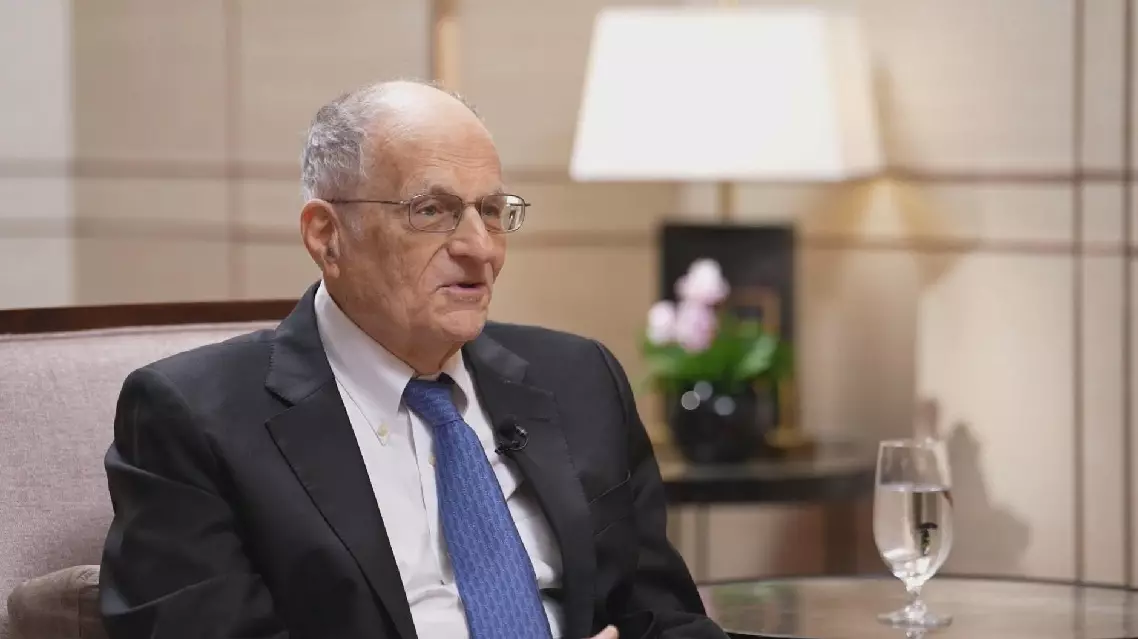
Nobel laureate says policy uncertainty driving U.S. economic woes