More than 200,000 migratory birds are flocking back to north China's Inner Mongolia's wetlands this spring, turning the Tumuji National Nature Reserve into a vivid showcase of China’s biodiversity gains and ecological recovery along the East Asia-Australia flyway.
The reserve, located in the transition zone between the Daxing’anling hills and arid grasslands, is a critical stopover on one of the world’s busiest migratory routes. Staff say the influx includes rare species such as the white crane, red-crowned crane, and white-naped crane, highlighting how improved water levels and vegetation cover are restoring habitats once under stress.
Strong protective measures by local authorities have transformed the reserve into a haven for rare birds. Staff report that water levels have stabilized at about 6,667 hectares, while grassland vegetation cover has climbed to roughly 75 percent, clear signs of ecological recovery supporting the migratory influx.
A similar scene is unfolding in Wuhai City, Inner Mongolia, where tens of thousands of black-headed gulls are arriving on schedule, drawing many visitors who come to photograph the spectacular spectacle.
"This time, I feel Wuhai is very particularly beautiful. It’s clean, beautiful and nice," said Zhao, a tourist from Baotou City.
Wang Chunxiao, a research assistant at the National Bird Banding Centre of China, said the first group of black-headed gulls arrived 15 days earlier than last year and in greater numbers.
"There are nearly 200 bird species here, including nationally protected Class I and Class II species. The diversity is extensive, and populations have increased in recent years. For example, the grey crane was only seen in southern Wuhai a few years ago; now its numbers have grown and it is found throughout the city," said Wang.
According to local forestry and grassland authorities, in recent years, nearly 100,000 migratory birds have nested and rested in Wuhai each year, forming a striking ecological scene along the Yellow River's banks.
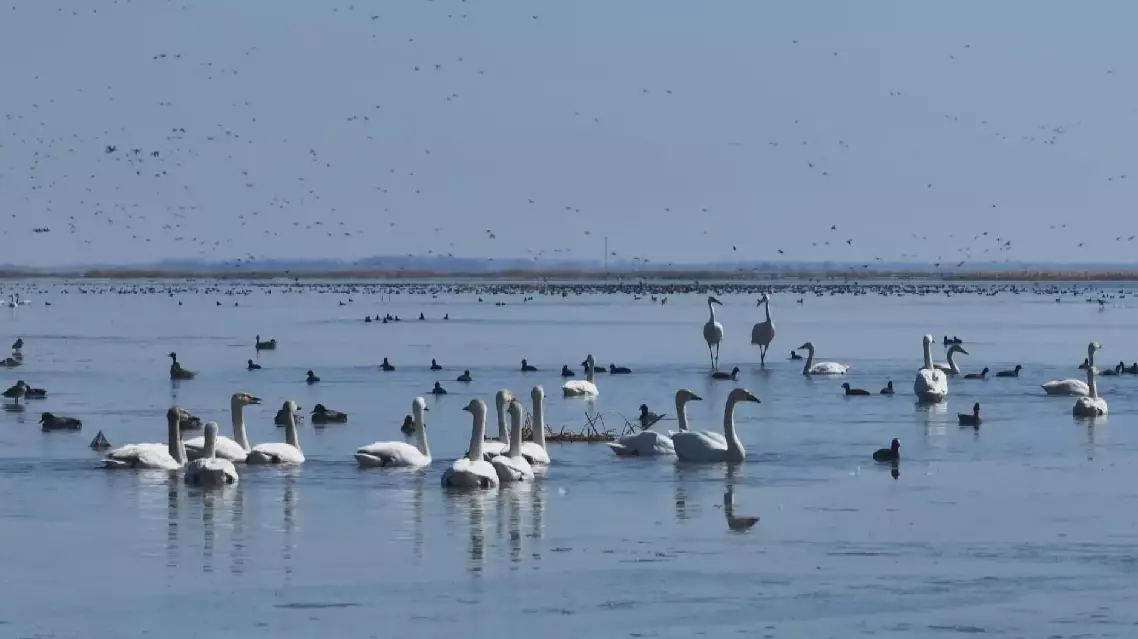
Over 200,000 migratory birds signal ecological recovery in Inner Mongolia wetlands