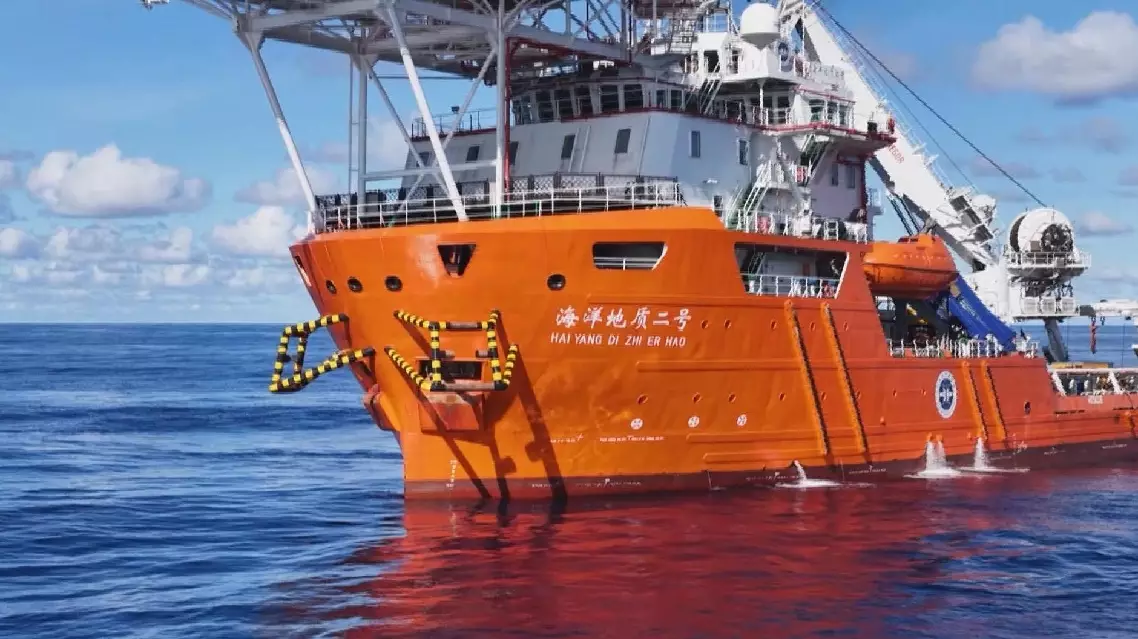
China's Ocean Geology 2 research vessel has completed its 33rd deep-sea scientific expedition with fruitful research results, according to the China Geological Survey (CGS).
The 30-day mission brought together 100 researchers from 16 Chinese institutions, including the CGS, the Ocean University of China, and the Second Institute of Oceanography of the Ministry of Natural Resources.
The team carried out standardized sea trials for projects of the National Natural Science Foundation of China and the National Key Research and Development Program.
Using homegrown Haima remotely operated vehicle (ROV), the scientists deployed and recovered 16 sets of instruments, including in-situ observation probes, seafloor microtremor arrays, and seafloor magnetotelluric instruments. They also retrieved 25 sets of equipment such as sediment traps and turbidity meters that had been deployed in previous years.
In addition, the team collected extensive geophysical data and sediment samples, providing valuable support for deep-sea geological disaster research and resource exploration.
"Data from the seafloor microtremor arrays can help us locate submarine landslides. The observation probes and other sensors enable us to detect changes in parameters such as flow velocity, temperature, and pressure at the bottom boundary layer and capture the evolution of fluid dynamics and the process of material transport in deep-sea canyons. The seafloor magnetotelluric and seismic data help us understand the structure of submarine strata," explained Chen Zongheng, deputy director of the Marine Geological Exploration Technology and Methods Institute of the Guangzhou Marine Geological Survey.
"With these data, we can comprehensively study the evolution of submarine geological disasters, providing a scientific basis for deep-sea resource exploration and hazard control," he added.
During this voyage, China's first 10,000-meter-class ultra-clean seawater sampling winch successfully completed the deployment and retrieval of its 11,000-meter coaxial cable, along with functional tests, application demonstrations, and standardized sea trials for other deep-sea instruments.
Ocean Geology 2 is a versatile, modern research vessel with a displacement of about 7,200 tons and a crew capacity of 150 people. Capable of independently conducting marine scientific surveys such as environmental assessment, geological sampling, and geophysical exploration, as well as submarine cable installation, deep-water salvage, and other offshore engineering operations, it is a key asset for China to build itself into a strong maritime country and explore deep-sea mysteries.
China’s research vessel completes fruitful deep-sea expedition
China's newly approved Inner Mongolia Pilot Free Trade Zone (FTZ) is expected to help turn the northern border areas into a new frontier of opening-up.
China on Thursday released a plan for the establishment of the China (Inner Mongolia) Pilot Free Trade Zone, bringing the total number of pilot free trade zones nationwide to 23. Leveraging its unique location linking Russia, Mongolia and wider Eurasia, the zone is designed to advance the country's high-level opening-up through policy support, industrial upgrading and improved connectivity.
The pilot FTZ covers 119.74 square kilometers and comprises three subzones in Hohhot, capital of the autonomous region, Manzhouli, a northern border city, and Erenhot, a land port on the China-Mongolia border, each tasked with differentiated functions and the development of industries tailored to local conditions.
Specifically, the Hohhot subzone will serve as a central hub, focusing on developing specialty industries and innovation clusters. The Manzhouli subzone will build on China-Russia-Mongolia cooperation to become an important gateway to Northeast Asia and Europe. The Erenhot subzone will tap into the China-Mongolia-Russia Economic Corridor and serve as a model for cooperation with neighboring countries.
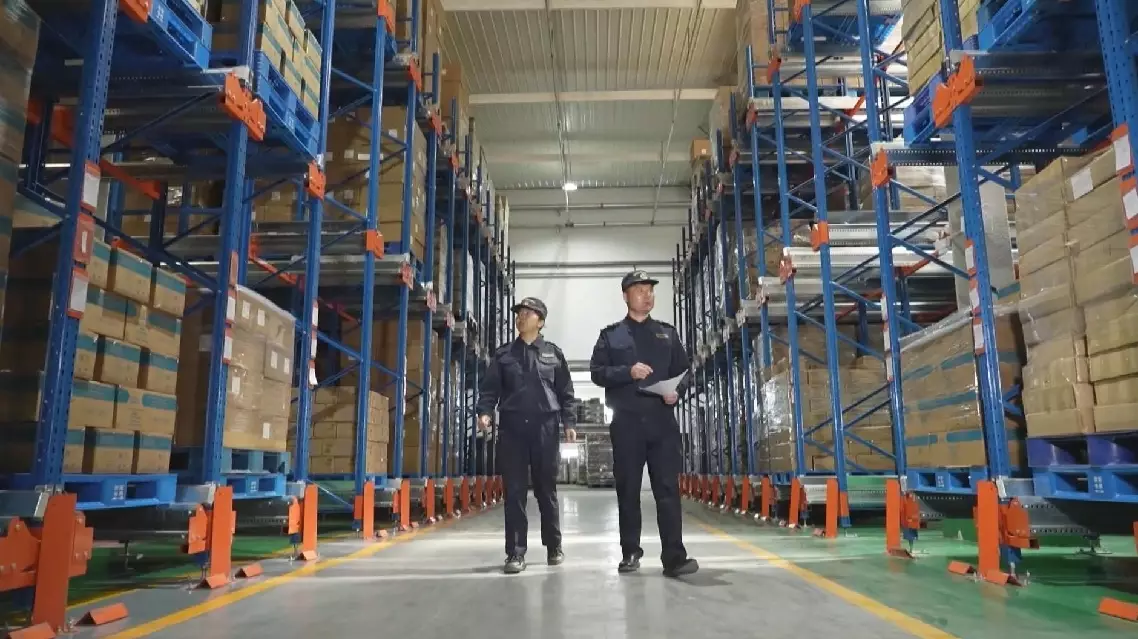
At the Hohhot Comprehensive Bonded Zone, a gold and silver refining project due to start operations will have an annual processing capacity of 100 tonnes of gold and 1,000 tonnes of silver.
The Manzhouli subzone will prioritize industries including the processing of imported resources, cross-border tourism, cross-border financial services and port services.
"Following the approval of the free trade zone, companies like ours are more confident in expanding our cross-border business further and broadening its scope. Specifically, we aim to achieve full coverage across the entire industrial chain," said Cui Rongzheng, head of Manzhouli Xincheng Supply Chain Limited Company.
Notably, in the first quarter of this year, the Erenhot Railway Port, a key hub on the "middle corridor" of the China-Europe Railway Express, handled a record-high 1,145 freight train trips, a 22.3 percent increase from last year, underscoring its role in stabilizing global supply chains and supporting foreign trade growth.
"The establishment of the Inner Mongolia Pilot Free Trade Zone will strengthen links between border provinces and China's inland regions, and enhance cooperation between land ports, coastal ports and inland ports. It is expected to play a key role in improving the wellbeing of ethnic minority populations in the border areas and turning China's northern border areas into a new frontier of opening-up," said Wang Xuekun, head of the Chinese Academy of International Trade and Economic Cooperation under the Ministry of Commerce.
Inner Mongolia FTZ subzones to drive coordinated opening-up