China on Friday issued a new set of rules regulating providers of AI systems that simulate human personality traits, thinking patterns and communication styles in continuous emotional interactions with users, placing strict safeguards on content for minors.
The new set of rules, officially known as the Interim Measures for the Administration of Artificial Intelligence Anthropomorphic Interactive Services, was jointly released by the Cyberspace Administration of China along with four other competent central government departments.
The rules, which will take effect on July 15, 2026, aim to balance technological innovation with safety and public interest.
Under the new rules, such services cannot generate content for minors that could encourage unsafe behavior, trigger extreme emotional responses or promote harmful habits that may affect their physical or mental well-being.
The new set of rules also bans AI systems from producing content that encourages self-harm or suicide, uses verbal abuse, or induces emotional dependency that could distort real-life social relationships.
It prohibits the use of emotional manipulation to induce users to make irrational decisions or to infringe upon their legitimate rights and interests.
The framework comes as human-like AI interaction tools expand rapidly in China, with applications emerging in cultural communication, childcare and elderly companionship.
The rules emphasize a "development with security" approach, combining encouragement of innovation with tiered supervision, with the aim of guiding the sector toward "healthy and responsible" growth.

China issues rules to regulate AI human-like interaction services to protect minors
China has recently made a breakthrough in deploying embodied AI robots for specialized purposes in high-risk environments, marking a significant step forward for the country's intelligent equipment industry.
One of the newly applied robots features humanoid dual arms, magnetic wall-climbing capability, and large-scale AI models, allowing it to replace human workers on hazardous tasks such as welding, flaw detection, and rust removal on chemical storage tanks, ships, and energy facilities.
Meanwhile, the robot is cable-powered, enabling continuous operation without battery limitations.
"Behind this robot is China's largest large-scale model for special-purpose robots. To train the model, our robots have accumulated over 100,000 hours of operation. They have covered a total working distance of 22,500 kilometers, more than half the Earth's equatorial circumference, and have operated across an accumulated area of over 5,000 square kilometers. The vast and rich amount of data has allowed the robot to learn extensively and become increasingly intelligent," said Pu Xiao, head of a special-purpose robot research and development team.
In addition, a land-based inspection robot has also been put into use.
It features a robust and highly flexible 6-axis robotic arm, capable of replacing human workers in dangerous scenarios such as fires or toxic gas leaks to perform tasks like shutting off switches or turning valves.
The robot can also detect fires or faults within a range of 2,000 meters, issue timely warnings, and help minimize potential dangers.
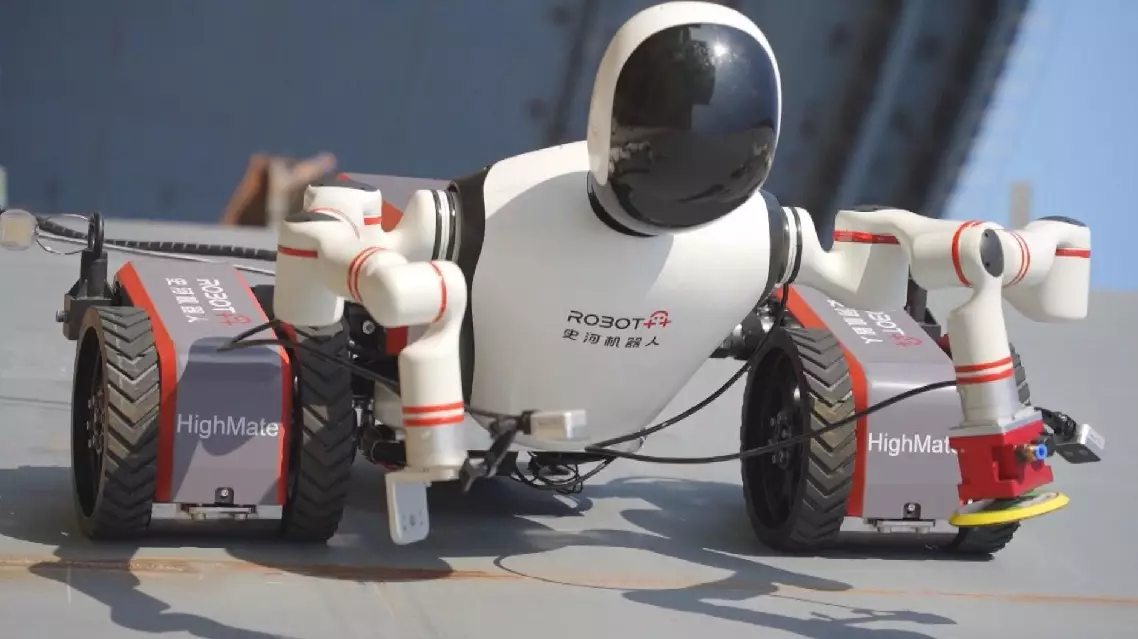
China deploys embodied AI robots in high-risk environment operations
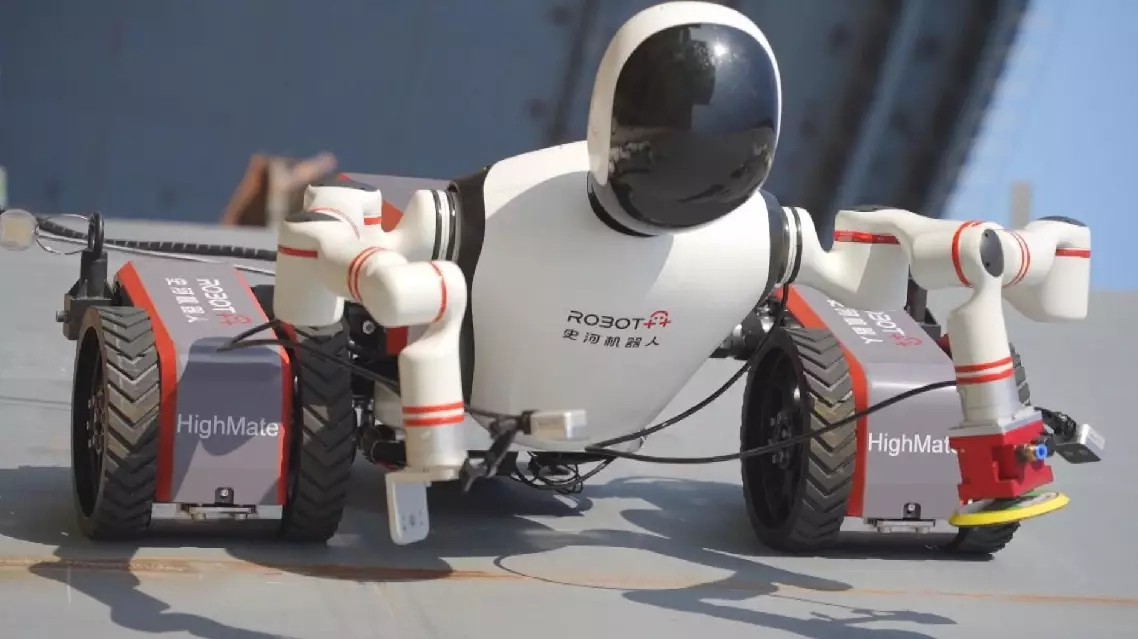
China deploys embodied AI robots in high-risk environments to perform dangerous tasks.