Many scholars said the remarks of Xi Jinping, general secretary of the Communist Party of China (CPC) Central Committee, during his meeting with Cheng Li-wun, chairwoman of the Chinese Kuomintang (KMT) party, on Friday in Beijing have charted the course for the development of cross-strait relations under the new circumstances.
Invited by the CPC Central Committee and Xi, Cheng is the first KMT chairperson to have led a delegation to the Chinese mainland in the past decade. The delegation had visited Jiangsu Province and Shanghai before coming to Beijing.
Some scholars on Taiwan affairs have pointed out that the four propositions put forward by President Xi are closely interlinked in the contexts of identity, peace, integration, and national rejuvenation. They not only draw a red line but also pave the way forward, providing clear answers to resolving issues in the current cross-strait relations.
"The first point is identity, emphasizing that people on both sides of the strait should take pride in their Chinese identity — this addresses the issue of garnering public support. The second point is about peace, making it clear that adhering to the 1992 Consensus and opposing Taiwan secession is the core issue for cross-strait peace, which draws the bottom line. The third point is integration: the mainland welcomes compatriots from Taiwan to develop their careers on the mainland, as well as Taiwan's agricultural and fishery products to enter the mainland market. This is aimed at addressing the issue of shared interests. The fourth point is national rejuvenation, pointing out that Taiwan's future lies in the strength of the motherland, which provides direction. These four points are interlocking: they not only draw a red line but also pave the way forward. This fully reflects the mainland's sincerity, patience, and strategic resolve in promoting the peaceful development of cross-strait relations," said Tang Hua, director of the Institute of Cross-Strait Relations of Taiwan Research Institute of Xiamen University.
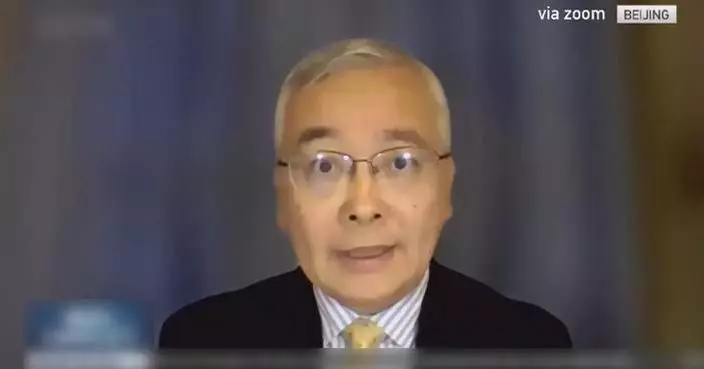
"President Xi put forward four commitments. I find this speech to be open-minded, featuring far-sightedness and broad perspective, and particularly composed in tone. We hope for better development of Taiwan, and therefore we also hope that society in Taiwan will unite. As long as we recognize that we are one family bound by a shared Chinese culture, Taiwan can gradually achieve development on this premise," said Liu Guoshen, director of Collaborative Innovation Center for Peaceful Development of Cross-Strait Relations.
Many scholars believe that the meeting between Xi and Cheng has sent multiple signals both at home and abroad. It not only demonstrates the mainland's resolve to resolutely combat separatist forces seeking Taiwan secession and oppose external interference, but also underscores that cross-Strait exchanges, integration, and joint rejuvenation represent the only correct path and the inevitable historical trend.
"This visit also helps society in Taiwan gain a more comprehensive and objective understanding of the mainland's development, its attitude and position on promoting cross-strait relations, as well as its sincerity and goodwill. This is of great positive significance to Taiwan, which remains under the information blockade imposed by the Lai Ching-te authorities," said Zhu Weidong, director of Institute of Taiwan Studies of Chinese Academy of Social Sciences.
"While resolutely opposing Taiwan secession and external interference, the mainland remains committed to uniting the broadest possible patriotic reunification forces on the island and striving for the prospect of peaceful reunification with the greatest efforts and sincerity. It also remains committed to pooling the wisdom and strength of all Chinese people to seek peace across the strait, the well-being of compatriots, and the rejuvenation of the nation, while firmly holding the future of cross-strait relations in the hands of the Chinese people," said Su Meixiang, a research fellow at the Fujian Academy of Social Sciences.

Xi's speech charts course for cross-Strait relations under new situation: scholars