Skip to Content Facebook Feature Image

Hungary's Tisza party wins parliamentary elections as 98.13 pct votes counted: election office

HotTV

HotTV

HotTV

Hungary's Tisza party wins parliamentary elections as 98.13 pct votes counted: election office

2026-04-13 09:50 Last Updated At:15:46

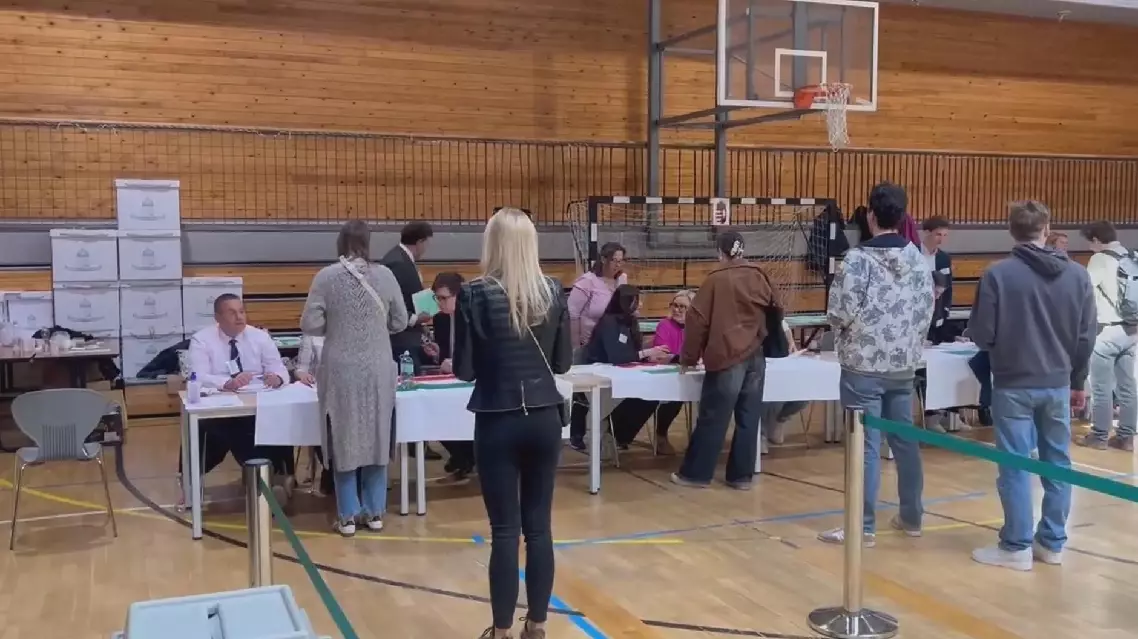
Hungary's opposition party Tisza, led by Peter Magyar, defeated Prime Minister Viktor Orban's ruling coalition by securing a majority in Sunday's parliamentary elections, according to preliminary results released by the National Election Office (NEO).

With 98.13 percent of votes counted by the NEO, Tisza had won 53.62 percent of the vote and was projected to win 138 of the 199 parliament seats, exceeding the two-thirds threshold. Orban's ruling Fidesz-KDNP alliance received 37.79 percent and was projected to win 55 seats.

The far-right Our Homeland Movement won 5.89 percent and is projected to take 6 seats. Other parties failed to clear the 5-percent threshold required to enter parliament.

Preliminary statistics showed that turnout reached about 77.8 percent among roughly 8.1 million eligible voters, marking a record high.

On social media, Hungarian President Tamas Sulyok expressed his congratulations to "the winning party of the elections and to all the candidates of the parliament."

Addressing supporters in Budapest, 45-year-old Magyar hailed his party's "decisive victory," saying it was a win seen "from every Hungarian window." He added that Hungary will once again be a strong ally in the European Union and NATO.

Orban, 62, conceded defeat. "The election results, though not yet final, are clear and understandable; for us, they are painful but unambiguous," he told reporters, adding: "We have not been entrusted with the responsibility and opportunity to govern. I congratulated the winning party."

Magyar said in a social media post that Orban has called to congratulate his party on its victory in the election.

The victory of the center-right Tisza party signals the imminent end of Orban's 16 consecutive years in power. Orban served as Hungary's prime minister from 1998 to 2002 and has remained in office since returning to power in 2010.

During the campaign, Tisza focused on anti-corruption and institutional reform, calling for the restoration of the rule of law and transparent governance. It also advocated repairing relations with the European Union and urged Hungarians to unite in building a sovereign, civic, modern and European Hungary.

Under Hungary's electoral law, parliamentary elections are held every four years. Hungary's parliament has 199 seats, including 106 elected directly in single-member constituencies and 93 allocated among parties that enter parliament.
Hungary's Tisza party wins parliamentary elections as 98.13 pct votes counted: election office


Hungary's Tisza party wins parliamentary elections as 98.13 pct votes counted: election office

A Chinese community in Madrid has become a witness to the growing ties between China and Spain.

Spanish Prime Minister Pedro Sanchez is on a five-day official visit to China from Saturday to Wednesday. This visit marks Sanchez's fourth visit to China in a four-year period, and it represents another significant high-level exchange between China and Spain in a short period, following the visits by Spanish King Felipe VI and Sanchez last year.

The Usera neighborhood in southern Madrid is the heart of the Chinese community - a living example of peaceful and prosperous coexistence and cooperation, which also proves the relations between the two nations continue to develop in a deeper level.

"More than 40,000 Chinese people live in this neighborhood that has a unique and different identity where two cultures coexist peacefully and that represents what Madrid is all about - an open and welcoming city," said Almudena Maillo, Councilor for Tourism of Madrid Town Hall.

A giant 15-by-20-meter dragon is part of a new 12-million-U.S. dollar investment into the neighborhood, a spectacular stop on a 1,700-meter pedestrian route that features Chinese characters and Confucian phrases on the street, with 290 new trees and 11,000 plants, a brand new 500kg marble panda, and an iconic paifang, or gateway, reminiscent of the ones at the London and New York Chinatowns.

The project received EU funding and won an award for its urban transformation from Catedra China in February, a Spanish organization set up to bolster Spain-China ties.

"It's beautiful, really original. It just looks great, brightens up the place," said a local resident.

China's ambassador to Spain sees China-Spain relations at an all-time high.

"This is the best time as far as the relations between China and Spain are concerned. So I think that we are lucky to have a partner like Spain in Europe. We hope that the partners like Spain in Europe could be also increasing in the future time," said Yao Jing, Chinese Ambassador to Spain.

Chinese community in Madrid witnesses closer China-Spain ties

Chinese community in Madrid witnesses closer China-Spain ties

Recommended Articles