Jordan and Syria signed multiple cooperation agreements at the second session of the Jordanian-Syrian Higher Coordination Council on Sunday in Jordanian capital Amman, discussing strengthening cooperation in various fields amid current regional situation.
At the joint press conference between the Syrian and Jordanian foreign ministers following the meeting, Jordan's Deputy Prime Minister and Minister of Foreign and Expatriate Affairs Ayman Safadi said Jordan supports Syria's sovereignty, territorial integrity, and future reconstruction. He said that the two sides have developed a joint roadmap aimed at consolidating stability in Syria's Suwayda province and southern regions.
Syrian Foreign Minister Asaad Hassan al-Shibani said Syria views Jordan as a strategic partner, adding that the two sides are eying larger-scale cooperation. Specific measures include jointly developing the Syrian ports of Latakia and Tartus with the Jordanian port of Aqaba as gateways to the Red Sea.
The two sides also discussed recent regional developments. On Lebanon, both sides supported Lebanon's efforts to achieve national sovereignty and enforce state control over weapons.
Both sides agreed that a potential ceasefire between the United States and Iran should ultimately be translated into a comprehensive agreement to ensure regional security and stability.
"Neither of us wants this war to happen. We hope that Iran and the United States can reach a ceasefire which will lead to a comprehensive agreement that ensures regional security and stability, respect for sovereignty of all countries, non-interference in internal affairs, compliance with international law, and freedom of navigation," said Safadi.
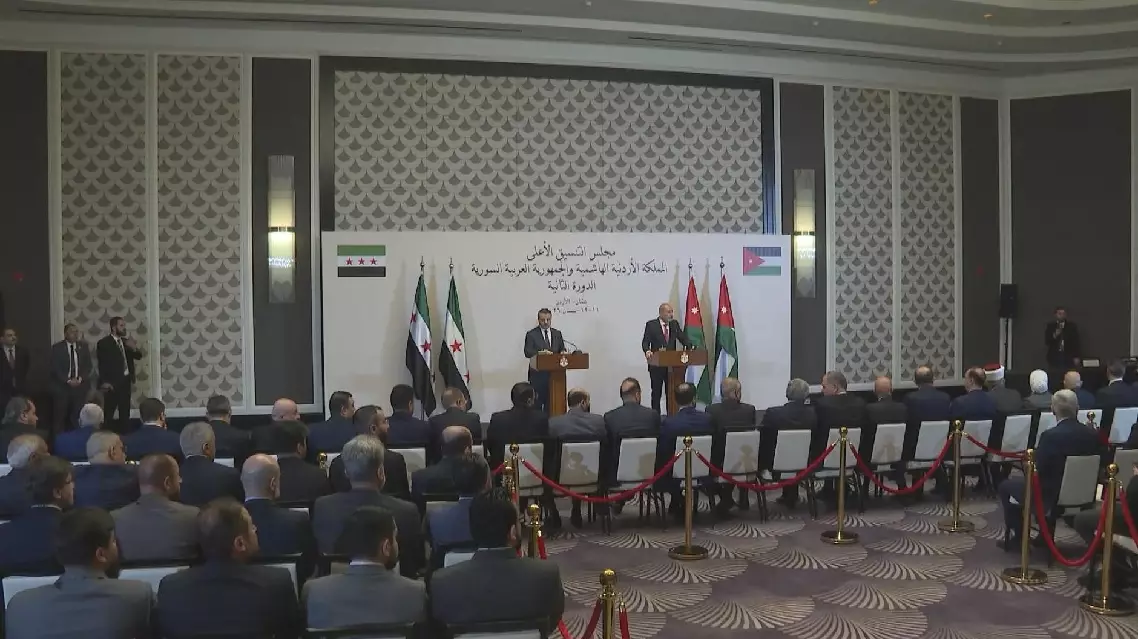
Jordan, Syria sign deals at high-level meeting to boost cooperation in multiple fields
Facing mounting economic and livelihood pressures from shipping disruptions in the Strait of Hormuz, several Asian countries have taken targeted measures to stabilize fuel prices and secure energy supplies.
Iran initially restricted navigation through the Strait of Hormuz as part of its response to U.S. and Israeli attacks. On Sunday, U.S. President Donald Trump announced the U.S. Navy would also begin blocking ships trying to enter or leave the Strait of Hormuz, after peace talks with Iran failed to produce a deal.
The blockade of this vital global energy route has driven up oil and gas prices worldwide.
Vietnam decided to extend the suspension of taxes on fuels to shield households and businesses from rising oil costs. On Sunday, the National Assembly, the country's lawmaking body, announced that the tax suspension, previously scheduled to end on April 15, will be extended until the end of June.
The country, which has extremely limited strategic crude oil reserves and relies heavily on imports, is facing significant pressure.
According to a report by Maybank Investment Bank, about 88 percent of Vietnam's crude oil imports come from Gulf countries.
The impact has already rippled through the economy, with railway passenger fares rising 3 percent on March 26, several airlines hiking ticket prices and cutting flights since April.
Amid surging transportation costs, the country's consumer price index rose by 4.65 percent year on year in March.
On the same day, the Republic of Korea (ROK) decided to maintain its current emergency response system as U.S.-Iran negotiations have yielded no agreement.
The ROK depends heavily on imported energy, with roughly 70 percent of its petroleum and 20 percent of its liquefied natural gas sourced from the Middle East.
The government activated an emergency response on March 25 and formed dedicated task groups to handle the situation.
Japan, meanwhile, is tapping into its strategic reserves while grappling with shortages of critical raw materials. The government announced plans to release a second batch of oil reserves in early May, enough to cover 20 days of domestic needs.
This follows a record first release on March 16 of about 80 million barrels, equivalent to about 45 days of consumption.
However, the country now faces a serious challenge in the medical sector, in part due to the tight supply of naphtha, a crude oil-derived ingredient that is key to some medical consumables, which are expected to experience possible shortages from mid-April to around August.

Asian countries take action to ease economic strain from Hormuz Strait disruptions