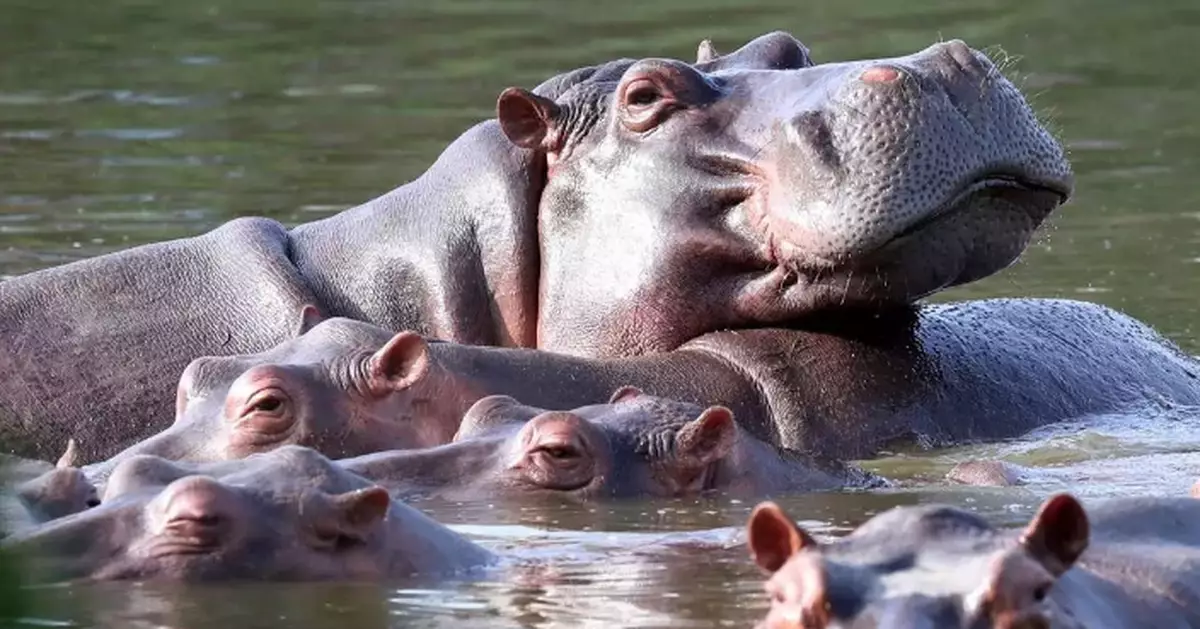
BOGOTA, Colombia (AP) — Colombian officials on Monday authorized a plan to cull dozens of hippos roaming freely through a region in the center of the country, where they threaten villagers and displace native species years after notorious drug lord Pablo Escobar brought in the first ones.
Environment Minister Irene Vélez said previous methods to control their population have been expensive and unsuccessful, including neutering some of the animals or moving them to zoos. Vélez said up to 80 hippos would be affected by the measure. She did not say when hunting would begin.
“If we don’t do this we will not be able to control the population,” Vélez said. “We have to take this action to preserve our ecosystems.”
Colombia is the only country outside of Africa with a wild hippo population. The hippos are the descendants of four brought to the country in the 1980s by Escobar as he built a private zoo in Hacienda Nápoles, a gigantic ranch in the Magdalena River valley with a private landing strip that served as his rural abode.
A study published by Colombia’s National University estimated that around 170 hippos were roaming freely in the country in 2022.
Recently, hippos have been spotted in areas that are more than 100 kilometers (60 miles) north of the ranch.
Environmental authorities in Colombia say the mammals pose a threat to villagers who have encountered them in farms and rivers. They also compete for food and space against local species such as river manatees.
Despite the challenges, the hippos have also become a tourist attraction, with residents of villages surrounding Hacienda Nápoles offering hippo spotting tours and selling hippo-themed souvenirs.
The hippos are also one of the main attractions at the Nápoles ranch, which was confiscated by Colombia’s government as it seized Escobar’s properties. It now functions as a theme park, featuring swimming spools, water slides and a zoo that includes several other African species.
Animal welfare activists in Colombia have long opposed proposals to kill the hippos, arguing they deserve to live. They say that addressing the problem through violence sets a poor example for a country that has gone through decades of internal conflict.
Andrea Padilla, a senator and animal rights activist who helped draft a law against bullfights in Colombia, described the plan to cull the hippos as a “cruel” decision, and accused government officials of trying to take the easy way out.
“Killings and massacres will never be acceptable,” Padilla wrote on X. “These are healthy creatures who are victims of the negligence” of government entities.
Over the past 12 years, spanning three presidential administrations, Colombia has tried to neuter some of the hippos in a bid to reduce their population. But the initiatives have had limited scope due to high costs that come with capturing the dangerous animals and performing surgeries on them.
Because Colombia’s hippos come from a limited gene pool and could carry diseases, taking them back to their natural habitat in Africa has been considered unfeasible.
Follow AP’s coverage of Latin America and the Caribbean at https://apnews.com/hub/latin-america
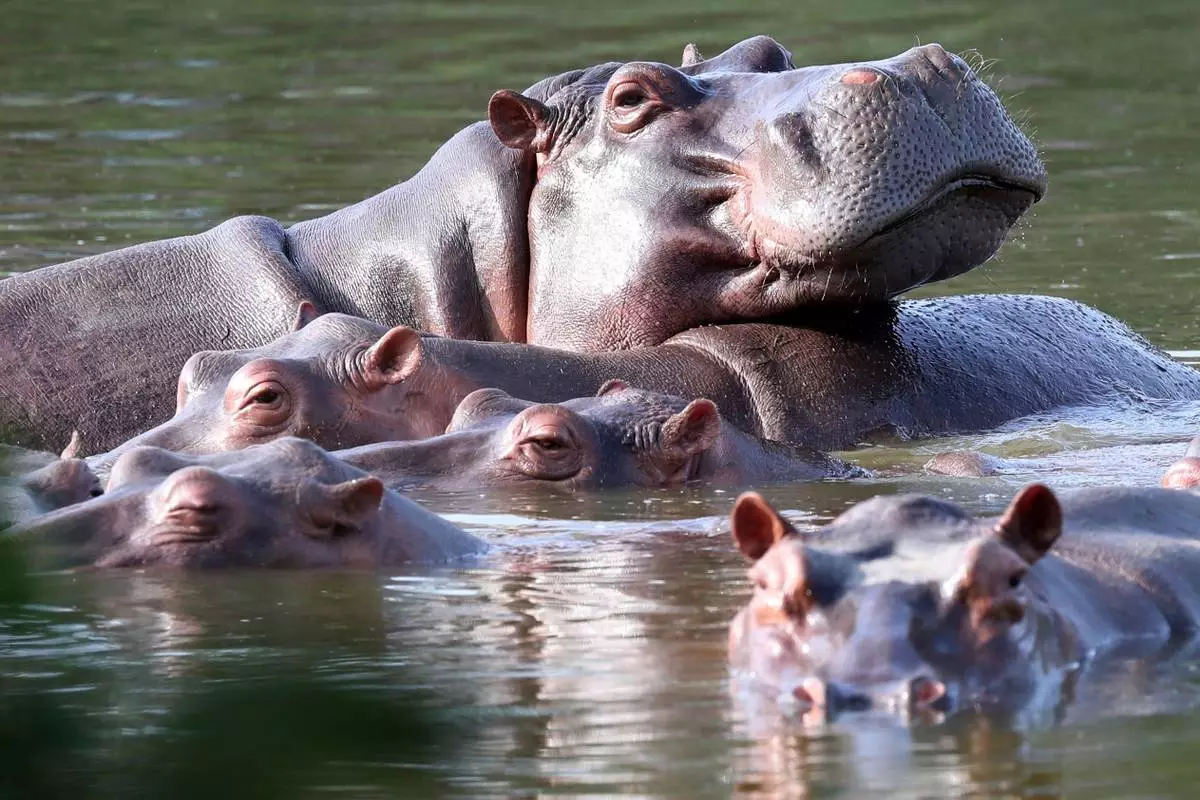
FILE - Hippos float in the lagoon at Hacienda Napoles Park, once the private estate of drug kingpin Pablo Escobar who imported three female hippos and one male decades ago in Puerto Triunfo, Colombia, Thursday, Feb. 4, 2021. (AP Photo/Fernando Vergara, File)

FILE - Hippo key rings are displayed for sale at a souvenir shop near the Hacienda Napoles Park in Puerto Triunfo, Colombia, Tuesday, Feb. 11, 2020. (AP Photo/Ivan Valencia, File)
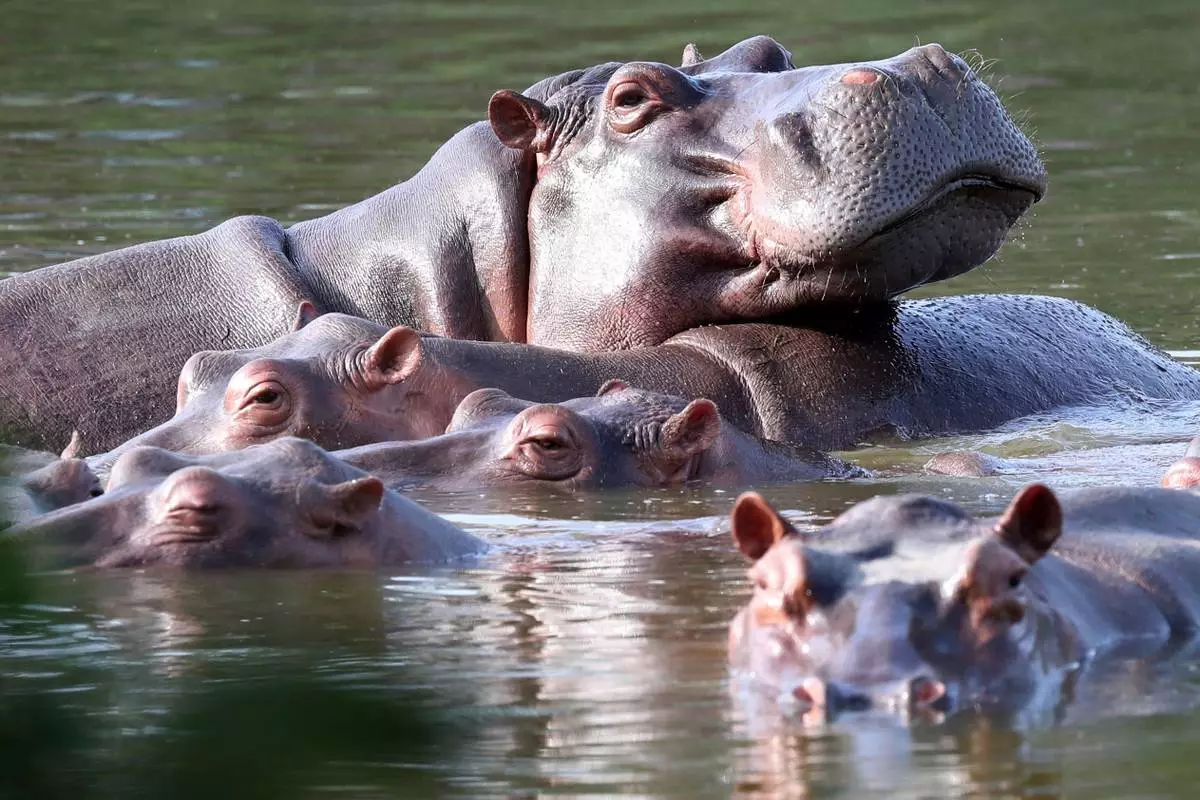
FILE - Hippos float in the lagoon at Hacienda Napoles Park, once the private estate of drug kingpin Pablo Escobar who imported three female hippos and one male decades ago in Puerto Triunfo, Colombia, Thursday, Feb. 4, 2021. (AP Photo/Fernando Vergara, File)
LUANDA, Angola (AP) — Pope Leo XIV called Sunday for Angolans to fight the “scourge of corruption” with a culture of justice as he opened a poignant day in his African odyssey that will take the American pope to an epicenter of the African slave trade.
Leo celebrated Mass before an estimated 100,000 people outside the capital and again sought to encourage Angolans. He denounced the exploitation of their mineral-rich land and people, who still bear the scars of a brutal, post-independence civil war.
“We wish to build a country where old divisions are overcome once and for all, where hatred and violence disappear, and where the scourge of corruption is healed by a new culture of justice and sharing,” Leo said in his homily in Kilamba, a Chinese-built development about 25 kilometers (15 miles) outside the capital.
Later Sunday, Leo will celebrate the Rosary prayer at the Sanctuary of Mama Muxima, an important Catholic shrine on the edge of the Kwanza River about 110 kilometers (70 miles) south of Luanda.
The Church of Our Lady of Muxima, built by Portuguese colonizers at the end of the 16th century as part of a fortress complex, became a hub in the slave trade. It was where enslaved Africans were gathered to be baptized by Portuguese priests before being forced to walk to the port of Luanda to be put on ships to the Americas.
While it's a popular Catholic shrine today, its history is emblematic of the Catholic Church’s role in the slave trade hundreds of years ago, the forced baptisms of enslaved people and what some scholars say is the Holy See’s continued refusal to fully acknowledge it and atone for it.
The visit is particularly significant because the Creole ancestors of the first U.S.-born pope include enslaved people and slave owners, according to genealogical research.
“For Black Catholics, Pope Leo’s visit to the Muxima shrine is an important moment of healing,” said Anthea Butler, senior fellow at the Koch Center, Oxford University.
She noted that many Black Catholics are Catholic because of slavery and the “Code Noir,” which she said required slaves purchased by Catholic owners to be baptized in the church.
“Others were already Catholic when they were trafficked from Angola to slave holding colonies,” said Butler, a Black Catholic scholar whose maternal family hails from Louisiana, where the pope’s ancestors also had their roots.
Angola’s Portuguese colonizers were emboldened by 15th-century directives from the Vatican that authorized them to enslave non-Christians.
In 1452, for example, Pope Nicholas V issued the papal bull Dum Diversas, which gave the Portuguese king and his successors the right “to invade, conquer, fight and subjugate” and take all possessions — including land — of “Saracens, and pagans, and other infidels, and enemies of the name of Christ” anywhere, said the Rev. Christopher J. Kellerman, a Jesuit priest and author of “All Oppression Shall Cease: A History of Slavery, Abolitionism, and the Catholic Church.”
The bull also gave the Portuguese permission “to reduce their persons to perpetual slavery.”
That bull and another issued three years later, Romanus Pontifex, formed the basis of the Doctrine of Discovery, the theory that legitimized the colonial-era seizure of land in Africa and the Americas, and justified slavery.
The Vatican in 2023 formally repudiated the Doctrine of Discovery, but it never formally rescinded, abrogated or rejected the bulls themselves. The Vatican insists that a later bull, Sublimis Deus in 1537, reaffirmed that Indigenous peoples shouldn’t be deprived of their liberty or the possession of their property, and were not to be enslaved.
Kellerman recalled that most of the 12.5 million Africans who were direct victims of the trans-Atlantic slave trade were sold into slavery by other Africans and were not captured by Europeans.
“That being said, at the time of the building of Muxima, the Portuguese were doing both — buying enslaved people and colonizing/slave raiding. So they were fully using their papal permissions during this time,” he said in emailed comments to The Associated Press.
He said the first pope to condemn slavery itself was Pope Leo XIII, the current pope’s namesake and inspiration, in two encyclicals in 1888 and 1890. But Kellerman said that pope and others since have continued to perpetuate the “false narrative” that the Holy See was always against slavery, when the historical record says otherwise.
While Leo's visit to Muxima was in honor of its role as a shrine, Kellerman said he hoped that the visit would also give Leo a chance to learn more about the history of the slave trade.
“The popes repeatedly authorized Portugal’s colonization efforts in Africa and Portuguese participation in the slave trade, but the Vatican has never fully admitted this,” he said. “It would be so powerful if at some point Pope Leo were to apologize for the popes’ role in the trade.”
During a 1985 visit to Cameroon, St. John Paul II asked forgiveness of Africans for the slave trade. In 1992 visit to Goree Island, Senegal, the largest slave-trading center in West Africa, he denounced the injustice of slavery and called it a “tragedy of a civilization that called itself Christian.”
According to genealogical research published by Henry Louis Gates Jr., 17 of Leo's American ancestors were Black, listed in census records as mulatto, black, Creole or a free person of color. His family tree includes slaveholders and enslaved people, Gates reported in an essay in the New York Times.
Gates, a Harvard University professor who hosts the popular PBS documentary series “Finding Your Roots,” presented his research to Leo during a July 5 audience at the Vatican. According to a report of their meeting in The Harvard Gazette, “The pope asked about ancestors, both Black and white, who were enslavers.”
Leo has not spoken publicly about his family heritage or the Gates research, and some Black Catholic scholars are hesitant to impose on him a narrative about his identity that he himself has not yet addressed publicly.
“It’s important that we tell our own stories,” said Tia Noelle Pratt, a sociologist of religion and professor at Villanova University, the pope’s alma mater.
“We haven’t heard anything from him about what he thinks about it, and so to impose anything on him, I think would be completely inappropriate,” said Pratt, author of “Faithful and Devoted: Racism and Identity in the African-American Catholic Experience.”
Cardinal Wilton Gregory, the retired archbishop of Washington and the first African American cardinal, said he was “delighted” to have facilitated the encounter.
“It’s one of the things that I think for many African Americans and people of color, they identify with great pride the pope has roots in our own heritage,” Gregory said. “And I think he’s happy about that too, because it’s another link to the people that he tries to serve and is called to serve.”
Associated Press religion coverage receives support through the AP’s collaboration with The Conversation US, with funding from Lilly Endowment Inc. The AP is solely responsible for this content.
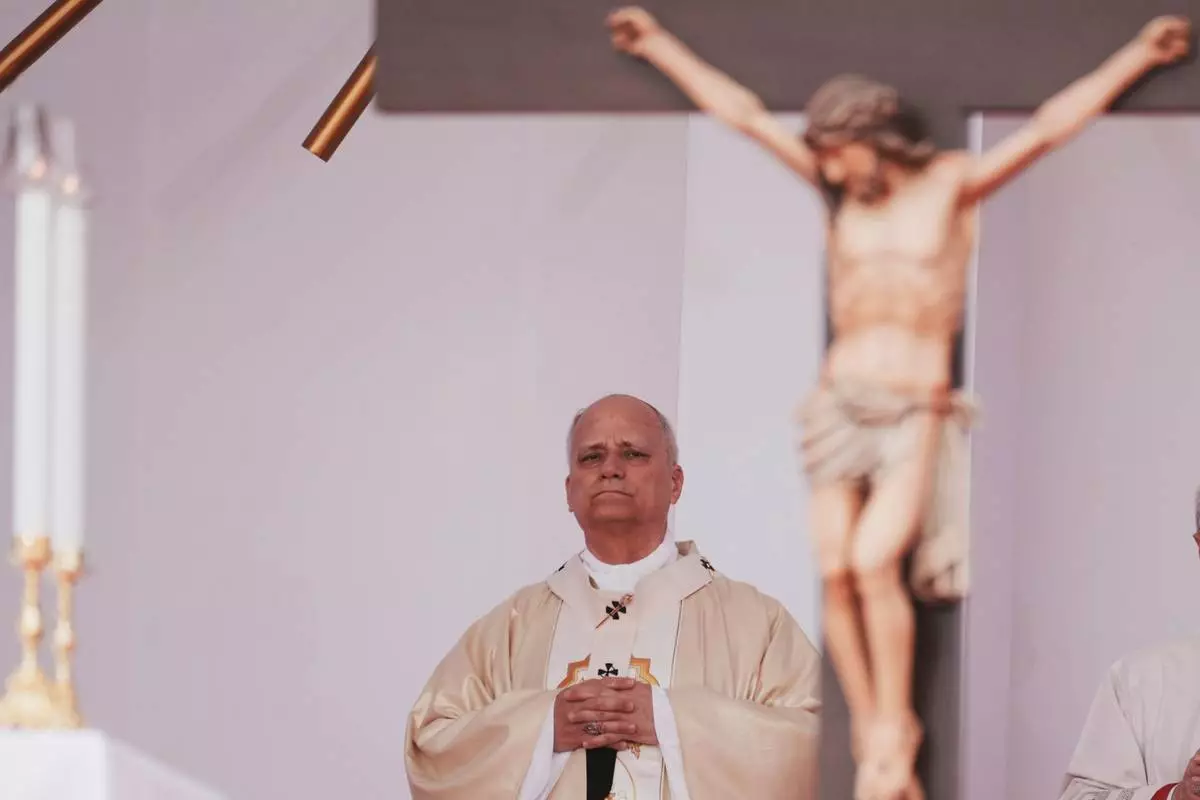
Pope Leo XIV presides over Sunday Mass, Sunday, April 19, 2026, in Kilamba, some 30 kilometers south of Luanda, Angola, on the seventh day of an 11-day apostolic journey to Africa. (AP Photo/Andrew Medichini)
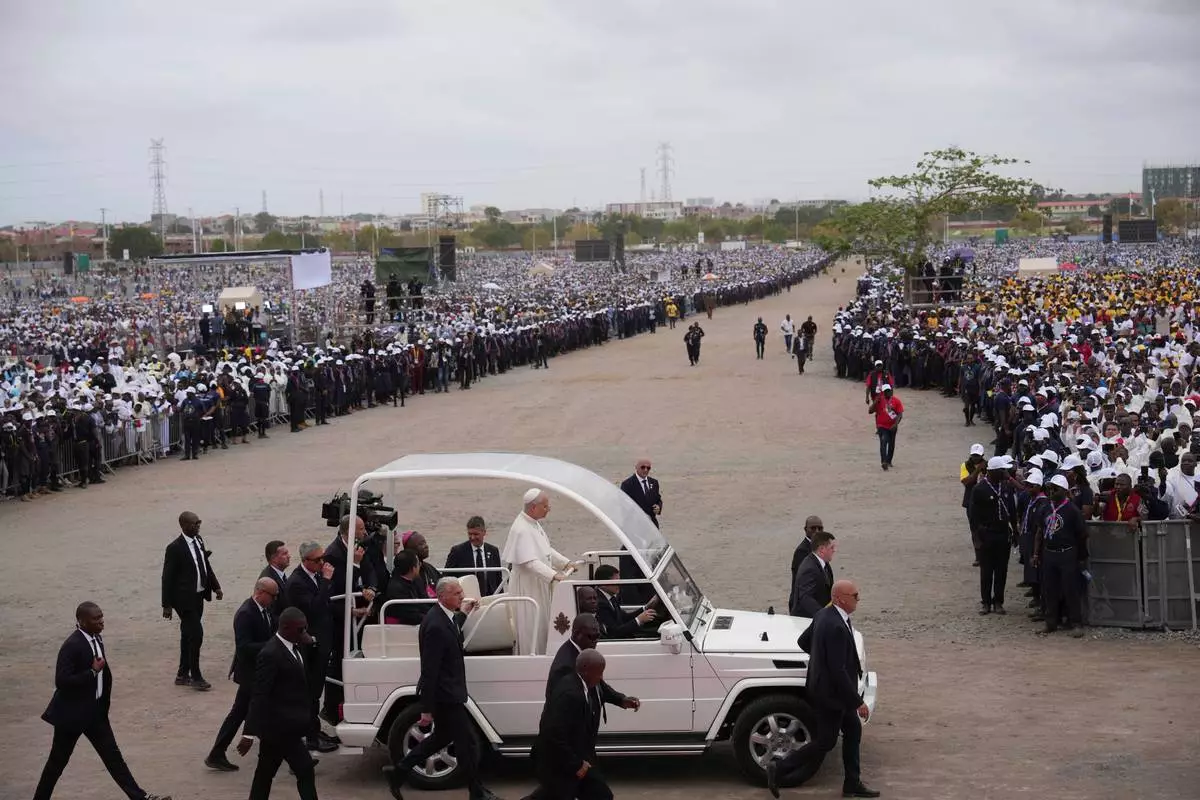
Pope Leo XIV arrives in Kilamba, some 30 kilometers south of Luanda, Angola, to preside over Sunday Mass, Sunday, April 19, 2026, on the seventh day of an 11-day apostolic journey to Africa. (AP Photo/Andrew Medichini)
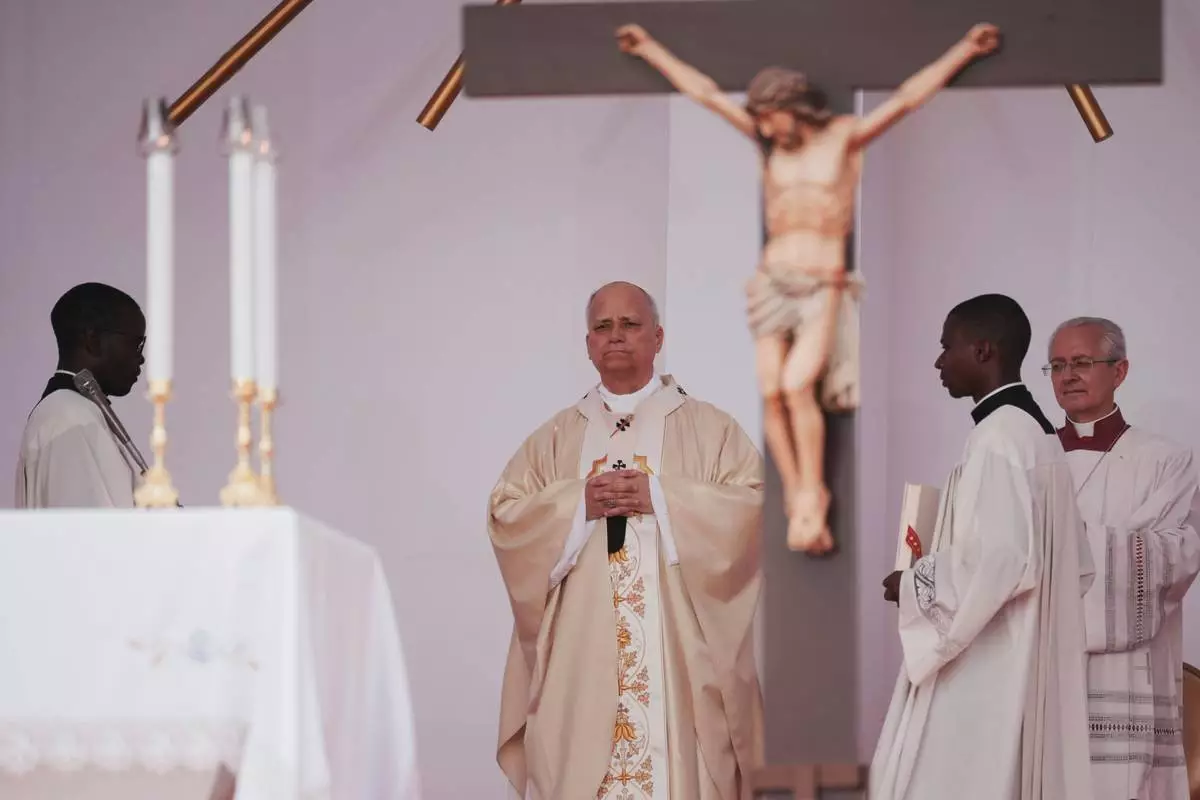
Pope Leo XIV presides over Sunday Mass, Sunday, April 19, 2026, in Kilamba, some 30 kilometers south of Luanda, Angola, on the seventh day of an 11-day apostolic journey to Africa. (AP Photo/Andrew Medichini)