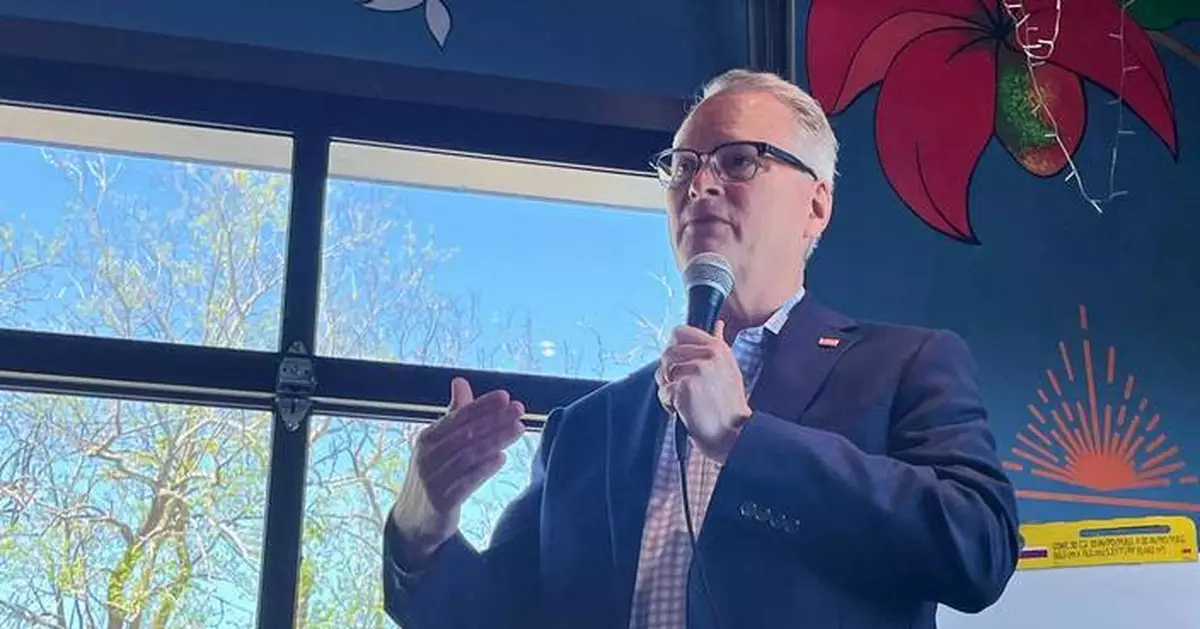
LENEXA, Kan. (AP) — The pastor of the largest United Methodist Church in the U.S. launched a campaign Thursday for the Democratic nomination for a U.S. Senate seat in Kansas, upending the race in a normally Republican state as the GOP’s small majority seems less secure than it was a year ago.
The Rev. Adam Hamilton enters the race as a potentially formidable candidate, though it wasn’t immediately clear how many of the eight other, lesser-known Democrats who’ve announced for the Aug. 4 primary would drop out. The winner will face incumbent Republican Roger Marshall, who aligned himself closely with President Donald Trump in his first run for the Senate in 2020.
Hamilton, 61, has a national following among mainline Protestants, and he’s built his Church of the Resurrection over the past 35 years in the Kansas City-area with about 22,000 members — giving him a base from which to tap volunteers and donors.
He had considered running as an independent candidate, telling his congregation that he could bridge partisan divides in a highly polarized political climate, but many Democrats believed an independent candidacy would simply split the anti-Marshall vote, making it easier for Marshall to win a second term.
“Every week, it seemed there was another news story in the last year where I would find myself shaking my head and thinking, we have to do better,” the self-described fifth-generation Kansan said.
While Democrats and Republicans have traded off the Kansas governor’s office for the past 60 years, Republicans haven’t lost a U.S. Senate race in the state since 1932. Democrats gave Marshall a vigorous challenge in 2020, but he still prevailed by more than 11 percentage points, even as Democrat Joe Biden ousted Trump and his party won control of both houses of Congress.
In some ways, Hamilton’s candidacy would be similar to that of the Democratic nominee in Texas, state Rep. James Talarico, a Presbyterian minister in training who speaks often of his faith and how it guides his positions, though Hamilton, is a generation older.
The Kansas Republican Party quickly signaled that it plans to portray Hamilton as liberal and out of step with the state, however he identifies himself.
“His so-called ‘independent’ exploration was little more than a political marketing strategy to mask a radical left agenda,” its executive director, Rob Fillion, said in a statement.
Hamilton, who lives in the town of Stillwell on the edge of the Kansas City metro, has never had trouble attracting followers. After graduating from Oral Roberts University in Tulsa and then Southern Methodist University in Dallas, his denomination tapped him at age 25 to start a church in suburban Kansas City for nonchurchgoers.
Worshippers initially met in the small chapel of a local funeral home and now gather at nine campuses. The main one, on 76 acres in an affluent suburb, resembles a small college. The Christmas Eve offering — devoted to mission work — sometimes tops $2 million.
“I’ve raised a lot money over the years and I’m not afraid to do that,” Hamilton said on the eve of his announcement.
He’s written and published dozens of books and his video-based lessons are popular for Sunday school classes in churches across the country. In 2013, he preached at the National Prayer Service.
His entry comes during what promises to be a challenging midterm election year for Republicans. Polling shows most Americans believe the U.S. military action against Iran has gone too far and voters are more and more worried about Trump’s failure to address affordability issues.
Hamilton’s home of Johnson County is the state’s most populous, with 643,000 people, more than one in every five Kansas residents. Once overwhelming Republican, it has grown increasingly blue, voting against Trump in the last two presidential elections.
The county is a key reason why a state with an overwhelmingly GOP Legislature has a Democratic governor.
How voters view Hamilton’s politics is a key question, because he’ll need to win over disaffected Republicans as well as unaffiliated voters — the formula for Democrat Laura Kelly’s successful bid for governor in 2018 and narrow reelection win in 2022.
Hamilton’s congregation is a nearly equal mix of Republicans, Democrats and Independents, and he describes himself as “a liberal conservative and a conservative liberal.”
Although Hamilton hasn’t run for public office before, he isn’t a blank slate, with decades of sermons, and more recently podcasts and Facebook videos.
Following a surge of federal law enforcement in Minneapolis, for instance, Hamilton cited an Old Testament verse that commands Israelites to treat foreigners with love and fairness.
On abortion, the father of two married to his high school sweetheart said during the final stop of a listening tour earlier this month that he voted against a state constitutional amendment that would have cleared the way for tougher abortion restrictions or a ban in Kansas.
“I didn’t think that our state legislators should be the ethicists and the spiritual guides for all of the women of the state of Kansas,” he said while tearfully describing that while he has counseled rape victims, his mother considered an abortion when she got pregnant with him as a teenager. “I feel both of these things at the same time.”
His church also applied financial pressure before the United Methodist Church conference struck down longstanding anti-LGBTQ policies. “We’ve lost a thousand people over the years because this was our commitment, and so I want to say that I will take that commitment with me to Washington D.C.," he said during his listening tour.
Hamilton said that if he wins, he would remain pastor but would scale back his preaching to around 12 to 18 times a year.
“Can you imagine a future,” he asked, “where Republicans and Democrats and Independents work together to actually solve problems?”

Adam Hamilton, a Methodist mega-church pastor from Kansas, talks to voters as he wraps up a U.S. Senate listening tour on Saturday, April 18, 2026, at Limitless Brewing in Lenexa, Kansas. (AP Photo/Heather Hollingsworth)

Adam Hamilton, a Methodist mega-church pastor from Kansas, talks to voters as he wraps up a U.S. Senate listening tour on Saturday, April 18, 2026, at Limitless Brewing in Lenexa, Kansas. (AP Photo/Heather Hollingsworth)
MUNSTER, Germany (AP) — President Donald Trump has again threatened to pull U.S. troops out of Germany, a key NATO ally and the European Union’s largest economy. Europeans have heard this before.
Trump's threats came after German Chancellor Friedrich Merz said this week that the U.S. was being “ humiliated ” by Tehran in negotiations to end the U.S.-Israel war against Iran.
The mercurial U.S. leader has mused for years about reducing America's military presence in Germany, and has railed against NATO for its refusal to assist the U.S. in its two-month-old war.
Trump wrote Wednesday on social media that the U.S. was reviewing possible troop reductions in Germany, with a “determination” to be made soon. On Thursday, he was still thinking about Merz, posting that the German leader should “spend more time on ending the war with Russia/Ukraine” and “fixing his broken Country” than concerning himself with Iran.
U.S. allies in NATO have braced for a U.S. troop withdrawal since just after the Trump administration took office, with Washington warning Europe would have to look after its own security, and that of Ukraine, in the future.
Depending on operations, exercises and troop rotations, around 80,000-100,000 U.S. personnel are usually stationed in Europe. NATO allies have expected for more than a year that U.S. troops deployed after Russia launched its war on Ukraine in 2022 would be first to leave.
Germany hosts several U.S. military facilities, including the headquarters of its European and Africa commands, Ramstein Air Base and a medical center in Landstuhl, where casualties from U.S. wars in places like Afghanistan and Iraq were treated. U.S. nuclear missiles are also stationed in the country.
Ed Arnold, an expert in European security at the Royal United Services Institute in London, said the U.S. gets a lot out of its presence in Germany — like logistics and support for Middle East combat operations — and was unlikely to withdraw.
Nico Lange from the Center of European Policy Analysis agreed and said there are approximately 36,000 U.S. soldiers in Germany who primarily serve U.S. interests, including “the projection of American power globally,” rather than helping with defense of Germany.
The U.S. has invested “substantial funds” in high-quality infrastructure in Germany which cannot be moved overnight and a different deployment would cost the U.S. a huge amount of money, which would require Trump to get approval from Congress, Lange said.
As early as 2020, Trump announced plan s to withdraw 11,900 U.S. troops from Germany but that didn't happen partly because Congress didn't provide the necessary funds and a withdrawal would have required enormous investments elsewhere.
That's why Trump’s post is most likely “bluster,” Arnold said.
“There is a difference between the military view and the political view,” Arnold said. “The issue with some of these threats is that they are not quite as galling as they were a couple of years ago.”
Merz, visiting troops Thursday at a military training area in Munster, northern Germany, did not directly address Trump’s comments, but alluded to working “shoulder to shoulder for mutual benefit and in deep trans-Atlantic solidarity,” and said his government has “made great efforts to strengthen Germany’s security.”
RUSI’s Arnold said Europe is more concerned about issues like a U.S. redeployment of Patriot missile systems and ammunition from Germany to the Middle East, and notifications to NATO countries such as Estonia and Belgium that orders for American weapons will be delayed as the U.S. government is prioritized.
A senior Western official told The Associated Press they were not aware of any discussions between the U.S. and Germany or other allies regarding the possibility of troop reductions in Germany.
The official, who spoke on condition of anonymity to discuss sensitive matters, noted that Europe and Germany, which recently announced its new military strategy, is taking more responsibility for security on the continent.
Last October the U.S. confirmed that it would reduce its troop presence on NATO’s borders with Ukraine. The move to cut 1,500-3,000 troops came on short notice and unsettled ally Romania where the military organization runs an air base.
The U.S. administration informed the allies early last year that it has been reviewing its military “posture” in Europe and elsewhere. The findings of that review had been due to be made public in late 2025 but still have not surfaced.
However, the U.S. did commit to inform its allies in advance about any changes to ensure that no security gap is created at a time when Russia is increasingly confrontational.
The U.S.-Israel war on Iran only made the prospect of a withdrawal more likely, and a flurry of meetings has been held between administration officials, NATO Secretary-General Mark Rutte and European leaders since the conflict started on Feb. 28.
Over the last year, European allies and Canada have understood that they will have to provide Europe’s conventional defenses. The main U.S. contribution to NATO deterrence going forward will be the presence of American nuclear weapons and some troops.
Beyond the uncertainty over U.S. personnel, the allies have gotten used to Trump’s outbursts, having weathered insults as “cowards” or hearing NATO branded as a “paper tiger” by their most powerful ally in recent weeks.
Repeated threats to leave altogether, or over things like defense spending, have inured them to social media posts that Trump might be considering some action or another.
The real damage to NATO unity was done by Trump’s fixation on Greenland, and his intent to annex the island, which is a semiautonomous part of ally Denmark, including sending family members and administration officials there.
Burrows reported from London and Cook from Brussels. Jamey Keaten in Geneva and Aamer Madhani in Washington contributed to this report.
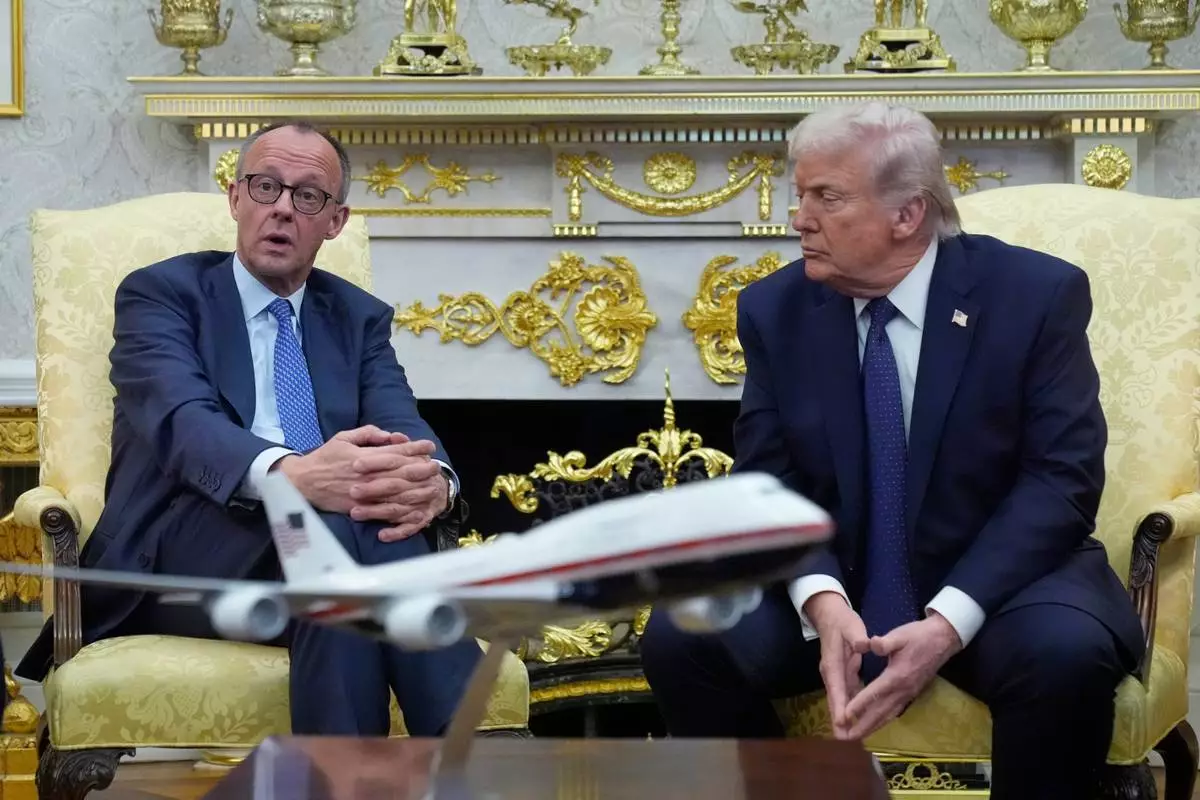
FILE - President Donald Trump meets with German Chancellor Friedrich Merz in the Oval Office at the White House, March 3, 2026, in Washington. (AP Photo/Mark Schiefelbein, File)
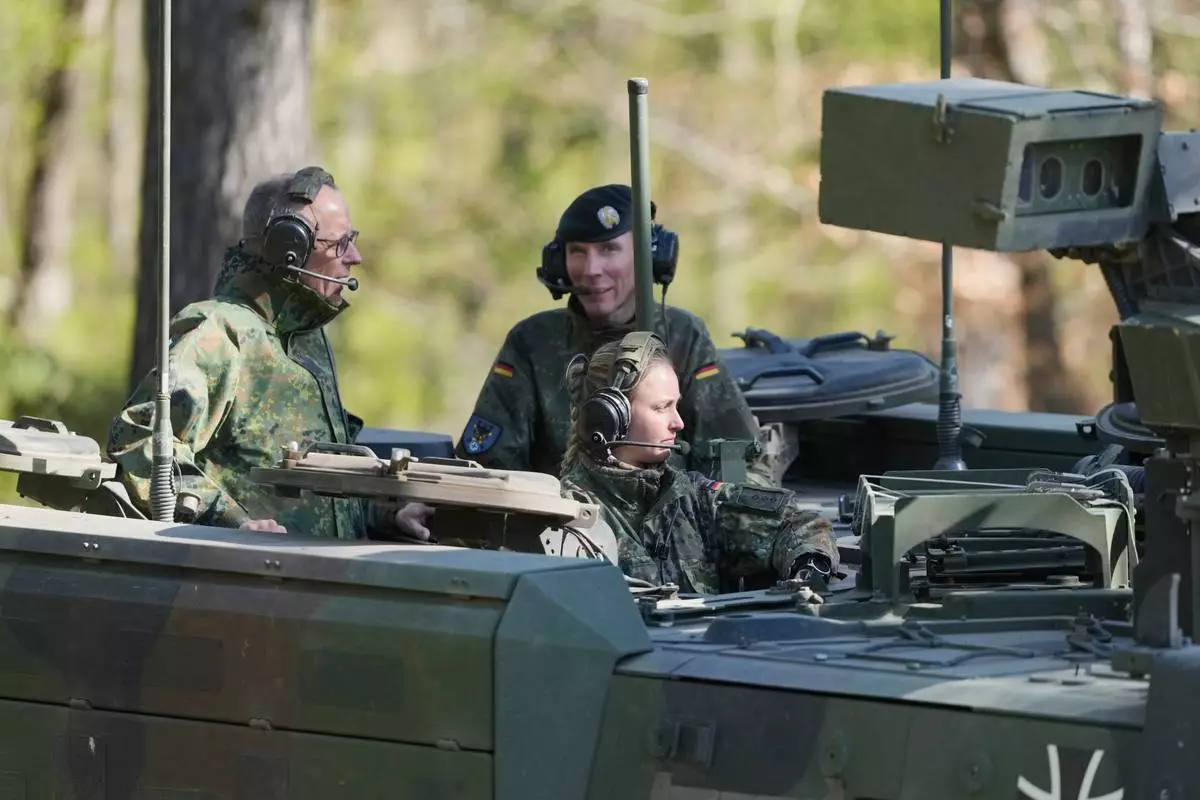
German Chancellor Friedrich Merz, left, drives in the armoured fighting vehicle Boxer during his visit to the army at the Bundeswehr base in Munster, Germany, Thursday, April, 30, 2026. (AP Photo/Markus Schreiber, Pool)
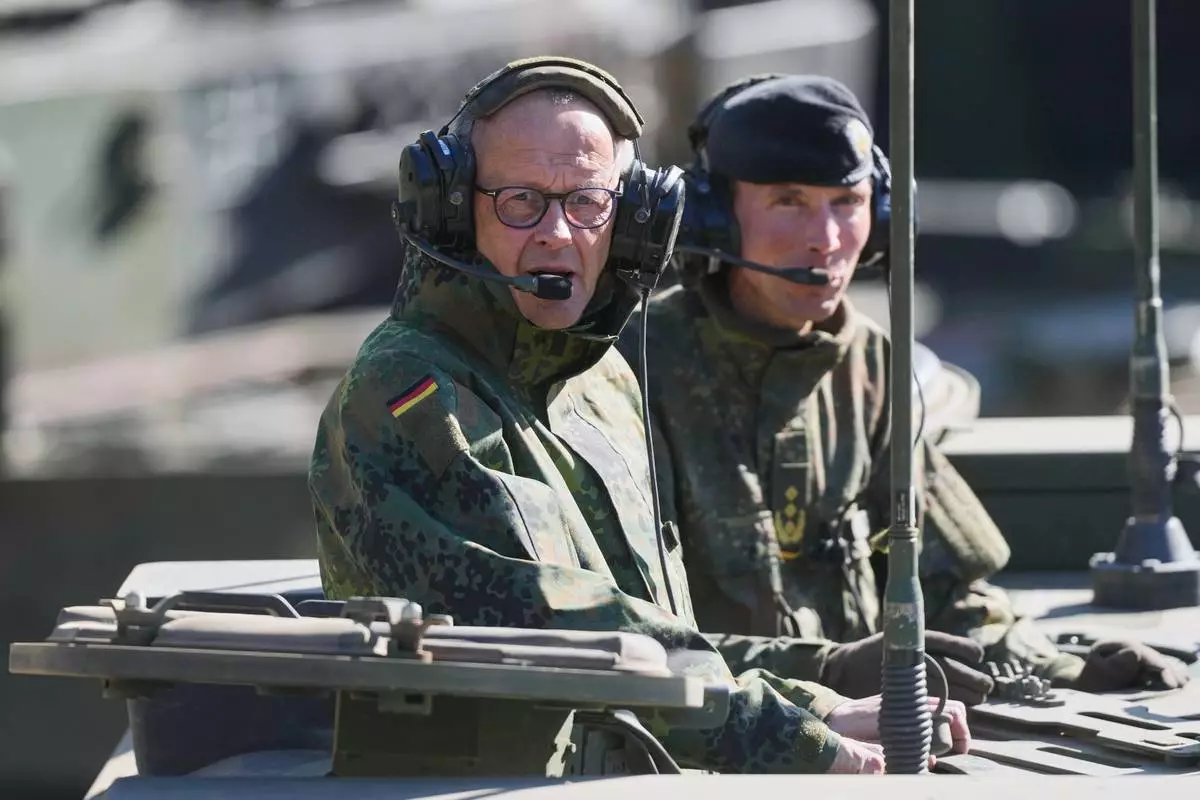
German Chancellor Friedrich Merz drives in the armoured fighting vehicle Boxer during his visit to the army at the Bundeswehr base in Munster, Germany, Thursday, April, 30, 2026. (AP Photo/Markus Schreiber, Pool)