A group of young technicians who have undergone extensive vocational training are helping power China's smart manufacturing future as the country's pursuit of high-quality development opens up broad new opportunities for the up-and-coming generation to excel.
In east China's Anhui, a province which is emerging as a key sci-tech hub and home to a rapidly growing new energy vehicle industry cluster, 25-year-old Liu Pengshuai is among the new crop of engineers who are playing their part in this high-tech revolution.
As a former graduate of a vocational school in the city of Wuhu, Liu is now turning his passion into a promising career as an electrical commissioning engineer, working with advanced equipment in the automation field.
Liu said his work usually starts with an offline programming phase based on the required design plan, followed by running simulations, and finally making on-site adjustments to the program — so the production line runs smoothly.
He says the moment he first saw a robotic arm respond to his line of coding changed the course of his life forever.
"Seeing the first robot I worked on start moving, then three, four, five and eventually more than a dozen robots moving together — it was incredible. I felt a huge sense of achievement, because I was part of it," Liu said.
China's rapid shift toward automation in manufacturing has made talents like Liu highly sought-after in the job market.
But as confident and professional as he is today, Liu's journey was not all plain sailing. At the age of 16, he entered the Wuhu Technician Institute, a vocational school in Anhui, a path often taken by students who struggled with conventional academic studies.
The vocational education Liu received there changed his trajectory, transforming him from a lost teenager into a skilled engineer.
In recent years, vocational education in China has been adapting to the needs of emerging industries. As a result, students gain skills that match evolving market demand and are then better prepared for the job market.
For instance, students in the robotics major at the Wuhu Technician Institute train on tasks that mirror real factory operations, making them well equipped to enter the world of work.
"My hope after graduation is to find a job that is relevant to what I am currently studying," said student He Xicheng, who said he would keep working hard to meet his goal of entering the intelligent manufacturing sector.
Each year, vocational schools across China send millions of graduates into the workforce, providing a steady pipeline of skilled talent for modern industries. At the same time, the country's complete industrial system is also creating vast opportunities for them.
In Anhui, a full automobile industry cluster has taken shape that includes seven vehicle manufacturers and over 3,000 auto parts companies, which saw the province become a national leader in both total vehicle output and new energy vehicle production in 2025.
Such a strong industrial base provides a solid foundation for talent development, with many firms offering short-term placements to youngsters.
"Notably, we collaborate with a robotics company called Efort. Each semester, we arrange for students to spend two to four weeks there, working on projects and learning how things are actually done in factories," said Yang Jinguo, a teacher from the Wuhu Technician Institute.
Efort Intelligent Equipment is part of Anhui's growing automobile industry, with its industrial robots widely used on production lines for various car brands. As their business expands, demand for skilled technical workers continues to rise.
"Vocational schools focus more on students' hands-on skills, like how to operate robots, how to apply their skills, and take on roles such as maintenance. After graduation, students can directly enter our factories for internships to to apply what they've learned," said Yang Yimin, director of training center of Efort Intelligent Equipment.
Across China, millions of young people are walking the same path. The country now has over 220 million skilled workers, including more than 70 million highly skilled professionals that support industrial upgrading and innovation.
Through their skills and hard work, they are becoming an essential part of the country's manufacturing future while building their own sense of worth and purpose.
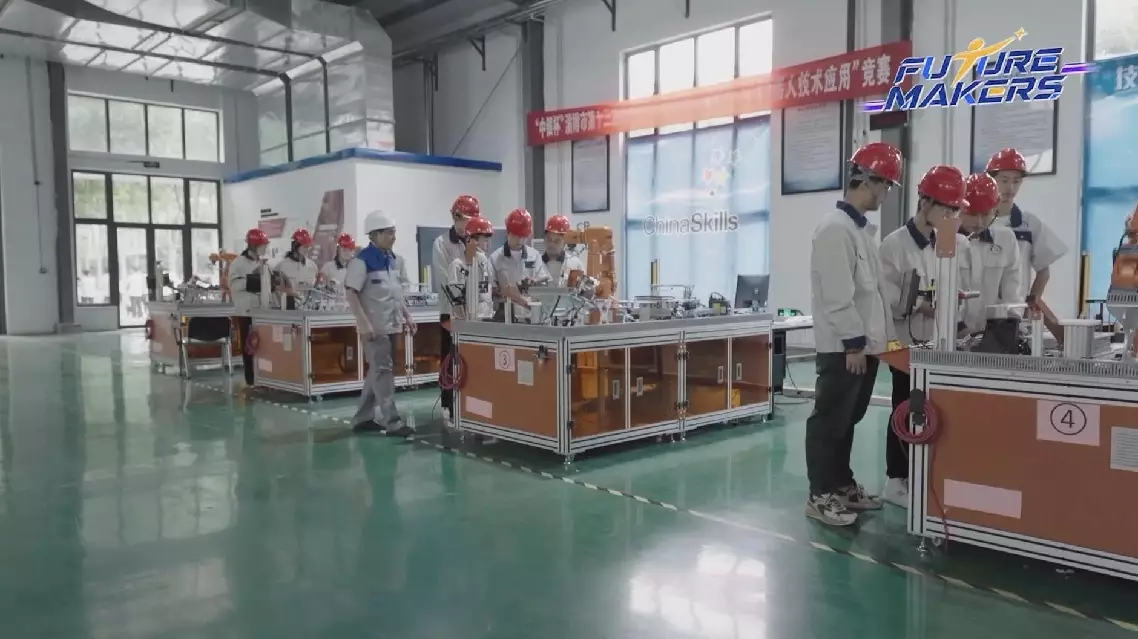
Young Chinese technicians learn key skills to power future of smart manufacturing sector