The Reporters Sans Frontieres’ (RSF) –Reporters Without Borders – low press freedom ranking for Hong Kong comes not from hard evidence but from revenge for barring one of its French reporters entering the city last year.
In November last, France Television journalist Antoine Vedeilhe was detained and deported when he tried to enter the city to produce a TV documentary on “how and why its freedoms have been curtailed,” according to his statement on RSF’s webpage. RSF highlighted the fact he was the 13th journalist to have been targeted by the territory’s authorities since the National Security Law was enacted in 2020. It did fail to note that many more were denied entry before then, implying that the vetting of journalists started only after the laws were implemented.
Each year so-called journalists are barred from entering countries, not only in Hong Kong but in the US, UK and elsewhere because they are either known activists, drug addicts, criminals or general undesirables. It is akin to allowing an undesirable person to enter your front door knowing he is going to harm you. The RSF statement said it condemns Hong Kong’s policy of weaponizing visas, a tactic long used by the Chinese regime to restrict access for foreign reporters. This “tactic” is used by every country, not only the Chinese regime, to restrict undesirables to enter a country.
Obviously, he planned mischief, which would not be allowed in any country, let alone Hong Kong. The reasons for his visit to Hong Kong were published well before the actual visit as if it was an invitation for the authorities to arrest him to fit into the script. The documentary is due for release this month.
On Thursday, RSF published its annual rankings of press freedoms, ranking Hong Kong 140 out of 180, citing as its main example the conviction and jailing of publisher Jimmy Lai, who was handed a 20-year sentence last year for treason related charges. Norway topped the list, as it did in previous years.
The Hong Kong government was quick to “strongly condemn the attempts by an anti-China organisation and foreign media to sugarcoat the criminal acts of national security offender Lai Chee-ying and to slander, smear, as well as attack the HKSAR by releasing a so-called press freedom index and presenting a so-called "award". Such despicable behaviours totally disregarded the rule of law and twisted the facts, which must be strongly condemned.”
If Jimmy Lai had committed his offences in any other country, be it the US, Australia or the UK, he would have been jailed with world-wide acclamation. But because it is Hong Kong/China and a multi-million-dollar public relations campaign carried out by his family with the help of international lawyers, he is viewed by the western media as a martyr for press freedom.
The courts proved, beyond reasonable doubt that he was guilty as charged after a 156-day trial with 2,220 pieces of evidence, 80,000 pages of documents and more than 1,000 pages of written submissions. Lai himself was given 52 days to plead his case. Nothing can be fairer than that.
In some countries, the RSF report noted, the information space has shrunk over the past 25 years due to political changes and increasingly draconian regimes, citing the case in Hong Kong which dropped 122 points “since Beijing tightened its control on the territory.” There has been no tightening controls by Beijing. The “controls” imposed by the national leadership have been to safeguard Hong Kong from the threats and attacks by foreign forces, namely the US, which is hell-bent on destroying Hong Kong to undermine the power of China.
It noted the closing down of Apple Daily (Jimmy Lai’s publication) and Stand News during the sedition investigations but failed to recognize that Hong Kong has 87 daily newspapers and 320 periodicals thriving very well. There are also about 50 foreign media organizations based in Hong Kong which report daily on local affairs.
But there is also a much more sinister aspect of RSF that merits recognition. It is partially sponsored by the US State Department’s National Endowment for Democracy (NED), which was deeply involved in the civil unrest of 2014-2020 by funding groups and organizations to raise against the Hong Kong administration. The US’s current Consul General in Hong Kong Julie Eadeh was photographed at the time conferring with the ring leaders.
With that background, RSF could hardly be an independent and trustworthy source to rank the “freedoms” of the media anywhere. The media in Hong Kong is alive and well and reporting daily events without fear or favor within the international constraints of the law.
Mark Pinkstone
** 博客文章文責自負,不代表本公司立場 **
As towers of glass, steel and concrete start forming the skyline of the Northern Metropolis, a swath of green the length of the development is being maintained to protect the wildlife inhabiting the area for more than a century.
The Northern Metropolis (NM) development is a futuristic university city, occupying one third of Hong Kong’s land mass along Shenzhen River boundary with the mainland. Catering for a new population of 2.5 million and offering 65, 000 jobs with additional transport links, the project is expected to reach it potential in 2036.
In addition to the residential development, the plan includes an extension of the existing logistics hub in the Hung Shui Kiu and Ha Tsuen areas. And two eco-tourism nodes will be established in the coastal areas of Tsim Bei Tsui and Pak Nai, featuring resorts, weekend markets, and camping sites. Authorities have expressed their intention to create a coastal protection park along the 10.7-km coastline.
However, it is being built on what was previously fish farms, agricultural land, marshes and mangroves – wetlands, a natural habitat for wildlife and an important foraging ground and habitat for migratory water birds.
The plan was launched as a proactive conservation policy in the Chief Executive’s annual policy address in 2021 and has gone through various consultation exercises involving surveyors, conservationists, property holders and the public.
The wetland conservation system is estimated to have a total area of about 2 000 hectares (ha). This includes the existing Hong Kong Wetland Park (HKWP) at Tin Shiu Wai (about 62 ha) plus an expansion of about 240 ha, the Mai Po Nature Reserve (about 370 ha), the proposed establishment of three Wetland Conservation Parks (WCPs) at Nam Sang Wai (about 400 ha), Sam Po Shue (about 520 ha) and Hoo Hok Wai (about 300 ha), as well as the establishment of Sha Ling/Nam Hang Nature Park (about 4 ha) and Tsim Bei Tsui/Lau Fau Shan/Pak Nai Coastal Protection Park (about 145 ha).
Indigenous to Hong Kong and southern China is the Eurasian Otter which has been documented in parts of the territory for more than a century with the earliest sighting records dating back to the 1890s. Today, the species is considered locally rare with a restricted distribution, occurring primarily around Mai Po Inner Deep Bay Ramsar Site, with occasional sightings in Lok Ma Chau, Hoo Hok Wai, and Hong Kong Wetland Park. (A Ramsar site is a wetland designated as being of international importance under the Ramsar Convention, a global treaty signed in 1971 in Ramsar, Iran, to protect and sustainably use wetlands).
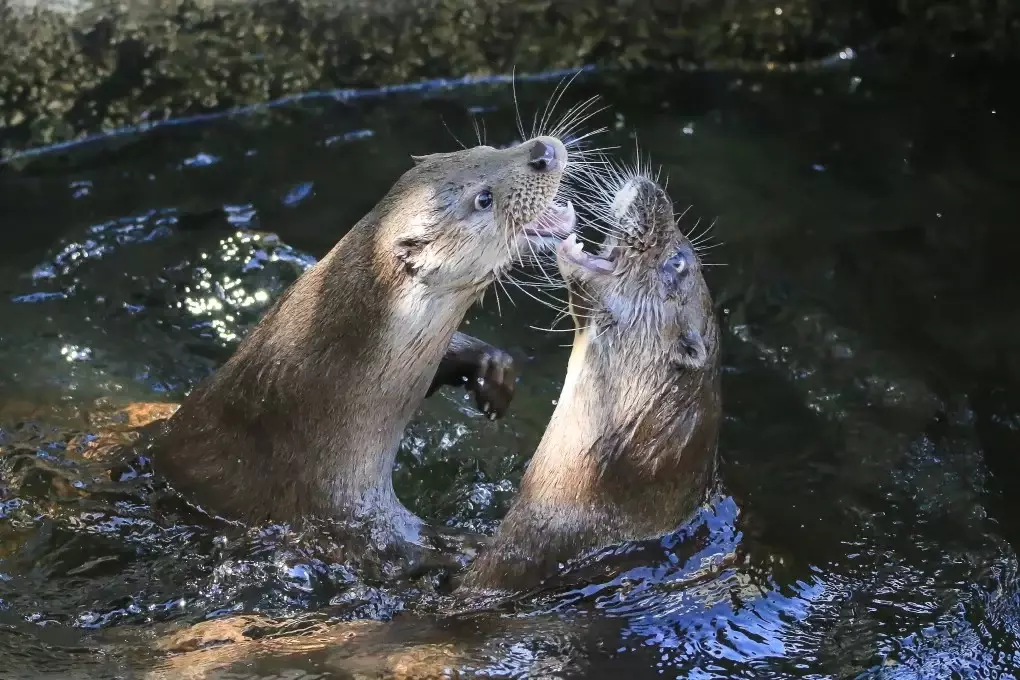
Otters in Hong Kong. (Source: South China Morning Post)
Access control measures are in place in areas with otter occurrence, such as Mai Po Nature Reserve, the non-visitation area of the Wetland Reserve at HKWP and ecological mitigation wetlands created under development projects, to protect the sensitive habitats and minimize potential disturbance to the wetlands and their associated animals. Separately, under the planned Sam Po Shue Wetland Conservation Park (SPS WCP), enhanced freshwater wetland habitats and ecological passage will be established to allow wildlife, particularly the otters, to travel between the SPS WCP and adjacent wetlands. Additionally, the river channels within the SPS WCP will be enhanced to provide habitats for the otters, with the incorporation of habitat enhancement features such as otter platforms, artificial holts (otter burrows) etc. at appropriate locations in the park.
Reports from the Adelaide Zoo in Australia indicate that otters are not shy (unless threatened) and in fact become more playful in the presence of humans.
Lau Fau Shan oysters were once favored in Hong Kong until the mid-70s when they were subjected to contamination from heavy metals fed into the Shenzhen River further upstream from battery making factories. The loss-making industry is now virtually dead save for about 10 per cent of its former glory being maintained by villagers with purified water systems.
Conservation groups believe the introduction of eco-tourism in the area would help the villagers bring survival back to the industry.
Now, under the NM development plan, a dedicated Coastal Protection Park (CPP) is being established along the Deep Bay coastline, covering Tsim Bei Tsui, Lau Fau Shan, and Pak Nai.
The CPP, spanning about 10 km and covering about 145 ha, aims to protect critical habitats for horseshoe crabs, mangroves, and seagrass beds.
Conservation groups, including The Nature Conservancy, are also actively advocating for Pak Nai, near Lau Fa Shan, to be designated as a formal Marine Protected Area (MPA) to safeguard its status as a biodiversity hotspot.
The government is to be applauded for taking the initiative of blending the eco system in an intense high-rise technical urban sprawl. The government has launched public engagement exercises and invited Expressions of Interest (EOI) for eco-tourism nodes in these areas. The goal is to transform conservation value into economic vitality through guided tours and educational facilities without compromising ecological integrity.