WASHINGTON (AP) — White House economists estimate that President Donald Trump’s deals with pharmaceutical companies to drop some of their U.S. prescription drug prices to what they charge in other countries could save $529 billion over the next 10 years.
The analysis obtained by The Associated Press includes the first economy-wide projections behind a policy at the core of Trump’s pitch to voters going into November’s midterm elections for control of the House and Senate. Democratic lawmakers have been doubtful about the savings claimed by Trump and these new numbers are likely to trigger additional questions about the data.
Cost-of-living issues are at the forefront of voters’ concerns and higher energy prices tied to the Iran war have deepened the public’s anxiety. Trump has tried in part to address affordability concerns by focusing on his efforts to cut deals with companies so that the cost of prescription drugs in the U.S. would no longer be dramatically higher than in other affluent nations.
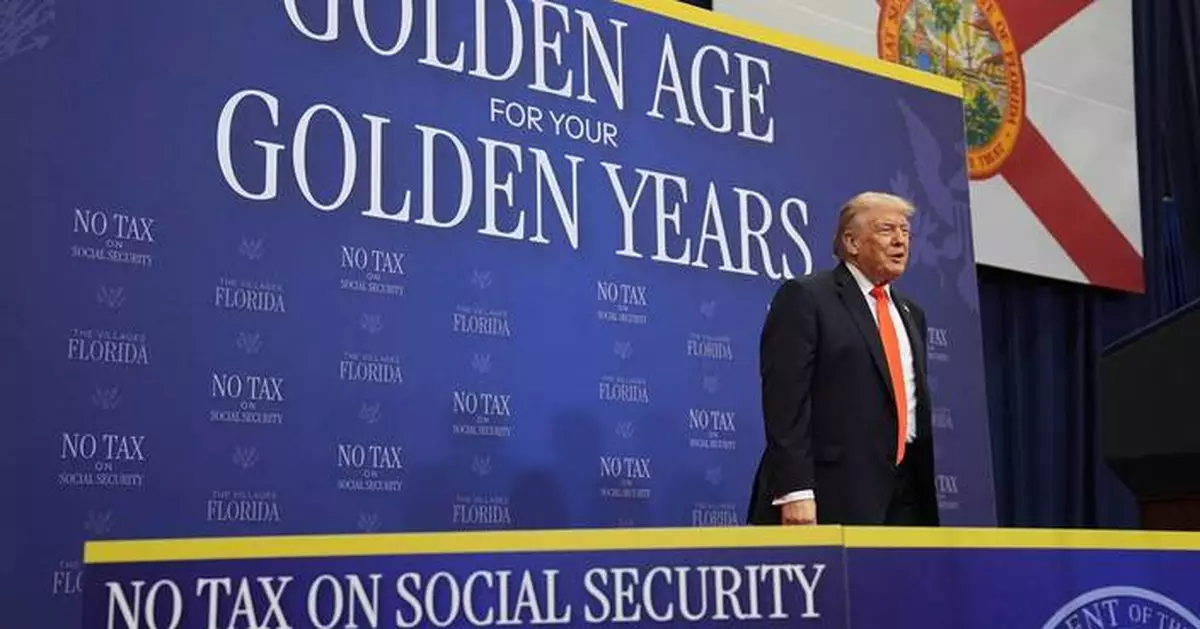
“Now you have the lowest drug prices anywhere in the world,” Trump said at a Friday rally before a crowd of seniors in Florida. “And that alone should win us the midterms.”
The analysis was done by administration officials for the White House Council of Economic Advisers. They also estimated that federal and state governments could save a combined $64.3 billion on Medicaid during the next decade because of what Trump calls his “most favored nation” policy on drug prices.
Few of the details of the deals struck by the Trump administration and 17 leading pharmaceutical companies have been made public, making it hard to independently verify the projected savings. The White House analysis sought to estimate the prospective savings as more medications come onto the market and fall under Trump’s framework — with one model in the report tallying the possible savings at $733 billion over a decade.
Trump and his Department of Health and Human Services have touted his drug-pricing deals as transformative and urged Congress to codify their principles into law. Democratic lawmakers have challenged the administration’s claims of savings. Senate Finance Committee Ranking Member Ron Wyden, D-Ore., and 17 Senate Democrats in April proposed a measure requiring the administration to disclose the terms of the agreements signed by pharmaceutical companies.
“If these deals are so great, why is the Trump administration afraid of showing them to the public?” Wyden said when announcing the measure. Health Secretary Robert F. Kennedy Jr. said his team would share details that didn’t include proprietary information or trade secrets.
The White House said it has not shared the text of the agreements because they include highly sensitive data that could move financial markets.
The potential savings estimated by the Trump administration would be substantial as Americans spent $467 billion on prescription drugs in 2024, according to the most recent government data available. The analysis is premised on the idea that foreign countries would also pay more for their prescription drugs, which would diversify drugmakers’ sources of revenue and preserve their ability to innovate with new treatments.
Outside economists have caveated that any savings might not flow directly to patients, many of whom already pay discounted prices for their drugs through their insurance coverage.
The Congressional Budget Office in October 2024 estimated that a plan similar to what Trump ended up adopting could reduce prescription drug prices by more than 5%, though the decrease “would probably diminish over time as manufacturers adjusted to the new policy by altering prices or distribution of drugs in other countries.”
The scope of the savings claimed by the Trump administration are likely to intensify the scrutiny by Democrats, who counter that any price reductions would be offset by higher costs for prescription drugs not covered by the “most favored nation” framework. One of their main critiques is that pharmaceutical companies have increased their profit margins while working with the administration.
In April, staff working for Sen. Bernie Sanders, I-Vt., released an analysis that looked at 15 of the companies that have agreed to this drug-pricing plan and found that their combined profits jumped 66% over the past year to $177 billion. The report noted that the tax cuts Trump signed into law last year “exempted or delayed many of the most expensive drugs” from price negotiations with Medicare.
The Trump administration has countered that they consider Sanders’ critique to be flawed, saying that it’s based on the list prices for pharmaceutical drugs instead of the actual price that patients pay.
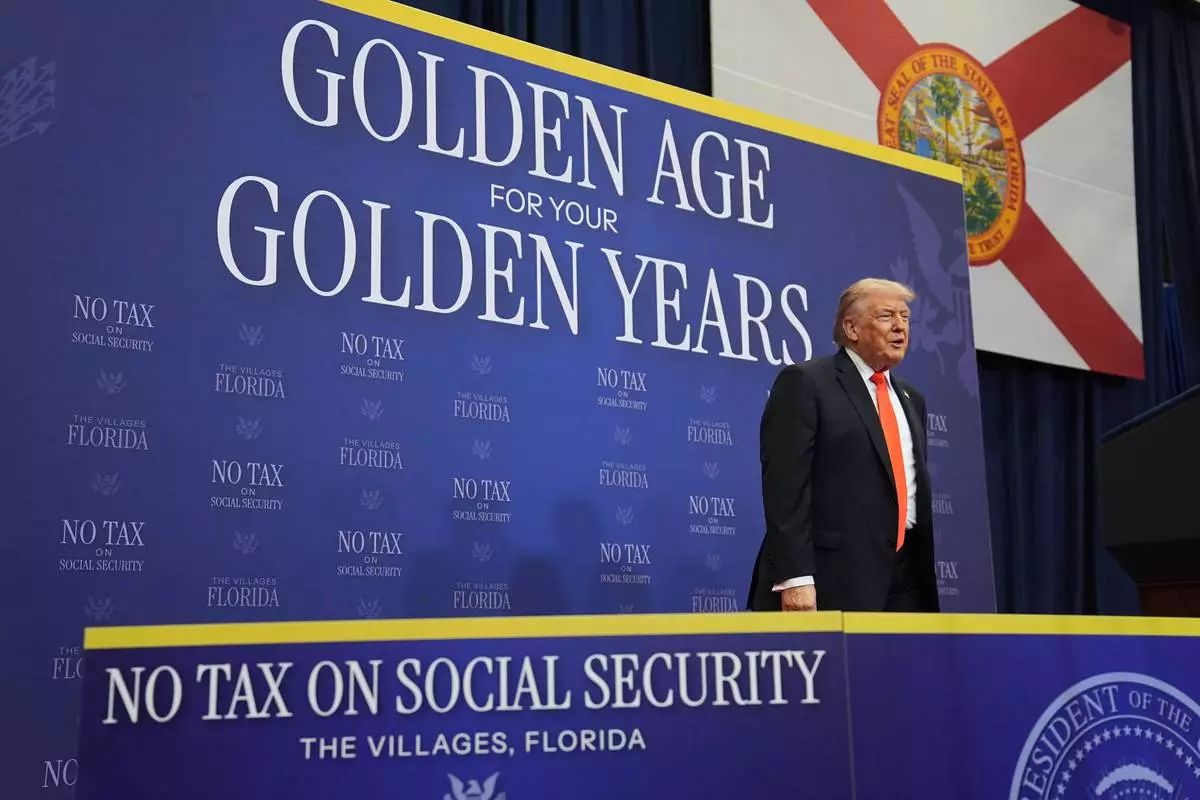
President Donald Trump arrives to speak at a charter school in The Villages, Fla., Friday, May 1, 2026. (AP Photo/Matt Rourke)
DUBAI, United Arab Emirates (AP) — U.S. military leaders said Tuesday that a ceasefire with Iran remains in effect a day after Tehran was blamed for new attacks in the Strait of Hormuz and against the United Arab Emirates.
The fragile truce, reached nearly a month ago, appeared to be holding as U.S. forces pressed ahead with efforts to reopen the vital waterway for global energy. On Monday, the U.S. said it sank six small Iranian boats that had threatened commercial ships.
So far, only two merchant ships are known to have passed through a new U.S.-guarded route, with hundreds more bottled up in the Persian Gulf. It's unclear whether continued U.S. military action will reassure shippers without reigniting the conflict that began with U.S. and Israeli strikes on Iran on Feb. 28.
The UAE, a key American ally, said it came under attack by Iranian missiles and drones for a second straight day on Tuesday. At least three people were wounded in attacks the day before, and a drone sparked a fire at a key oil facility in the eastern emirate of Fujairah.
Iran’s effective closure of the strait, through which major oil and gas supplies passed before the war, along with fertilizer and other petroleum-derived products, has sent fuel prices skyrocketing and rattled the global economy. Breaking Iran's grip would deny its main source of leverage as U.S. President Donald Trump demands a major rollback of its disputed nuclear program.
U.S. Defense Secretary Pete Hegseth and Gen. Dan Caine, the U.S. military’s top officer, told a news conference Tuesday that Iran’s renewed aggression hadn’t reached the threshold of what Caine called “major combat operations.” He said Tuesday marked a “quieter” day in the strait.
“No, the ceasefire is not over,” Hegseth said, affirming Caine’s assessment. They spoke before the latest attacks on the UAE.
Iran has said the new effort does violate the ceasefire. Iran’s parliament speaker and chief negotiator, Mohammad Bagher Qalibaf, accused the U.S. of undermining regional security. In a post on X, he signaled that Iran has yet to fully respond to the U.S. attempt to reopen the waterway.
“We know full well that the continuation of the status quo is intolerable for America; while we have not even begun yet,” he said. His statement did not mention negotiations with the U.S. that are now in the form of passing messages via Pakistan.
Disputing Washington’s claim of sinking six boats, an Iranian military commander said two small civilian cargo boats were hit on Monday, killing five civilians, Iran’s state TV reported.
Caine, the top U.S. general who serves as chairman of the Joint Chiefs of Staff, said more than 100 U.S. military aircraft are patrolling skies around the strait.
“Since the ceasefire was announced, Iran has fired at commercial vessels nine times and seized two container ships, and they’ve attacked U.S. forces more than 10 times – all below the threshold of restarting major combat operations at this point,” Caine said.
The administration has cited the April 8 ceasefire in asserting that the president does not have to give a formal update to Congress on the war under the War Powers Resolution. That law typically requires presidents to seek formal approval from Congress for war activities 60 days after beginning military action.
So far, just two civilian vessels, both U.S.-flagged merchant ships, are known to have passed through the strait as part of the lane the U.S. says it has created.
“At this point in time our risk assessment remains unchanged,” Hamburg, Germany-based shipping company Hapag-Lloyd AG said in a statement. “Transits through the Strait of Hormuz are for the moment not possible for our ships.”
Ship tracking data showed a Panamanian-flagged crude oil tanker heading toward the center of the strait Tuesday after leaving an anchorage in the Persian Gulf, though it was unclear if it would try to pass through. The tanker had a stated destination of Singapore, according to the MarineTraffic ship tracking site.
Iran has attacked ships that try to transit without going through its own route in the northern part of the narrow strait near the Iranian coastline. That involves going through vetting by Iran's Revolutionary Guard and payment in some cases.
The U.S.-approved “Project Freedom” route goes through territorial waters of Oman to the south.
“For shipping companies and for insurance companies, they still have to wait and see how this plays out,” said Torbjorn Soltvedt, principal Middle East analyst at risk intelligence company Verisk Maplecroft.
“This initiative alone isn’t something that looks like it’s going to open the Strait of Hormuz,” he said.
The United Arab Emirates said its air defenses had engaged 15 missiles and four drones fired by Iran. Authorities in the eastern emirate of Fujairah said one drone sparked a fire at a key oil facility, wounding three Indian nationals. The British military reported two cargo vessels ablaze off the UAE, also on Monday.
On Tuesday, the UAE's Defense Ministry said air defenses were responding to another Iranian drone and missile attack.
Indian Prime Minister Narendra Modi on Tuesday condemned the attacks, calling the targeting of civilians and infrastructure “unacceptable.” On X, Modi said India stands in “firm solidarity” with the UAE, and stressed the need for safe and uninterrupted shipping through the Strait of Hormuz.
Tehran did not confirm or deny the attacks but Iran’s Foreign Minister Abbas Araghchi early Tuesday said on X that both the U.S. and the UAE “should be wary of being dragged back into quagmire.”
Pakistan and Saudi Arabia condemned the strikes against the UAE. The Saudi condemnation came despite increasingly strained relations with the UAE.
The disruption of the waterway has squeezed countries in Europe and Asia that depend on Persian Gulf oil and gas, raising prices far beyond the region.
The U.S. meanwhile has enforced a naval blockade on Iranian ports since April 13, telling at least 49 commercial ships to turn back, according to its Central Command. It also has warned shipping companies they could face sanctions if they pay Iran for transit of the strait.
The blockade has deprived Tehran of oil revenue it needs to shore up its ailing economy. U.S. officials have expressed hope the blockade will force Iran to make concessions in talks on its nuclear program and other longstanding issues.
Finley reported from Washington and Becatoros reported from Athens, Greece. Sally Abou AlJoud in Beirut, Lebanon; Sheikh Saaliq in New Delhi; Meg Kinnard in Columbia, South Carolina; Bill Barrow in Atlanta; and Russ Bynum in Savannah, Georgia, contributed to this report.
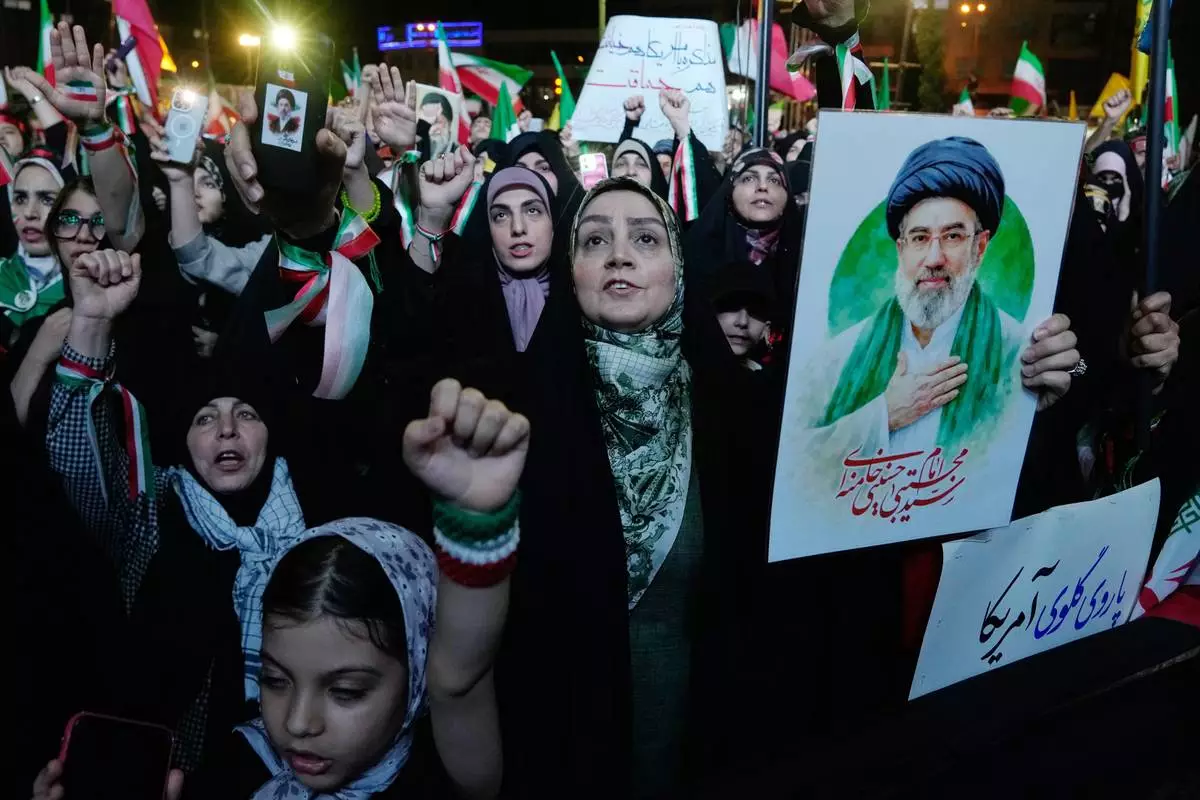
Pro-government demonstrators chant slogans as one of them holds a poster of the Iranian Supreme Leader Ayatollah Mojtaba Khamenei during their gathering at Enqelab-e-Eslami, or Islamic Revolution, square in Tehran, Iran, Monday, May 4, 2026. (AP Photo/Vahid Salemi)
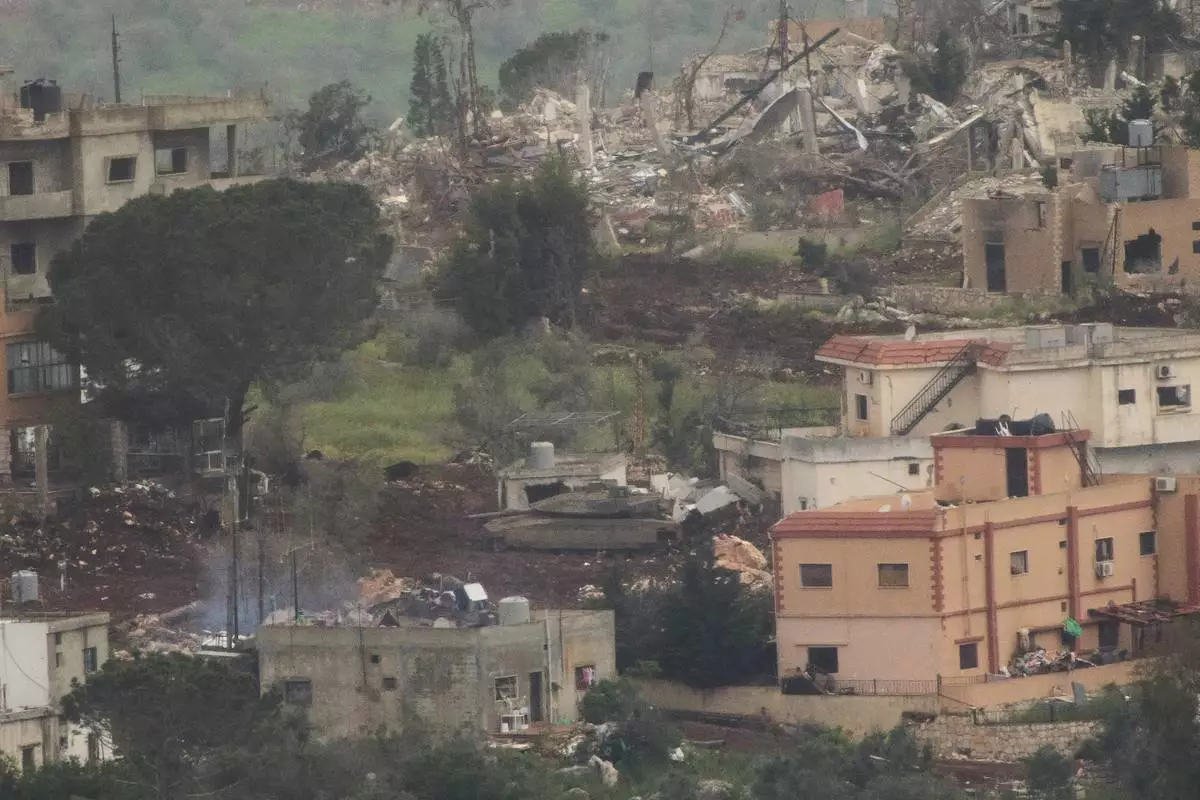
Israeli soldiers drive a tank inside a village in southern Lebanon, as seen from northern Israel, Tuesday, May 5, 2026. (AP Photo/Ariel Schalit)
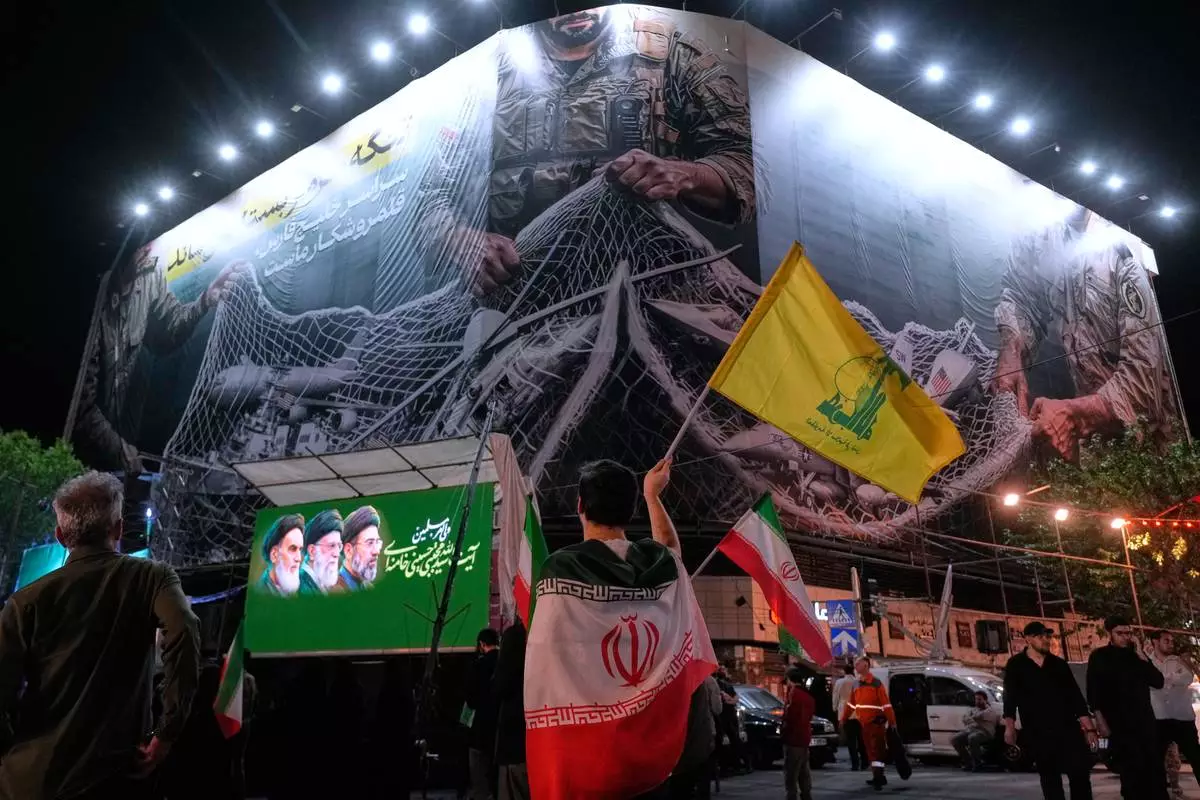
An Iranian demonstrator waves a flag of Lebanon's militant Hezbollah group under an anti-U.S. billboard depicting the American aircrafts into the Iranian armed forces fishing net with signs that read in Farsi: "The Strait of Hormuz will remain closed, The entire Persian Gulf is our hunting ground," during a pro-government gathering at Enqelab-e-Eslami, or Islamic Revolution, square in Tehran, Iran, Monday, May 4, 2026. (AP Photo/Vahid Salemi)
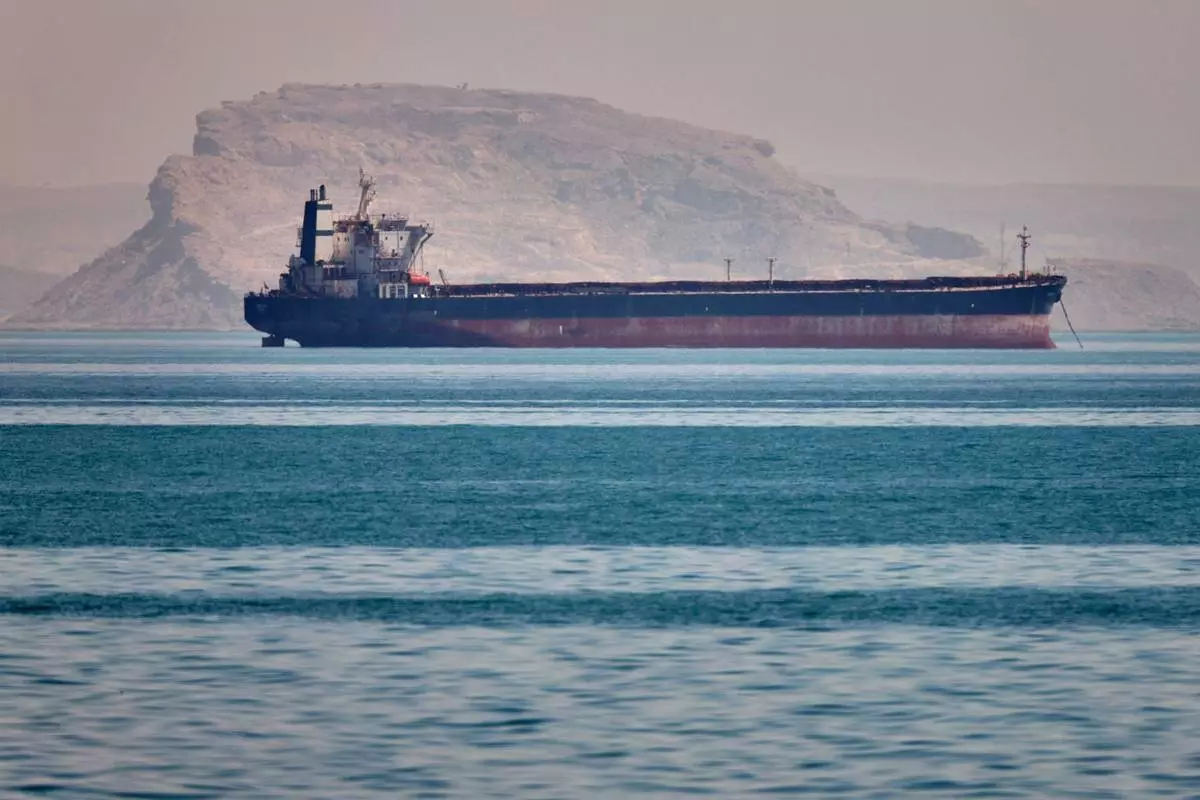
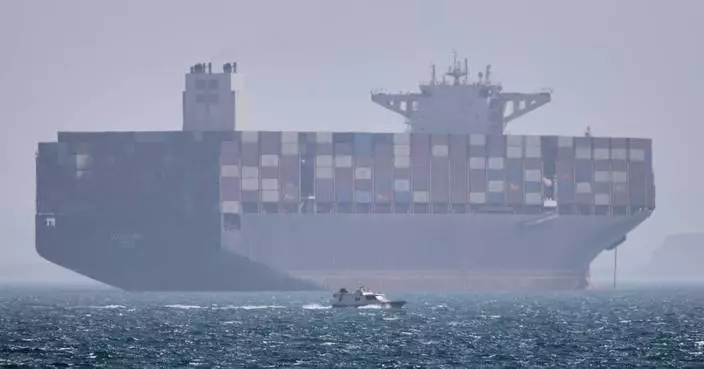
A bulk cargo ship sits at anchor in the Strait of Hormuz off Bandar Abbas, Iran, Saturday, May 2, 2026.(Amirhosein Khorgooi/ISNA via AP)