WASHINGTON (AP) — Global warming extinctions usually have people picturing the last polar bears or other furry critters disappearing, but the crucial and oft-overlooked world of plants is going to be decimated by climate change. Scientists predict tens of thousands of plant species will disappear by the end of the century.
Between warmer temperatures and shifts in rain and snow patterns, between 7% and 16% of the world's plant species are likely to lose at least 90% of their habitat and go essentially extinct in about 55 to 75 years, according to a study in Thursday's journal Science.
That equates to roughly 35,000 to 50,000 plant species based on moderate carbon pollution scenarios, and much more if the world's pollution soars, said study co-author Xiaoli Dong, a University of California Davis ecologist.
“The warming rate drives the extinction,” Dong said.
Dong and her colleagues used numerous biology and climate computer models to examine the potential futures of 18% of the world's plant species in detail, seeking to get a good handle on what's in store for all of them.
Scientists have figured that plant species could gradually shift to cooler climates as the world warms, borne by wind, water and animals toward the poles or higher altitudes. Scientists have observed this process and even relocated plants to conserve them. But Dong's millions of computer simulations show that even if these species move as fast as possible “it's not going to reduce the extinction rate.”
“It is not because they are not moving fast enough,” Dong said — it’s because the habitats they depend on will no longer exist.
Climate change, whether by temperature or changes in rainfall, will make areas where plants used to grow no longer livable for some species, she said.
Consider the tulip, Dong said: It prefers a certain soil, temperature and rain level. Climate change has disrupted this combination: The right temperature pushed north, the proper rain pattern moved east and the perfect soil stayed put. “The perfect condition required by this tulip has become like really small,” Dong said.
This scenario is getting especially bad in the Arctic, the Mediterranean and Australia, the study found. In the Arctic it's because the temperature is warming four times faster than the rest of the globe and in Australia it's driven more by rainfall changes, Dong said.
While Dong’s study looks at future extinction risk, a second study published Thursday in the same journal looked at the current extinction risk of flowering plants, a group with more than 335,000 species, more than most varieties of flora and fauna.
Scientists at Kew Gardens in the United Kingdom found that nearly 10,000 flowering plant species are currently in danger of blinking out, and are so evolutionarily old and unusual that if they go, 21% of Earth’s “tree of life” would disappear with them. They include odd species such as titan arum, the world’s smelliest plant, and ones humans find useful, such as the orchid that provides vanilla, researchers said.
Evolutionary plant biologist and study lead author Felix Forest applied a 20-year system British biologists developed to prioritize species conservation by saving species that are most unique. The study doesn't look at what's causing the extinction risk, just what would be lost in terms of biological history and distinctiveness.
In the biggest species prioritization study scientists have undertaken, Forest found that there's more evolutionary history at risk in unusual flowering plants than almost any other groups of flora or fauna, except turtles and tortoises.
Some other species, like different types of rats, have close relatives and a bushy branch, so if one blinks out, others remain to share its evolutionary history. But flowering plants include trees like the Ginkgo biloba, which has no similar species and presents hundreds of millions of years of evolution.
The trouble is that extinction in plants is often overlooked, even by official organizations, when compared with animals, Forest and Dong said.
“We're trying to redress that imbalance between plants and animals, especially vertebrates,” Forest said. “Humans are generally more interested in fluffy furry things and things with two wings than plants. And that's just the way things are.”
The two studies together show that the world cannot wait to take action to save endangered plant species, wrote Chilean biologists Rosa Scherson and Federico Luebert, who weren't part of the studies.
When the future of plants is unstable, “it can also affect human food security and access to basic materials,” Scherson and Luebert wrote in a review of the two studies. “Maintaining the current conditions that support human life requires urgent action.”
—-
The Associated Press’ climate and environmental coverage receives financial support from multiple private foundations. AP is solely responsible for all content. Find AP’s standards for working with philanthropies, a list of supporters and funded coverage areas at AP.org.

FILE - Tulips stand at the Wooden Shoe Tulip Farm in Woodburn, Ore., April 11, 2026. (AP Photo/Jenny Kane, File)
NASHVILLE, Tenn. (AP) — Amid raucous protests Thursday, Republicans in Tennessee enacted a new U.S. House map that carves up a majority-Black district in Memphis, reshaping it to the GOP’s advantage as part of President Donald Trump’s strategy to hold on to a slim majority in the November midterm elections.
The final Senate vote unfolded as demonstrators chanted loudly in the galleries and hallways. Democratic state Sen. Charlane Oliver stood on her desk in the Senate chamber, holding a banner denouncing the redistricting as a “Jim Crow” effort, then clapping and dancing. Other Democratic senators linked arms in the front of the chamber. Republican leadership quickly adjourned the special session, sending the new map on to Republican Gov. Bill Lee, who promptly signed it into law.
Protesters in the galleries also had disrupted the Republican-led House as it voted for the new map — yelling, chanting and blowing air horns. In the hallways, other shouting protesters were held back by Tennessee state troopers.
Tennessee is the first state to pass new congressional districts since a U.S. Supreme Court ruling last week significantly weakened federal Voting Rights Act protections for minorities. But more Southern states could follow. Republicans in Louisiana, Alabama and South Carolina also have taken steps toward redistricting. More legal challenges are expected.
The Supreme Court ruled that Louisiana relied too heavily on race when creating a second Black-majority House district as it attempted to comply with federal law. The high court’s decision altered a decades-old understanding of the law, giving Republicans grounds to try to eliminate majority-Black districts that have elected Democrats.
Louisiana has postponed its congressional primary to give state lawmakers time to craft a new House map. Legislation awaiting a final vote in Alabama also would upend the state’s congressional primaries if courts allow the state to change its U.S. House districts. In South Carolina, meanwhile, Republican state House members released a proposed new congressional map designed to give them a clean sweep of the seats.
The states are the latest to join an already fierce national redistricting battle. Since Trump prodded Texas to redraw its U.S. House districts last year, eight states have adopted new congressional districts. From that, Republicans think they could gain as many as 13 seats while Democrats think they could gain up to 10. But some competitive races mean the parties may not get everything they sought in the November elections.
As a first step to adopting new House districts, Tennessee lawmakers gave final approval Thursday to legislation — quickly signed into law by Lee — that repealed a state law prohibiting mid-decade redistricting. They then passed a bill that would reopen candidate qualifying until May 15 to allow time for new people to enter the U.S. House primaries and existing candidates to switch districts or drop out.
The new House map would break up Tennessee’s lone Democratic-held district, centered on the majority-Black city of Memphis, creating a ripple effect of alterations to districts throughout the western and central parts of the state. The geographically compact 9th District that includes Memphis — currently represented by Steve Cohen, who is white — would stretch a couple hundred miles eastward before reaching north toward the Nashville suburbs.
Unlike in Louisiana — where lawmakers had crafted a second majority-Black district to try to comply with the federal Voting Rights Act — Memphis has long been the base of its own congressional district.
Republican House Speaker Cameron Sexton said the new districts were drawn based on population and politics, not racial data.
But Democrats dismissed such assertions.
“These maps are racist tools of white supremacy at the behest of the most powerful white supremacist in the United States of America, Donald J. Trump,” said state Rep. Justin Pearson, a Black Democrat from Memphis who is running for the U.S. House.
Republican state Sen. John Stevens defended the new districts he sponsored by noting that Democrats in Illinois, Massachusetts and other states also had drawn congressional districts to their advantage.
“This bill represents Tennessee’s attempt to maximize our partisan advantage,” he said.
It does so at the expense of both Memphis residents and democracy, said Sen. London Lamar, a Democrat from Memphis.
“You cannot take a majority Black city, fracture its voting power and then tell us race has nothing to do with it,” she said.
Democrats noted that the state Supreme Court in April 2022 rejected a challenge to the current congressional map, finding it was too close to the election to make changes. This year, there’s even less time before the Aug. 6 primary, raising the potential of confusion for both candidates and voters, Democrats said.
Audience members watching an Alabama legislative committee Thursday erupted in shouts of “shame” after Republican lawmakers advanced legislation to authorize special primaries if the state can put a new congressional map in place for the November midterms.
Alabama has asked federal judges to lift an order requiring the state to have a second district where Black voters are the majority or close to it. That district gave rise to the election of Rep. Shomari Figures, a Black Democrat, in 2024.
Republicans instead want to put in place a map lawmakers drew in 2023 — which was rejected by a federal court — that could allow them to reclaim Figures’ district. Black residents currently make up about 48% of the district’s voting-age population. That would drop to about 39% under the 2023 map. Republicans hope the federal courts will see the case differently in the wake of the Supreme Court’s Louisiana decision.
If a court grants Alabama’s request, the legislation under consideration would ignore the May 19 primary results for congressional seats and direct the governor to schedule a new primary under the revised districts. The House passed the legislation on a party-line vote Wednesday. A final Senate vote is expected Friday.
Addressing a Senate committee on Thursday, Figures said his concern isn’t for himself but for the people who fought for decades “to have a voice in what government looks like.”
A proposed new U.S. House map was distributed Thursday on the South Carolina House floor, where members huddled around desks to review it.
The proposal would take Democratic U.S. Rep. Jim Clyburn out of the 6th District he has represented since 1992. His district currently is made up of nearly 50% Black voters and provided a greater than 60% vote for Democrat Kamala Harris in 2024 presidential election. The proposal would split it into four different districts.
The proposed map also would split the Democratic stronghold of Columbia and its redder suburbs into four different districts.
The South Carolina House on Wednesday approved a resolution giving lawmakers permission to return after the May 14 end of the regular work to continue consideration of a redistricting plan. But that also would require a two-thirds vote of the Senate.
The state’s primary elections are June 9.
Chandler reported from Montgomery, Alabama; Collins from Columbia, South Carolina; and Lieb from Jefferson City, Missouri. Associated Press reporter Kristin M. Hall contributed.

A woman protests outside the House chamber before a special session of the state legislature to redraw U.S. Congressional voting maps Thursday, May 7, 2026, in Nashville, Tenn. (AP Photo/George Walker IV)

Rep. Caleb Hemmer, D-Nashville, and Rep. Sam McKenzie, D-Knoxville, walk to the House chamber arm in arm for a special session of the state legislature to redraw U.S. Congressional voting maps Thursday, May 7, 2026, in Nashville, Tenn. (AP Photo/George Walker IV)
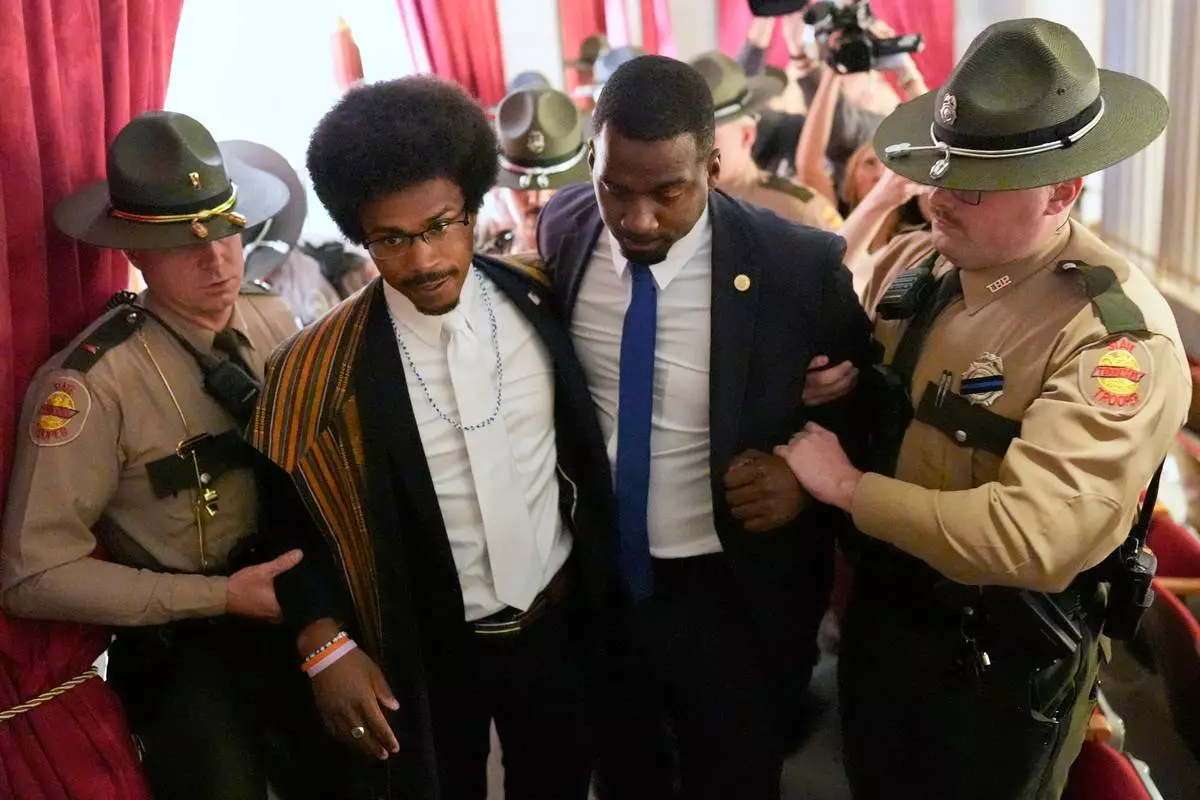
Rep. Justin J. Pearson, D-Memphis, second from left, walks with his brother KeShaun Pearson, as he is arrested and removed from the House gallery during a special session of the state legislature to redraw U.S. Congressional voting maps Thursday, May 7, 2026, in Nashville, Tenn. (AP Photo/George Walker IV)
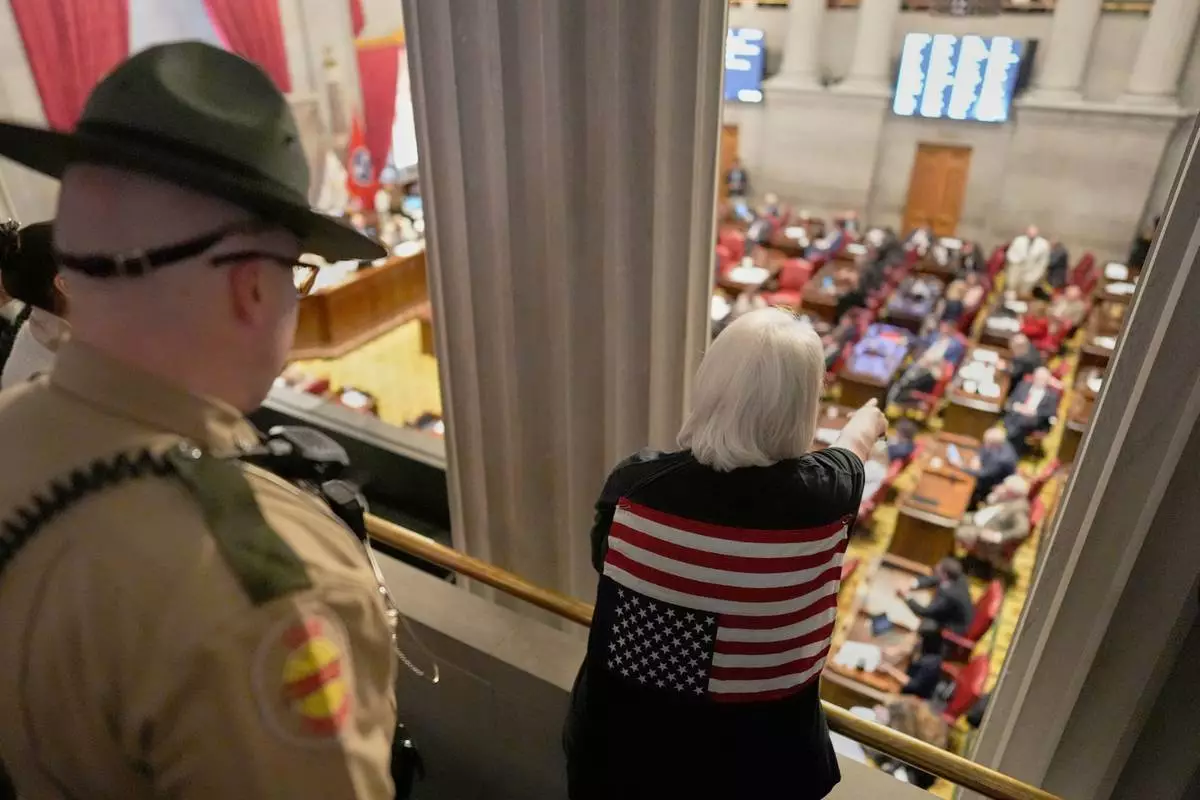
A woman yells down to the House floor as the gallery is cleared by state troopers during a special session of the state legislature to redraw U.S. Congressional voting maps Thursday, May 7, 2026, in Nashville, Tenn. (AP Photo/George Walker IV)
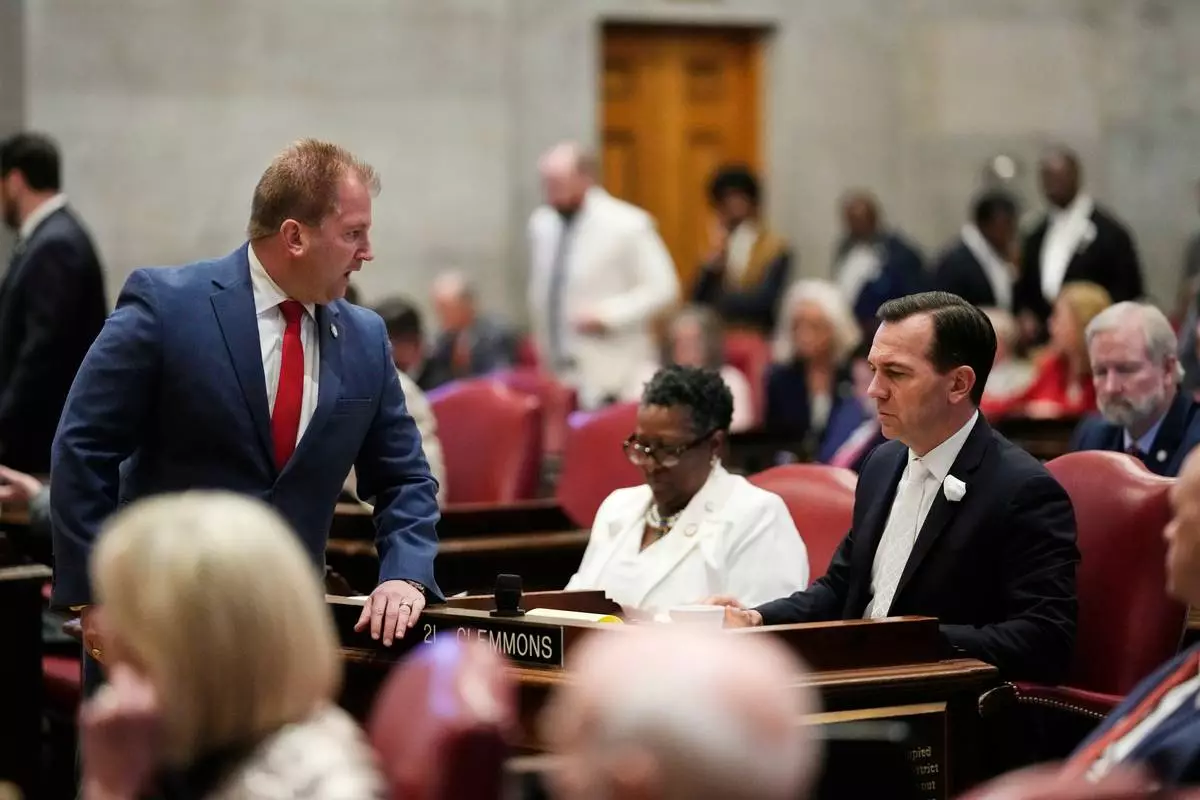
Rep. William Lamberth, R-Portland, left, speaks with Rep. John Ray Clemmons, D-Nashville, right, during a special session of the state legislature to redraw U.S. Congressional voting maps Thursday, May 7, 2026, in Nashville, Tenn. (AP Photo/George Walker IV)

A woman protests outside the House chamber before a special session of the state legislature to redraw U.S. Congressional voting maps Thursday, May 7, 2026, in Nashville, Tenn. (AP Photo/George Walker IV)

Rep. Todd Warner, R-Chapel Hill, arrives to the House chamber wearing a Trump flag for a special session of the state legislature to redraw U.S. Congressional voting maps Thursday, May 7, 2026, in Nashville, Tenn. (AP Photo/George Walker IV)

House Speaker Cameron Sexton, R-Crossville, sits alone after a House committee meeting during a special session of the state legislature to redraw U.S. Congressional voting maps Wednesday, May 6, 2026, in Nashville, Tenn. (AP Photo/George Walker IV)

State troopers clear a House committee meeting after it was disrupted by protesters during a special session of the state legislature to redraw U.S. Congressional voting maps Wednesday, May 6, 2026, in Nashville, Tenn. (AP Photo/George Walker IV)

Rep. Joe Towns Jr., D-Memphis, gestures during procedural vote in a House committee meeting of a special session of the state legislature to redraw U.S. Congressional voting maps Wednesday, May 6, 2026, in Nashville, Tenn. (AP Photo/George Walker IV)