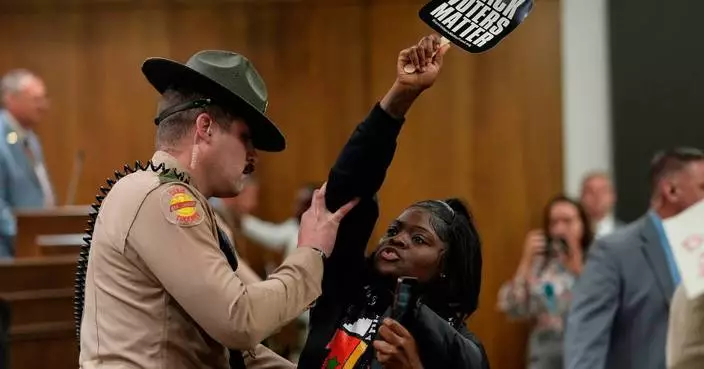
MONTGOMERY, Ala. (AP) — Alabama lawmakers looking to take part in a national redistricting battle could vote Friday on a plan to alter state's congressional primaries if the courts allow Republican state officials to switch to more advantageous U.S. House maps ahead of the November midterm elections.
The Alabama legislation, which needs only a final Senate vote to go to Republican Gov. Kay Ivey, seeks to leverage a recent U.S. Supreme Court ruling in a Louisiana case that significantly weakened Voting Rights Act protections for minorities.
Republicans in Southern states have moved quickly to try to capitalize on the case. Tennessee enacted new congressional districts Thursday that carve up a Democratic-held, Black-majority district in Memphis. Louisiana postponed its U.S. House primaries as lawmakers work to enact new districts. And Republicans in the South Carolina House also have proposed a new U.S. House map.
Even before the high court ruling, Republicans and Democrats already were engaged in a fierce redistricting battle, each seeking an edge in the midterm elections that will determine control of the closely divided House.
Since President Donald Trump prodded Texas to redraw its congressional districts last summer, a total of nine states have adopted new House districts. From that, Republicans think they could gain as many as 14 seats while Democrats think they could gain up to 10. But the parties may not get everything they sought, because the gerrymandering could backfire in some highly competitive districts.
Alabama has asked federal judges to lift a court order requiring the state to have a second district where Black voters are the majority or close to it. That district gave rise in 2024 to the election of Democratic Rep. Shomari Figures, who is Black.
Republicans instead want to put in place a map lawmakers drew in 2023 — which was rejected by a federal court — that could allow them to reclaim Figures’ district. Black residents currently make up about 48% of the district’s voting-age population. That would drop to about 39% under the 2023 map.
Republicans hope the federal courts will see the case differently in the wake of the Supreme Court’s Louisiana decision. If a court grants Alabama’s request, the legislation under consideration would ignore the May 19 primary for some congressional seats and direct the governor to schedule a new primary under the revised districts.
“It is an if, and only if, the courts take action,” Republican state Sen. Chris Elliott said.
The House passed the legislation on a party-line vote Wednesday, and a Senate committee on Thursday advanced it to the full chamber.
Addressing the Senate committee, Figures said his concern isn’t for himself but for the people who fought for decades “to have a voice in what government looks like.”
“I ran into a gentleman last night, and he said, ‘Hey man, I hear your job is on the line.’ And I told him, 'No, Shomari Figures is going to be OK. Your voice is on the line,'” Figures said.
Some Democrats noted that the state’s segregationist past isn’t that long ago, and it was districts created under the Voting Rights Act that gave rise to Black representation after centuries of disenfranchisement.
“How long are we going to have to repeat history before we realize that all people deserve to be respected and deserve to have the feeling that they are valued?” asked Democratic state Sen. Linda Coleman-Madison, who is Black.
Republicans in the South Carolina House distributed a proposed new U.S. House map Thursday. It would give the GOP an improved chance at winning the only seat currently held by a Democrat.
The proposal would take Democratic U.S. Rep. Jim Clyburn out of the 6th District he has represented since 1992 while splitting the district into four different ones. Clyburn's current district is made up of nearly 50% Black voters and in the 2024 presidential election, greater than 60% of residents voted for Democrat Kamala Harris.
The proposed map also would split the Democratic stronghold of Columbia and its redder suburbs into four different districts.
The state House on Wednesday approved a resolution giving lawmakers permission to return after the May 14 end of their regular work to continue consideration of a redistricting plan. But the Senate on Thursday delayed a decision on the resolution, because members wanted some idea of what the new districts could look like, Republican Senate Majority Leader Shane Massey said.
After the House plan was released, Massey cited continued concerns. He said as many as four districts could become competitive, requiring substantial support for Republican candidates and hurting down-ballot races for the party.
“If we get too cute with this, we could end up losing seats,” Massey said.
The state’s primary elections are June 9.
Collins reported from Columbia, South Carolina, and Lieb from Jefferson City, Missouri.
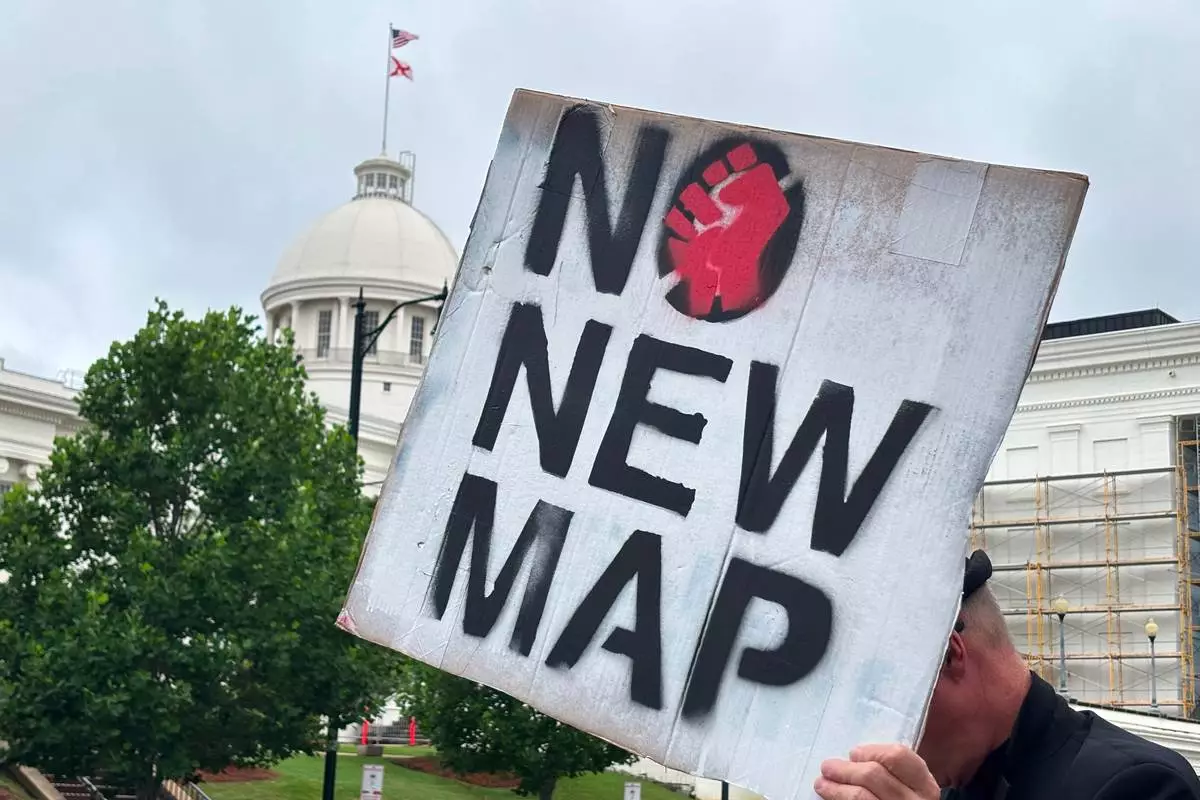
A demonstrator holds up a sign outside the Alabama Statehouse in Montgomery, Ala., on Thursday, May, 7 2026. (AP Photo/Kim Chandler)
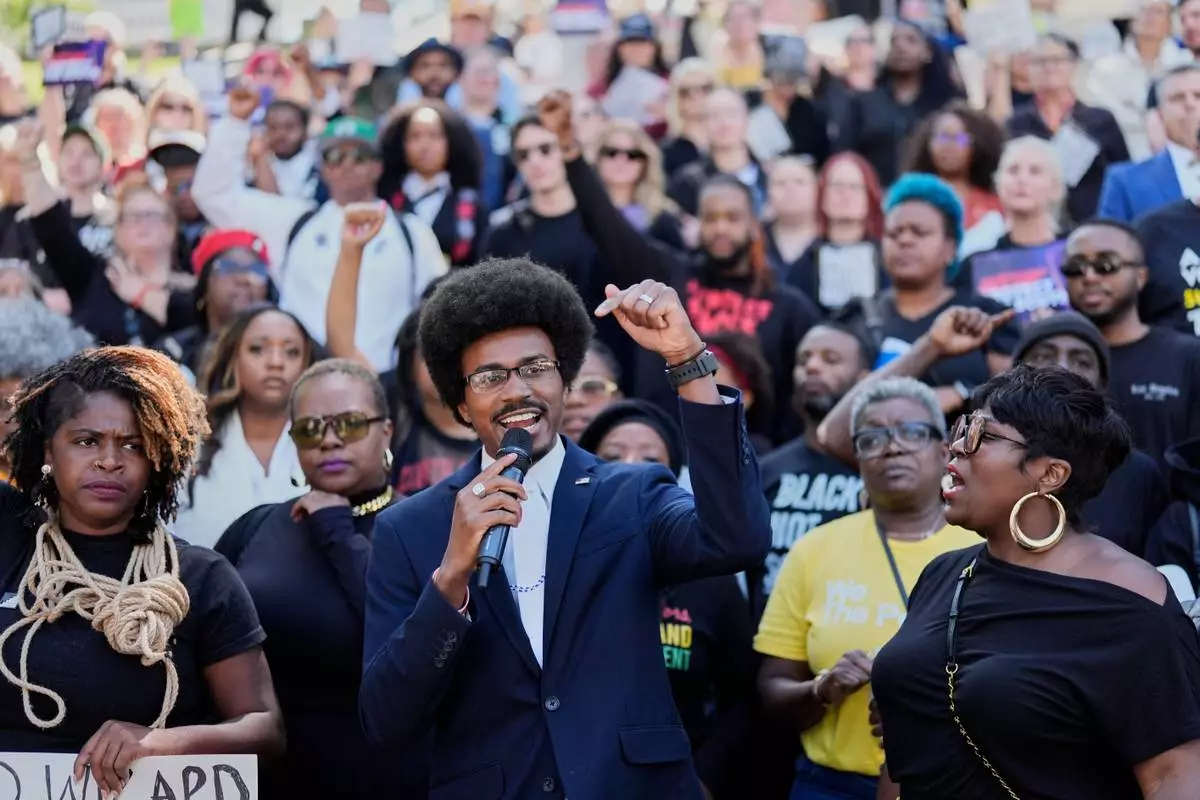
Rep. Justin J. Pearson, D-Memphis, speaks during a rally after a special session of the state legislature to redraw U.S. Congressional voting maps Thursday, May 7, 2026, in Nashville, Tenn. (AP Photo/George Walker IV)