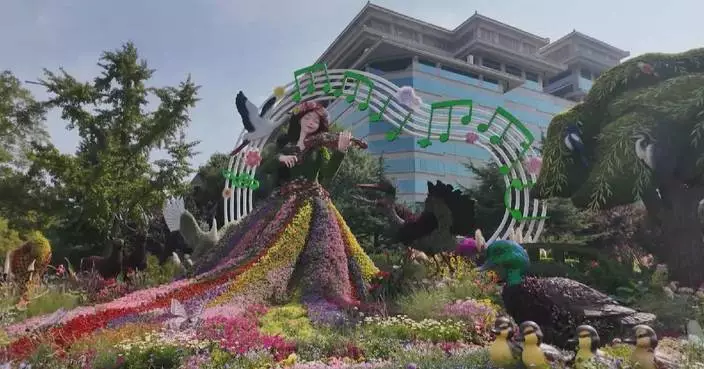
Beijing's major streets and ring roads have been coated with blooming pink Chinese roses, adding more colors to the national capital with a pleasant view.
Roses grow along the second, third and fourth ring roads -- the main arteries of Beijing. The city's greening department says it selected a special variety for the traffic-heavy roads.
"The variety selected for the Guomao bridge area is Yueding, a new strain we cultivated on our own in Beijing. This strain of rose is prominent in its improvement the rose's traits of vehicle exhaust-, drought-, and heat-resistance, and its flowering period is longer with greater flower volume," said Ji Peng, deputy director of the Urban Greening Division of Beijing Municipal Forestry and Parks Bureau.
The pink Chinese rose Yueding's flowering period lasts from early May to mid-November, up to 200 days.
To guarantee the growth and ultra-long flowering period of the roses, the greening department has installed smart irrigation systems in bridge areas, with flower boxes equipped with precision drip irrigation devices that automatically adjust water volume and irrigation time according to weather conditions.
The Chinese rose is the city flower of Beijing and has become an iconic flower for the city's ecological landscape.
Currently, Beijing has grown nearly 2,000 Chinese rose varieties, including some 200 self-bred varieties, and has built rose landscape belts stretching over 1,000 kilometers.
"In the process of building the capital into a garden city, we focus on creating greening scenes around people's living quarters. Different areas are decorated with different colors to match their tone, allowing people to have refreshed feelings about the surroundings when they go from place to place. This is also to keep citizens in a pleasant mood when they are commuting to and from work," Ji said.
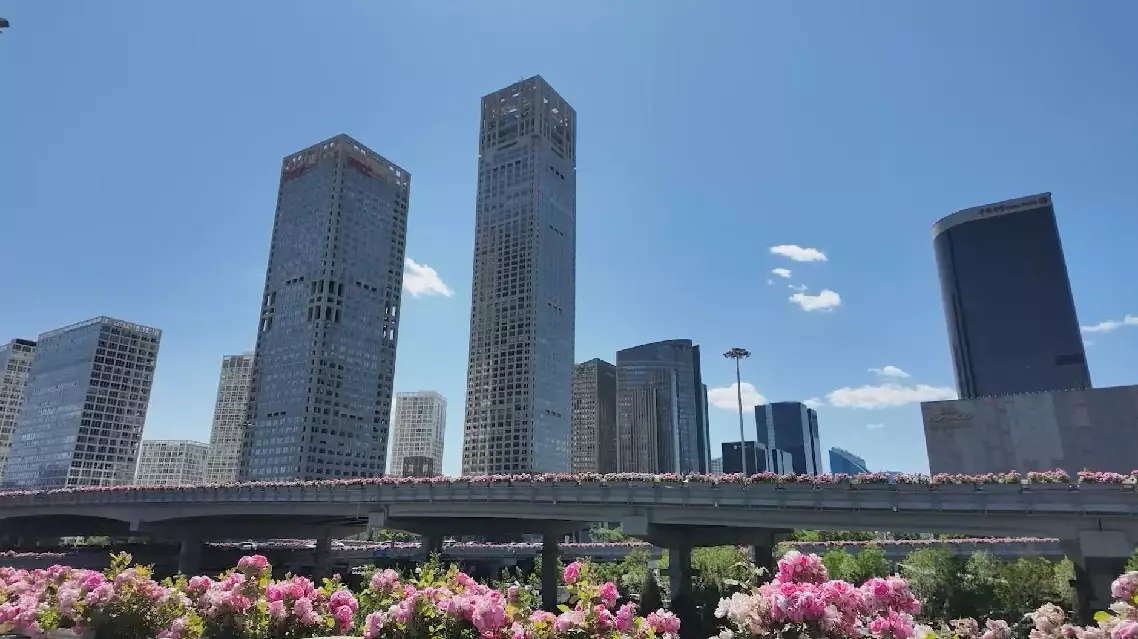
Blooming Chinese roses decorate Beijing's major roads
Competition between the United States and China is healthy when it is fair, but dangerous when it becomes an effort to trip or eliminate the other side, David Lampton, former president of the National Committee on United States-China Relations, said in commenting on Chinese President Xi Jinping's just-concluded state visit to the U.S.
Xi paid a state visit to the United States on Sept 23-25 at the invitation of President Donald Trump. It was Xi's first state visit to the country in 11 years and followed Trump's state visit to China back in May.
During the trip, Xi had an in-depth exchange of views Trump on bilateral relations as well as major international and regional issues of common concern.
The two leaders reached a consensus on eight outcomes which span a wide range of areas, including the economy and trade, technology, people-to-people exchanges and international situations. A major one is that the two sides have agreed to build a constructive relationship of strategic stability based on respect, fairness and reciprocity.
Speaking at a welcome ceremony hosted by Trump at the White House on Thursday, Xi said that China and the U.S. should embrace healthy competition, avoid confrontation, and jointly explore the right way to get along.
Reflecting on the nature of competition between major countries, Lampton outlined three distinct forms it can take.
"There are different forms of competition. There's the form of competition, like a tracks race, a running race. You all line up at the same line, the gun fires and whoever is the most capable wins at the end of the race. But there's the kind where the gun goes off and I try to trip, or you try to trip the other guy. And then there's the kind of competition where you're trying to eliminate the other, right?" he said in an interview with China Global Television Network (CGTN) on Friday.
Lampton made clear which form he believes should define the China-U.S. relationship.
"Obviously, I think competition is good in that first sense. That's what economic progress, scientific innovation [means]. It was [Thomas] Edison [who] made fortune out of inventing the light bulb. Inventors were motivated by their desire for knowledge, but also money. So, I think competition is basically human life, but I think we need to have the kind of competition if we're not helping the other, in some case through partnership and so forth, we're at least not trying to trip them," he added.
During the visit, Xi and Trump agreed to support each other as China will host the 2026 APEC Economic Leaders' Meeting in November and the United States will host the G20 Leaders' Summit in December, expressing intention that they will attend each other's event.
Lampton said the focus now should be on putting those commitments into practice to build a stronger foundation for future engagement.
"[It is] very important for both sides to do what they say. If it's only for two months, at least let's both do what we say for two months and then that'll create a better foundation when we get together for the next two meetings that you just mentioned," said Lampton.
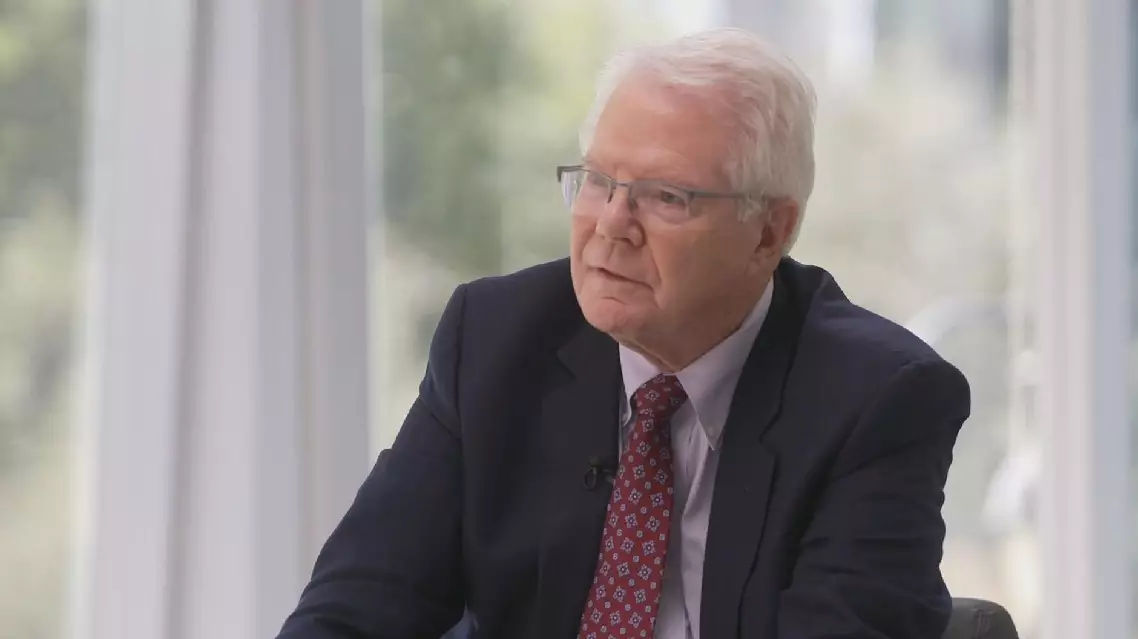
China-U.S. relations expert urges fair competition, warns against "tripping" each other