The US State Department’s power grabbing agency, the National Endowment for Democracy (NED) is spending HK$4.036 million to infiltrate Hong Kong’s social fabric this year, according to its 2025 annual report.
But it could have been more had it not been for the intervention of Tesla billionaire Elon Musk. In February last year President Trump appointed Musk to look into wastage in his administration with a new government Department of Government Efficiency (DOGE). Musk immediately took aim at USAID, the umbrella agency for NED, which he criticized as “rife with corruption” and an “evil organization that needs to be dissolved.” He also described it as a scam.
NED went into a tailspin and immediately suspended all payments to its benefactors, causing them to lay off staff and cut expenditures.
In March, NED filed a lawsuit against the US government and was granted an injunction to allow access to the HK$743 million of its previously approved funds for 2025.
However, the allocation of funds for 2025 is still short of $78 million compared to 2024 budget.
The allocation to Hong Kong includes HK$782,000 to build international solidarity for defending freedoms and the rule of law, inform international stakeholders about regional political deterioration, advocate for strategic responses through legal mechanisms, and expand its international network of supporters through outreach and media engagement.
Another HK$2.34 million is reserved to build a civil society capacity to monitor government and counter censorship of official records and democratic narratives, the organization will conduct workshops training groups and individuals in using digitally secure methods for collecting and archiving materials related to government accountability for human rights violations and preserving the historical record. And it would provide support to political prisoners and those at-risk.
It is also spending HK$907,400 to strengthen the resilience of human rights defenders and their families, foster solidarity networks and conduct community-building campaigns.
The NED annual reports once named its beneficiaries who carried out subversive acts in various countries, but the practice stopped around 2011 (riots in Hong Kong) and now the recipients of the NED handouts are hidden in a cloud of secrecy.
China is the main recipient of NED’s attacks. It said in its latest report that China continued to keep an iron grip on politics and freedoms at home while seeking to solidify its growing influence globally.
It claims that “The Chinese Communist Party (CCP) escalated its repression in Hong Kong, Tibet, and East Turkestan, while exporting its model of digital censorship, transnational repression, and elite capture to neighboring countries and farther abroad.” The report further says that “NED-supported partners worked to expose CCP influence, expand independent information channels, and defend civic space.”
Looking ahead, in 2026 the NED will continue to invest most heavily in Asia, even as its most significant growth in grant making occurs in Latin America and the Caribbean. China-related programs—spanning the Mainland, Tibet, East Turkestan, Hong Kong, and China’s global influence— will remain its single largest area of investment.
“When countries can resist foreign authoritarian pressure, they become stronger partners for the United States,” the report boasts.
The first sentence in NED’s 2025 annual report is a lie that NED is a private, nonprofit foundation dedicated to advancing freedom and democracy worldwide. As part of the US’s Department of State drawing on public funds, it is hardly private and as for advancing freedom and democracy worldwide, NED is hellbent crippling regimes it doesn’t like in pursuit of world supremacy.
Mark Pinkstone
** 博客文章文責自負,不代表本公司立場 **
As towers of glass, steel and concrete start forming the skyline of the Northern Metropolis, a swath of green the length of the development is being maintained to protect the wildlife inhabiting the area for more than a century.
The Northern Metropolis (NM) development is a futuristic university city, occupying one third of Hong Kong’s land mass along Shenzhen River boundary with the mainland. Catering for a new population of 2.5 million and offering 65, 000 jobs with additional transport links, the project is expected to reach it potential in 2036.
In addition to the residential development, the plan includes an extension of the existing logistics hub in the Hung Shui Kiu and Ha Tsuen areas. And two eco-tourism nodes will be established in the coastal areas of Tsim Bei Tsui and Pak Nai, featuring resorts, weekend markets, and camping sites. Authorities have expressed their intention to create a coastal protection park along the 10.7-km coastline.
However, it is being built on what was previously fish farms, agricultural land, marshes and mangroves – wetlands, a natural habitat for wildlife and an important foraging ground and habitat for migratory water birds.
The plan was launched as a proactive conservation policy in the Chief Executive’s annual policy address in 2021 and has gone through various consultation exercises involving surveyors, conservationists, property holders and the public.
The wetland conservation system is estimated to have a total area of about 2 000 hectares (ha). This includes the existing Hong Kong Wetland Park (HKWP) at Tin Shiu Wai (about 62 ha) plus an expansion of about 240 ha, the Mai Po Nature Reserve (about 370 ha), the proposed establishment of three Wetland Conservation Parks (WCPs) at Nam Sang Wai (about 400 ha), Sam Po Shue (about 520 ha) and Hoo Hok Wai (about 300 ha), as well as the establishment of Sha Ling/Nam Hang Nature Park (about 4 ha) and Tsim Bei Tsui/Lau Fau Shan/Pak Nai Coastal Protection Park (about 145 ha).
Indigenous to Hong Kong and southern China is the Eurasian Otter which has been documented in parts of the territory for more than a century with the earliest sighting records dating back to the 1890s. Today, the species is considered locally rare with a restricted distribution, occurring primarily around Mai Po Inner Deep Bay Ramsar Site, with occasional sightings in Lok Ma Chau, Hoo Hok Wai, and Hong Kong Wetland Park. (A Ramsar site is a wetland designated as being of international importance under the Ramsar Convention, a global treaty signed in 1971 in Ramsar, Iran, to protect and sustainably use wetlands).
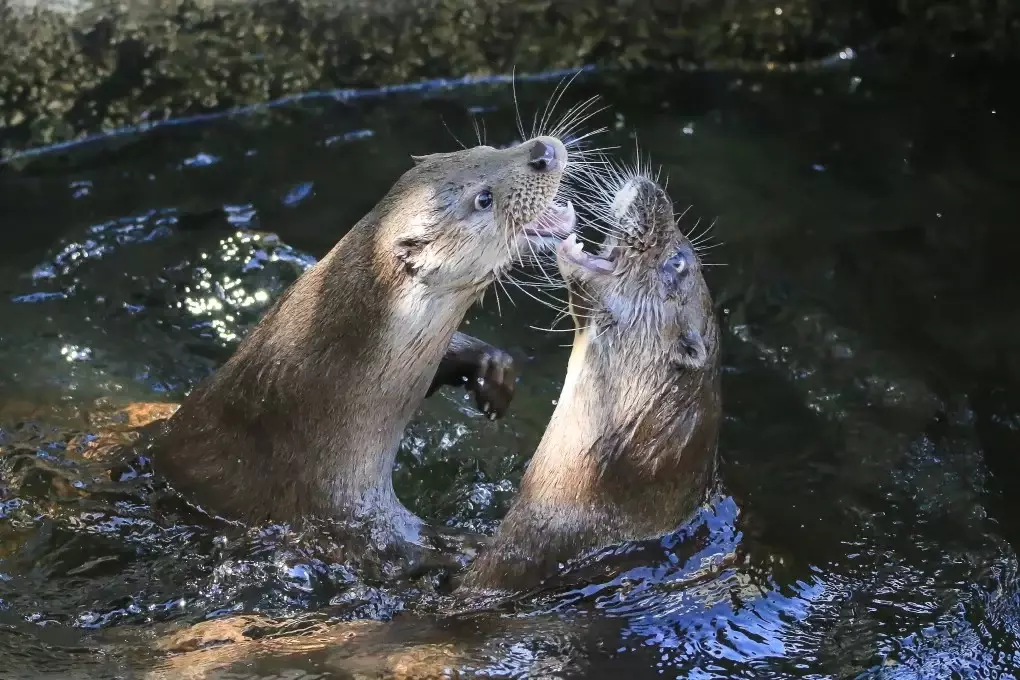
Otters in Hong Kong. (Source: South China Morning Post)
Access control measures are in place in areas with otter occurrence, such as Mai Po Nature Reserve, the non-visitation area of the Wetland Reserve at HKWP and ecological mitigation wetlands created under development projects, to protect the sensitive habitats and minimize potential disturbance to the wetlands and their associated animals. Separately, under the planned Sam Po Shue Wetland Conservation Park (SPS WCP), enhanced freshwater wetland habitats and ecological passage will be established to allow wildlife, particularly the otters, to travel between the SPS WCP and adjacent wetlands. Additionally, the river channels within the SPS WCP will be enhanced to provide habitats for the otters, with the incorporation of habitat enhancement features such as otter platforms, artificial holts (otter burrows) etc. at appropriate locations in the park.
Reports from the Adelaide Zoo in Australia indicate that otters are not shy (unless threatened) and in fact become more playful in the presence of humans.
Lau Fau Shan oysters were once favored in Hong Kong until the mid-70s when they were subjected to contamination from heavy metals fed into the Shenzhen River further upstream from battery making factories. The loss-making industry is now virtually dead save for about 10 per cent of its former glory being maintained by villagers with purified water systems.
Conservation groups believe the introduction of eco-tourism in the area would help the villagers bring survival back to the industry.
Now, under the NM development plan, a dedicated Coastal Protection Park (CPP) is being established along the Deep Bay coastline, covering Tsim Bei Tsui, Lau Fau Shan, and Pak Nai.
The CPP, spanning about 10 km and covering about 145 ha, aims to protect critical habitats for horseshoe crabs, mangroves, and seagrass beds.
Conservation groups, including The Nature Conservancy, are also actively advocating for Pak Nai, near Lau Fa Shan, to be designated as a formal Marine Protected Area (MPA) to safeguard its status as a biodiversity hotspot.
The government is to be applauded for taking the initiative of blending the eco system in an intense high-rise technical urban sprawl. The government has launched public engagement exercises and invited Expressions of Interest (EOI) for eco-tourism nodes in these areas. The goal is to transform conservation value into economic vitality through guided tours and educational facilities without compromising ecological integrity.