Skip to Content Facebook Feature Image

Qrypt and PANTHEON.tech Bring Quantum-Safe Keyless Encryption to SONiC Networks

Business

Qrypt and PANTHEON.tech Bring Quantum-Safe Keyless Encryption to SONiC Networks
Business

Business

Qrypt and PANTHEON.tech Bring Quantum-Safe Keyless Encryption to SONiC Networks

2026-05-14 00:17 Last Updated At:00:41

NEW YORK--(BUSINESS WIRE)--May 13, 2026--

Qrypt and PANTHEON.tech today published qp-vpp, an open-source integration of Qrypt’s BLAST protocol with VPP, the high-performance data plane underlying SONiC deployments worldwide. This is the latest example of what quantum entropy makes possible: a WireGuard tunnel running in SONiC-VPP networks where the session key is never transmitted. Leveraging Qrypt’s BLAST protocol, both endpoints derive the same key independently, from quantum entropy sourced through exclusive agreements with Oak Ridge National Laboratory and Los Alamos National Laboratory.

This press release features multimedia. View the full release here: https://www.businesswire.com/news/home/20260513932024/en/

Two threats make this urgent. The first is already active: a Keyfactor study of 175 million RSA certificates found that 1 in 172 were vulnerable due to weak entropy during key generation, breakable for under $3,000 in cloud compute.¹ The second is approaching: “harvest now, decrypt later” attacks, where adversaries capture encrypted traffic today and decrypt it once quantum computing matures. NIST’s post-quantum cryptography standards and CISA’s quantum readiness guidance name this as an active procurement concern, not a future one. BLAST addresses both threats. Strong entropy means strong keys. Keys that never travel mean nothing to intercept and nothing to retroactively decrypt.

SONiC is the open networking operating system created by Microsoft, now a Linux Foundation project, running the data center infrastructure of Microsoft Azure, Alibaba Cloud, and Google. Its Foundation counts more than 100 member organizations, including Cisco, NVIDIA, Intel, Dell, Nokia, Arista, and Marvell. PANTHEON.tech, a SONiC Foundation member and leading contributor, highlights qp-vpp integration as a key enabler for projects like SONiC-VPP.

“This is just the latest example of what you can do with quantum entropy. SONiC networking. AI inference. Air-gapped government infrastructure. Cloud, on-prem, or fully disconnected. The entropy and the protocol are the same in every case. Every new environment we add is another layer of proof.”

— Kevin Chalker, Founder and CEO, Qrypt

“VPP runs in production across carrier and enterprise networks worldwide. Most quantum-safe approaches we evaluated still transmit key material. BLAST doesn’t. As a leading contributor to Linux Foundation projects, PANTHEON.tech has always been committed to the open-source ecosystem, and we published this code to continue that mission of building open networking standards for the community.”

— Miroslav Miklus, PANTHEON.tech

Qrypt Co-Founder Denis Mandich is presenting at the ONUG AI Networking Summit in Dallas this week, where he will demonstrate the integration live. His session, “Quantum Networking for Quantum-Safe Data Center Connectivity in Enterprise-Scale Environments,” runs May 14. Mandich has presented on quantum-safe AI infrastructure at every major ONUG event since 2023. The release targets the SONiC Foundation’s membership directly.

The use cases are immediate. Any WireGuard tunnel on VPP gets quantum-safe key generation with no changes to the underlying infrastructure: site-to-site links between corporate locations, data centers, or cloud regions; east-west traffic inside a SONiC-based data center; branch-to-data-center connections. For AI infrastructure teams, BLAST already secures inference traffic on NVIDIA Jetson edge devices and BlueField-3 DPUs; qp-vpp extends that protection to the SONiC switching fabric those workloads run on. The GPU and the network are now on the same security layer. Agent-to-agent communications across distributed AI systems face the same harvest now, decrypt later exposure as any other network traffic. BLAST closes that at the network layer with no key transmission. For network security teams, Qrypt participates in Palo Alto Networks’ QRNG Open API initiative, which brings quantum entropy into next-generation firewalls. For air-gapped environments, the Quantum Entropy Appliance generates keys with no external network dependency.

qp-vpp is an open-source reference implementation demonstrating quantum-safe key injection into a VPP WireGuard tunnel. The full threat model and production deployment requirements are documented in SECURITY.md in the repository.

“BLAST protocol allows the generation of secure, yet reproducible, keys to remote participants, without this key ever transmitted over a traditional computational channel, such as TLS. Breaking such keys requires an incredible amount of capabilities and coordination on behalf of the attacker, and becomes completely impossible after a short window of time. Indeed, BLAST realizes a very strong type of everlasting security not achieved by the traditional solutions.”

— Yevgeniy Dodis, Qrypt Chief Cryptographer, IACR Fellow, Professor of Computer Science, NYU

A free 14-day trial is available now at qrypt.com. No procurement required.

¹ Keyfactor, “Factoring RSA Keys in the IoT Era,” December 2019.

About Qrypt

Qrypt provides quantum-safe encryption and key generation technology to enterprise, government, and defense organizations. Its BLAST protocol generates symmetric keys independently at each endpoint from quantum entropy, with no key transmitted between them. Qrypt’s entropy is sourced through exclusive licensing agreements with Oak Ridge National Laboratory and Los Alamos National Laboratory, NIST ESV certified. The only quantum security company in NVIDIA Inception. Qrypt’s technology is protected by multiple issued U.S. patents, including Nos. 11,831,764, 12,058,237, and 11,997,200. Available via cloud (AWS Marketplace), on-premises appliance, and air-gapped deployment. Headquartered in New York, NY. qrypt.com

About PANTHEON.tech

PANTHEON.tech is a software engineering firm specializing in open-source networking technologies including VPP, DPDK, and SONiC. A member of the SONiC Foundation and a leading contributor to SONiC-VPP integration, PANTHEON.tech serves tier-1 carriers, hyperscalers, and enterprise network operators globally. Headquartered in Bratislava, Slovakia. pantheon.tech
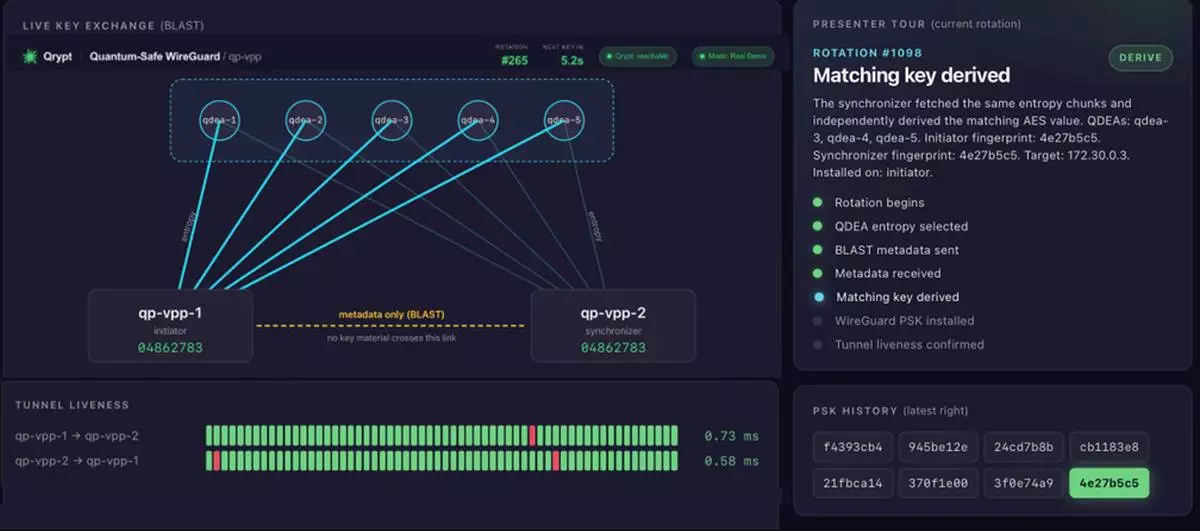
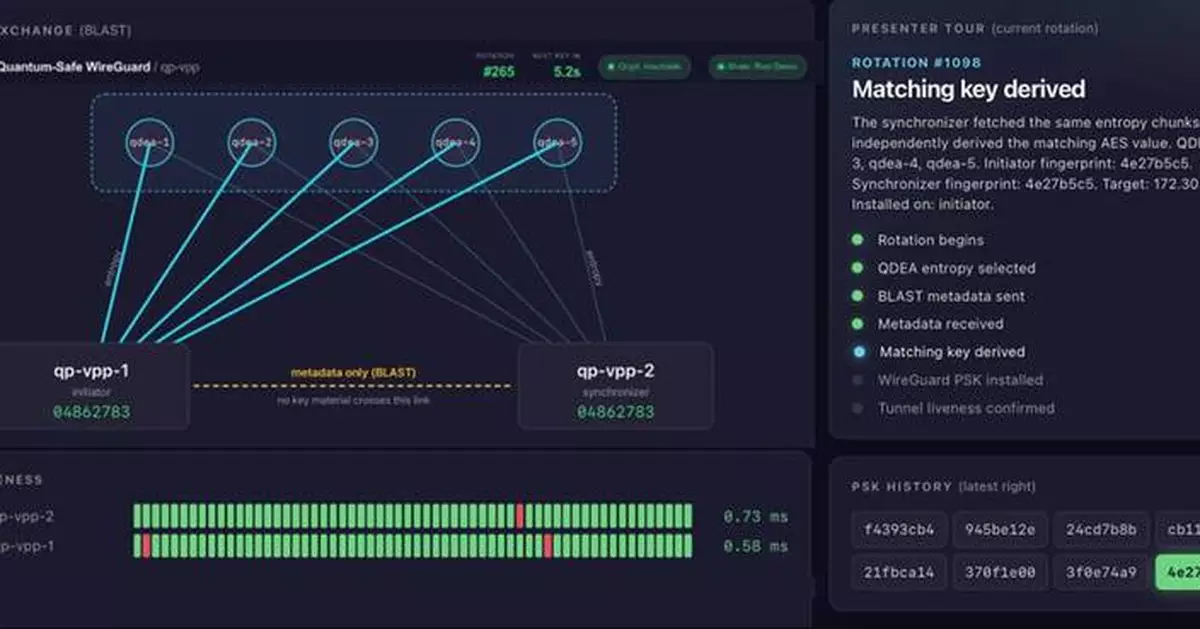
Both endpoints independently derive the same cryptographic key from quantum entropy. Only a signed metadata recipe crosses the wire, never the key itself. Live qp-vpp dashboard running on AWS showing rotation #265.


Both endpoints independently derive the same cryptographic key from quantum entropy. Only a signed metadata recipe crosses the wire, never the key itself. Live qp-vpp dashboard running on AWS showing rotation #265.

ABUJA, Nigeria (AP) — The World Health Organization declared the Ebola disease outbreak caused by a rare virus in Congo and neighboring Uganda a public health emergency of international concern on Sunday, after more than 300 suspected cases and 88 deaths.

The WHO said the outbreak does not meet the criteria of a pandemic emergency like COVID-19, and advised against the closure of international borders.

The WHO said on X that a laboratory-confirmed case has also been reported in Congo’s capital, Kinshasa, which is about 1,000 kilometers (620 miles) from the outbreak's epicenter in the eastern province of Ituri, suggesting a possible wider spread. It said the patient had visited Ituri and that other suspected cases have also been reported in North Kivu province, which is one of Congo’s most populous and borders Ituri.

Ebola is highly contagious and can be contracted via bodily fluids such as vomit, blood or semen. The disease it causes is rare, but severe and often fatal.

The WHO’s emergency declaration is meant to spur donor agencies and countries into action. By the WHO’s standards, it shows the event is serious, there is a risk of international spread and it requires a coordinated international response.

The global response to previous declarations has been mixed. In 2024, when the WHO declared mpox outbreaks in Congo and elsewhere in Africa a global emergency, experts at the time said it did little to get supplies like diagnostic tests, medicines and vaccines to affected countries quickly.

Health authorities say the current outbreak, first confirmed on Friday, is caused by the Bundibugyo virus, a rare variant of the Ebola disease that has no approved therapeutics or vaccines. Although more than 20 Ebola outbreaks have taken place in Congo and Uganda, this is only the third time the Bundibugyo virus has been detected.

Congo accounts for all except two of the cases, both of which were reported in Uganda, the WHO said.

The Bundibugyo virus was first detected in Uganda’s Bundibugyo district during a 2007-2008 outbreak that infected 149 people and killed 37. The second time was in 2012, in an outbreak in Isiro, Congo, where 57 cases and 29 deaths were reported.

Africa Centres for Disease Control and Prevention Director-General Dr. Jean Kaseya said Saturday that a high number of active cases remain in the community, particularly in Mongwalu, where the first cases were reported, “significantly complicating containment and contact tracing efforts.”

Violent conflict with militants, some backed by the Islamic State group, as well as constant population movement due to mining, both within Congo and across the border in Uganda, have also posed a major challenge to response efforts.

Officials first reported the spread of the disease in Ituri province, close to Uganda and South Sudan, on Friday. On Saturday, the Africa CDC reported 336 suspected cases and 87 deaths in Congo.

“There are significant uncertainties to the true number of infected persons and geographic spread associated with this event at the present time. In addition, there is limited understanding of the epidemiological links with known or suspected cases,” WHO Director-General Tedros Adhanom Ghebreyesus said.

The two cases in Uganda include one person whom officials said had traveled from Congo and died at a hospital in Uganda’s capital, Kampala, and another the WHO said had also traveled from Congo.

The WHO said the high percentage of positive cases among samples tested, the spread to Kampala and Uganda and the clusters of deaths across Ituri “all point toward a potentially much larger outbreak than what is currently being detected and reported, with significant local and regional risk of spread.”

Kaseya said slow detection delayed the response and gave the virus time to spread.

“This outbreak started in April. So far, we don’t know the index case. It means we don’t know how far is the magnitude of this outbreak,” Kaseya said, using a term for the first detectable case of an epidemic.

The earliest known suspected case, a 59-year-old man, developed symptoms on April 24 and died at a hospital in Ituri on April 27.

By the time health authorities were first alerted to the outbreak via social media on May 5, 50 deaths had already been recorded, the Africa CDC said.

The WHO said at least four deaths have been reported among healthcare workers who showed Ebola symptoms.

Shanelle Hall, principal adviser to the head of Africa CDC, told reporters Saturday that there were four therapeutics under consideration for the Bundibugyo virus, but no vaccine was being actively considered.

A bigger issue is that even existing vaccines and therapeutics for other Ebola viruses are not manufactured in Africa. Africa’s struggle to get vaccines from richer countries during the COVID-19 pandemic spurred different efforts to accelerate its capacity to manufacture shots, but resources remain scarce.

Kaseya said the demand for a vaccine for a rare virus like Bundibugyo, which is not as deadly as the Ebola Zaire prominent in Congo’s past outbreaks, has been the recurring issue in discussions with pharmaceutical companies over vaccine manufacturing,

“If we are serious in this continent, we need to manufacture what we need," he said. "We cannot every single day look for others to come to tell us what they are doing.”

FILE - This undated colorized transmission electron micrograph file image made available by the Centers for Disease Control and Prevention (CDC) shows an Ebola virus virion. (Frederick Murphy/CDC via AP, File)

FILE - This undated colorized transmission electron micrograph file image made available by the Centers for Disease Control and Prevention (CDC) shows an Ebola virus virion. (Frederick Murphy/CDC via AP, File)

People wait to have their temperature taken in front of Kibuli Muslim Hospital in Kampala, Uganda, Saturday, May 16, 2026. (AP Photo/ Hajarah Nalwadda)

People wait to have their temperature taken in front of Kibuli Muslim Hospital in Kampala, Uganda, Saturday, May 16, 2026. (AP Photo/ Hajarah Nalwadda)

A health worker wearing protective gear walks outside the a hospital in Bunia, Congo, Saturday, May 16, 2026. (AP Photo/Jorkim Jotham Pituwa)

A health worker wearing protective gear walks outside the a hospital in Bunia, Congo, Saturday, May 16, 2026. (AP Photo/Jorkim Jotham Pituwa)

A health official uses a thermometer to screen people in front of Kibuli Muslim Hospital in Kampala, Uganda, Saturday, May 16, 2026. (AP Photo/ Hajarah Nalwadda)

A health official uses a thermometer to screen people in front of Kibuli Muslim Hospital in Kampala, Uganda, Saturday, May 16, 2026. (AP Photo/ Hajarah Nalwadda)

Recommended Articles