MADRID (AP) — No special menu, no themed decorations and no shared suspense over which musician's flamboyant performance proves victorious.
For the first time in seven years, Silvia Díaz won’t get together with friends to watch the Eurovision Song Contest finals on Saturday night. Their host called off their annual gathering after Spain’s public broadcaster withdrew from the festival, protesting Israel’s participation over its war against Hamas in Gaza. Díaz will watch on YouTube, but only if she has no other plans.
“It’s not the same watching it alone at home as it is with friends. That’s the only thing that upsets me.”
The five-day song competition drew 166 million viewers last year — considerably more than Super Bowl viewership in the U.S. Spain hasn't won since 1969; nevertheless, after months of television, radio and newspaper play for Spain’s song, friends and families usually watch the final at home and bars, and their contestant's performance dominates the day-after headlines. Spaniards at the event wave the country's flag, wear red clothing, or don the occasional bullfighter costume.
Spain announced its boycott in December, after the European Broadcasting Union said Israel would be allowed to compete, and has been joined by Ireland, Slovenia, the Netherlands and Iceland. Some Spanish fans respect the choice to take a stand by sitting out the cherished event, even if it’s bittersweet.
Spain's broadcaster has repeatedly expressed disapproval over Israel’s participation. In last year's semifinals, RTVE's commentators introduced Israel's singer in the same breath as they mentioned Palestinians killed in the war. Before airing the final, the network transmitted the message “Peace and justice for Palestine” on a black background to hundreds of thousands of Spanish televisions.
As Eurovision finals take place in Vienna, RTVE will air a tribute to the network's musical history. It will feature a performance by Tony Grox and Lucycalys, the musicians who RTVE would have dispatched to represent Spain at Eurovision.
Ireland's public broadcaster will air a film about one couple's life in the Irish countryside. Slovenians will be shown an episode of a 10-part program about Palestinians. People can still watch Eurovision on the European Broadcasting Union's YouTube channel, but the lack of a performer or commentator from their own country renders the vibe decidedly less passionate.
Israel has been competing for 50 years and won four times. Israelis gather in bars to watch and are enthusiastic about the country’s participation, which is seen by many as a sign of international acceptance and normalcy. Its contestant each year becomes a national celebrity and a strong showing — even if not an outright victory — is a source of pride.
Among Spain's Eurovision fans, this year's boycott has supporters and detractors.
For Rebeca Carril, who enjoys replaying performances from the 1960s and 1970s, before she was born, the turning point came a few years ago with the influx of Israeli sponsors. She didn't want to support their marketing efforts by tuning in.
“I have Palestinian friends and I began to understand a little better how things worked,” said Carril, a 42-year-old marketing executive in Madrid.
For others, like Guillermina Bastida, music and politics should be separate. She drove 3 1/2 days from northern Spain in a van with her two daughters to last year's competition in Basel, her third time attending. This year, she will settle for YouTube.
“It’s a song festival, period,” Bastida, a 47-year-old who works in communications, said by phone from Asturias province. “I also have my own stance, which is critical, but not to the point of boycotting the festival.”
Eurovision’s motto is “United by Music,” and organizers strive to keep politics out, vainly, in recent years. Months after the invasion of Ukraine in 2022, the European Broadcasting Union disqualified Russia, and it hasn’t been allowed to return. Contest rules ban overtly political lyrics or symbols, and organizers stress it is a competition among national broadcasters, not governments.
Spain is one of the so-called “Big Five” countries that contribute the most financially to Eurovision. In addition to missing out on big bucks for broadcasting rights, Eurovision is losing publicity and credibility, said Jose García, co-director of a website that provides news about the competition, whose main social media channels have a combined total of almost 100,000 followers.
That doesn't mean people will tune out completely, he added.
“It has marked the television and personal history of many people, and fans will watch it via international channels or YouTube. But it’s one thing to be able to watch it and another to agree with what’s happening,” García said.
On the streets of Vienna, the lack of Spaniards is noticeable, said Vicente Rico after attending the first night of the semifinals.
“We’re a group that, just like at other events, makes its presence felt — we’re among the happiest, the loudest and the most fun,” said Rico, 40, who runs a perfumery in Madrid.
This is Rico's 18th Eurovision, and he had been torn before embarking on his annual pilgrimage because he believes the boycott is morally right. Still, it doesn't sit well.
“It bothers me that Eurovision is being used as a scapegoat,” he said, noting the lack of action by international organizations and boycotts at other events like the FIFA World Cup, which kicks off in a month.
And who will Rico support, with Spain absent?
“I think Finland is going to win, but the support for Italy is crazy,” he said. If Sweden, Serbia or Australia prevails, he would return to Spain happy.
“This year, we’re rooting for everyone except Israel.”
Associated Press writers Josef Federman in Jerusalem and Jill Lawless in Vienna contributed to this report.
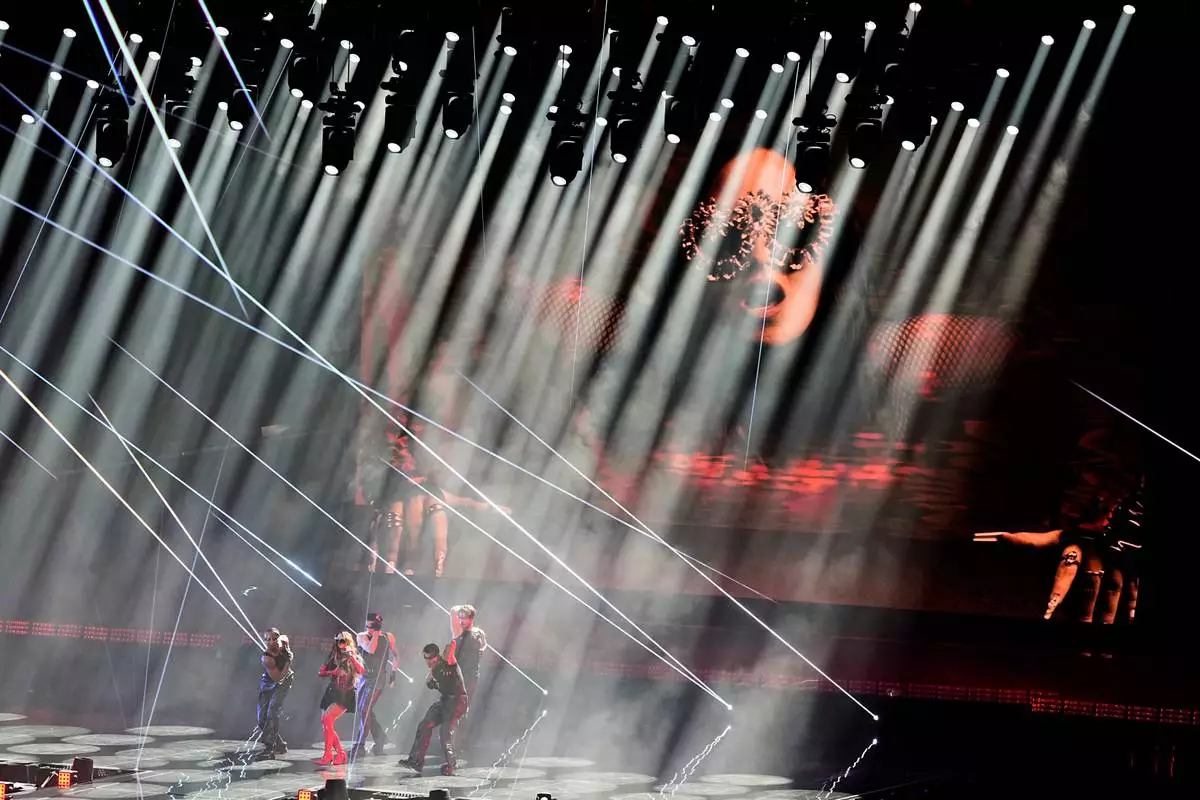
Felicia from Sweden performs the song "My System" during the dress rehearsal for the Grand Final of the 70th Eurovision Song Contest in Vienna, Austria, Friday, May 15, 2026. (AP Photo/Martin Meissner)