SAN FRANCISCO--(BUSINESS WIRE)--May 18, 2026--
Chef Robotics, a leader in physical AI for the food industry, today announced the development of a bi-manual physical AI system for prep table food assembly. While today’s Chef robots handle high-volume meal assembly on food manufacturing conveyor lines, this new bi-manual physical AI system will focus on lower-volume, higher-complexity prep-table-based assembly for industries such as ghost kitchens, fast-casual restaurants, airline catering, schools, hospitals, military, prisons, stadiums, corporate dining, and hotels.
This press release features multimedia. View the full release here: https://www.businesswire.com/news/home/20260518262468/en/
With the advent of physical AI and imitation learning, Chef’s AI team is developing a new physical AI system designed to handle meal assembly tasks on prep tables, such as back-of-house burger or burrito assembly. These tasks are lower-volume but higher-complexity than food manufacturing on conveyor lines because a single worker (or robot) must assemble the entire meal, rather than breaking the process down into separate workstations for each ingredient.
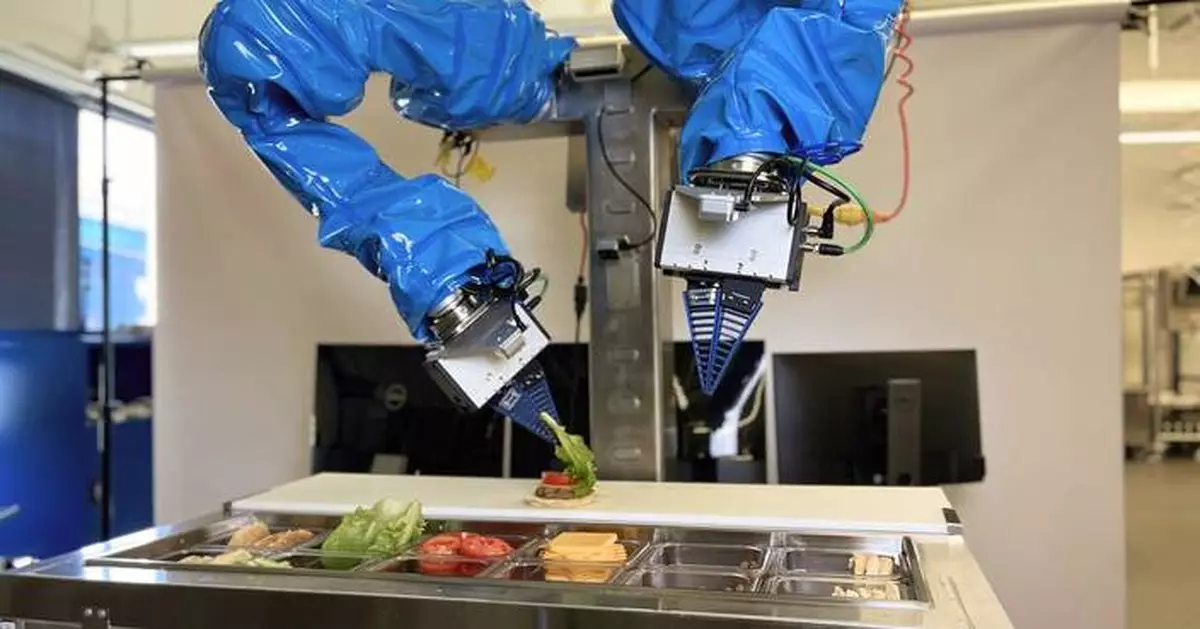
To perform higher-complexity tasks, the new system will use two robotic arms, enabling bi-manual control. It will be able to perform coordinated, dexterous manipulation comparable to that of human arms and hands. The system’s end effectors will be flexible enough to pick up different food ingredients and utensils.
Powered by Chef’s Food Foundation Model (FFM)
The new physical AI system will be powered by Chef’s Food Foundation Model (FFM), which learns faster and adapts to a wider range of use cases than traditional robotic systems.
Off-the-shelf vision-language-action models (VLAs) and physical AI models aren’t sufficient for food manipulation. Most VLAs and physical AI models are trained on rigid-body manipulation, but food manipulation involves highly variable, deformable materials (e.g., wet, sticky, irregular items). This requires Chef’s AI models to generalize across a broad range of physical states and interactions.
Instead of requiring separate models for tasks such as picking and placing food, detecting trays, compartments, and inserts, and handling scoopable or discrete ingredients, the FFM supports all of these capabilities through a single “foundational” AI model. It can also be extended to new tasks more efficiently and with improved performance.
Rather than being programmed, the FFM learns from demonstration (imitation learning) to perform specific tasks like assembling a burger or building a burrito bowl. It also generalizes across different robotic hardware platforms by learning task representations that transfer across hardware embodiments (e.g., systems with different kinematics, end effectors, and configurations). In that sense, Chef is building the physical AI layer for food.
The FFM is expected to unlock additional capabilities over time. For example, it may support zero-shot or few-shot ingredient onboarding, adapting to new ingredients with minimal training. The model will also self-improve and autonomously increase yield and consistency over time.
Other benefits
Chef’s new physical AI system will be:
“We started Chef by focusing on high-throughput food manufacturing, but a large part of the industry still relies on manual prep table assembly,” said Rajat Bhageria, Founder and CEO of Chef Robotics. “These environments are more complex and less structured, which makes them harder to automate. With this new physical AI system and our Food Foundation Model, we will extend physical AI to handle those real-world conditions and unlock a much broader set of applications in the food industry.”
About Chef Robotics
Chef is the first company to have commercialized a scalable AI-driven food robotics solution. With over 100 million servings made in production, Chef leverages ChefOS, an AI platform for food manipulation, to offer a Robotics-as-a-Service solution that helps industry-leading food companies increase production volume and meet demand. Headquartered in San Francisco, CA, Chef aims to empower humans to do what humans do best by accelerating the advent of intelligent machines. Visit https://chefrobotics.ai to learn more.
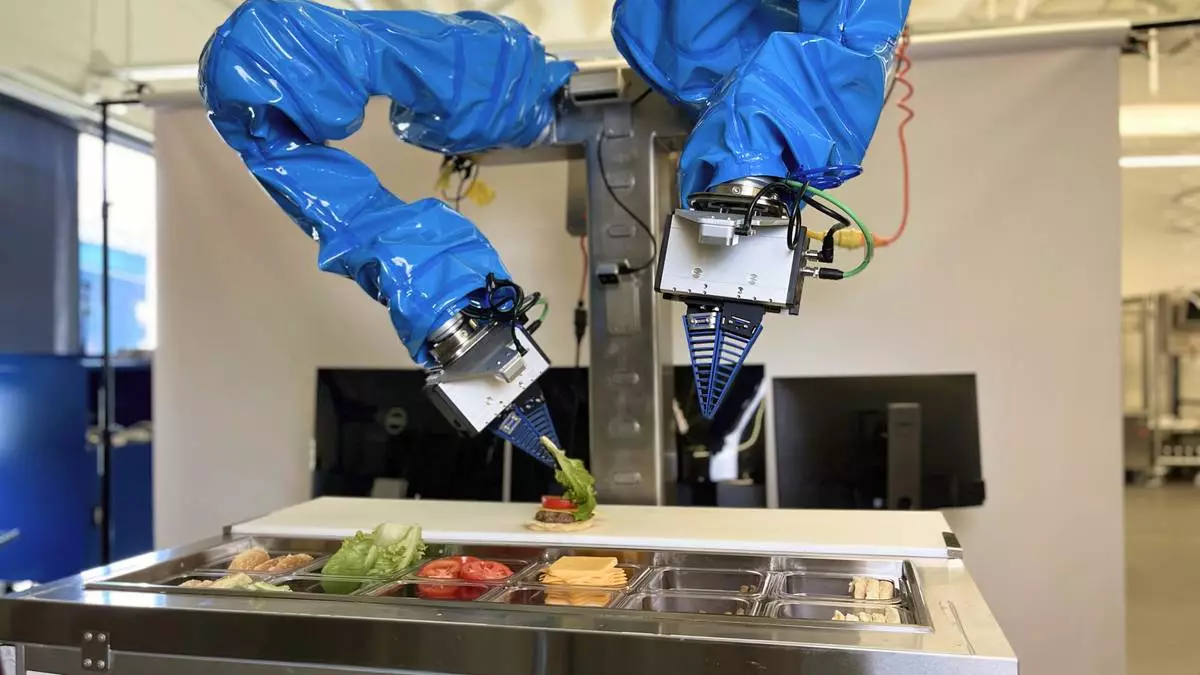
Chef's bi-manual physical AI system for prep table food assembly

MIAMI (AP) — A close ally of ousted Venezuelan President Nicolás Maduro was charged Monday with bribing top officials to steal hundreds of millions of dollars from lucrative contracts to import food at a time of widespread hardship in the South American country.
Alex Saab made his initial court appearance after being deported over the weekend by acting President Delcy Rodríguez as part of a purge of insider businessmen who are believed to have enriched themselves through corrupt dealings with Maduro.
Shackled and wearing a beige prison uniform, Saab answered “Yes, ma'am,” in English after being asked by a federal judge in Miami whether he understood the charges against him: a single count of money laundering tied to a decade-old conspiracy to create fake companies, falsify shipping records and skim from government contracts to import food from Colombia and Mexico.
As U.S. sanctions crippled Venezuela's foreign trade, Saab and others allegedly expanded their corrupt influence deep inside the Maduro government, accessing billions of dollars in oil sales from state-run oil company PDVSA, prosecutors said in a five-page indictment unsealed Monday.
Saab, 54, was previously charged during the first Trump administration in 2019 and then arrested during a refueling stop in Cape Verde on what the Venezuelan government described as a high-level humanitarian mission to Iran.
But President Joe Biden pardoned him in 2023 in exchange for the release of several imprisoned Americans in Venezuela and the return of a fugitive foreign defense contractor. The deal, part of a failed effort by the Biden White House to lure Maduro into holding a free presidential election, was harshly criticized by Republicans and federal law enforcement officials, who began investigating Saab for other alleged crimes not covered by the narrowly tailored pardon.
U.S. officials have long described Saab as Maduro's “bag man” and could ask him to serve as a valuable character witness against his former protector, who is awaiting trial on drug charges in Manhattan after being captured in a raid by the U.S. military in January.
The new U.S. prosecution of Saab is taking place against the backdrop of the Trump administration’s efforts to overhaul relations with Venezuela.
Trump and senior administration officials have heaped praise on Rodríguez, who has thrown open Venezuela's oil industry to U.S. investment at a time of surging oil prices tied to the war in Iran. In exchange, the White House has dampened talk of elections, which are required by Venezuela's constitution within 30 days of the president becoming “permanently unavailable.”
But Rodríguez faces enormous domestic pressures from the more radical, ideological wing of the ruling socialist party, some of whom, like Interior Minister Diosdado Cabello, wield great influence inside Venezuelan security forces and face criminal charges themselves in the U.S.
Mario Silva, who for years spread pro-government propaganda as the host of a program on state TV before being removed from the airwaves shortly after Maduro's capture, questioned the legality of Saab's removal, saying it violates a constitutional ban on extradition.
“The imperialists don't negotiate. They conquer, test and probe — until our country shatters,” said Silva in a livestream posted Sunday on social media. “Nobody is safe right now.”
Silva also pointed out that the efforts of Venezuela’s government to previously secure the release of Saab outmatch the work done to bring home Maduro and former first lady Cilia Flores.
Perhaps anticipating blowback, Venezuela's immigration authority, SAIME, in a statement Saturday referred to Saab only as a “Colombian citizen who is implicated in committing several crimes in the United States of America, a fact that is widely known, notorious, and heavily documented in the media.”
Cabello on Monday expressed support for Saab’s deportation, arguing that he had falsified his national ID card and was not a Venezuelan citizen.
Rodríguez's silence stands in contrast to the praise she heaped on Saab a few years ago during the international campaign Venezuela's government mounted to free him from U.S. custody. At the time, Rodríguez described him as an “innocent Venezuelan diplomat” who had been illegally “kidnapped” while on a humanitarian mission to Iran to circumvent the “immoral, imperial blockade” imposed by the United States.
As Rodríguez cements her rule, she has distanced herself from Saab, firing him from her Cabinet and stripping him of his role as the main conduit for foreign companies looking to invest in Venezuela.
Saab amassed a fortune through Venezuelan government contracts. The indictment against him in 2019 was tied to a government contract for low-income housing that was never built.
The new indictment stems from another case the Justice Department brought against Saab’s longtime partner, Alvaro Pulido, over the so-called CLAP program set up by Maduro to provide staples — rice, corn flour, cooking oil — to poor Venezuelans at a time of rampant hyperinflation and a crumbling currency.
Saab had been identified in the 2021 indictment as “Co-Conspirator 1" and allegedly helped set up a web of companies used to bribe a pro-Maduro governor who awarded the business partners a contract to import food boxes from Mexico at an inflated price.
Saab secretly met with the Drug Enforcement Administration before his first arrest and, in a closed-door court hearing in 2022, his lawyers revealed that the businessman for years had helped the DEA untangle corruption in Maduro’s inner circle. As part of that cooperation, he forfeited more than $12 million in illegal proceeds from dirty business dealings.
AP writer Regina Garcia Cano in Mexico City and Eric Tucker in Washington contributed to this report.
This story is part of an investigation that includes the FRONTLINE documentary “Crisis in Venezuela,” which aired Feb. 10, 2026, on PBS. Watch the documentary at pbs.org/frontline, in the PBS App and on FRONTLINE’s YouTube channel.
FILE - Venezuela's President Nicolas Maduro, left, and Alex Saab stand together during an event marking the anniversary of the 1958 coup that overthrew dictator Marcos Perez Jimenez, in Caracas, Venezuela, Jan. 23, 2024. (AP Photo/Jesus Vargas, File)