A single photograph from a state banquet is currently electrifying the tech world. Apple CEO Tim Cook and Tesla founder Elon Musk sit attentively on either side of a woman with no internet empire or privileged pedigree. That woman is Zhou Qunfei, once a 15-year-old school dropout who forged her steel on a Shenzhen assembly line.
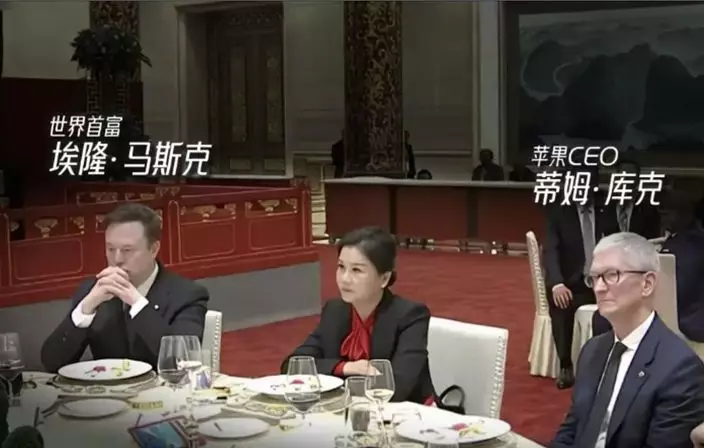
The founder of Lens Technology has become the undisputed linchpin of the China-US tech supply chain. Known affectionately as "China's most remarkable factory girl," Zhou commands a net worth of roughly 125 billion yuan and a formidable technological arsenal, according to Zhiguchushi Trend. Her prime seating between two American titans exposes a larger truth about China's precision manufacturing taking centerstage in the global AI hardware race.
Click to Gallery
Zhou Qunfei's worker ID card from her early days in Shenzhen. (Internet photo)
From factory girl to publicly listed startup founder.
Known as the "Queen of Glass," Zhou Qunfei (right) maintains a low profile.
Zhou's beginnings were defined by absolute scarcity. Born in a rural village in Xiangxiang, Hunan, she lived in a leaking thatched house with a blind father and survived by weaving bamboo baskets and growing rice after her mother's early passing. Shenzhen's reform and opening-up policies gave the 15-year-old an escape hatch. Armed with nothing but resilience, she travelled south with relatives to toil on a labour-intensive glass-cutting assembly line.
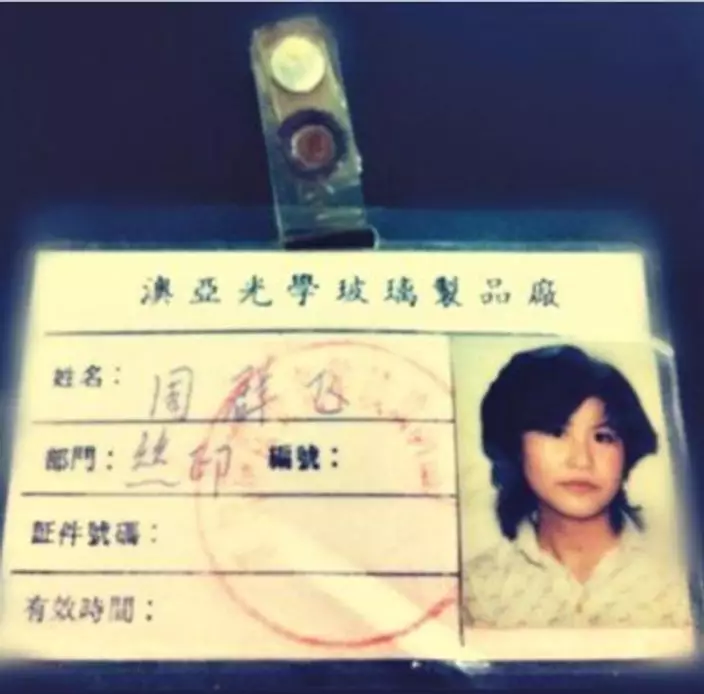
Zhou Qunfei's worker ID card from her early days in Shenzhen. (Internet photo)
This was no romantic origin story. It was the brutal, unvarnished reality of China's first generation of industrial workers. Yet this grueling crucible gave Zhou an intimate understanding of manufacturing pain points, driving her to channel poverty into relentless momentum.
On the factory floor, Zhou quickly separated herself from the pack. While other workers rested, she volunteered for extra shifts to master new techniques and spent her nights earning certificates in accounting, computing, and customs clearance. Even her driving test showcased this drive: she bypassed the standard Class C licence for the demanding Class B, simply because she liked doing things differently.
Just three months in, she hit a learning ceiling and decisively quit. Her boss, recognizing her raw potential, challenged her to master a complex, entirely new production process. Armed only with a borrowed Peking University library book on precision printing, she taught herself the mechanics and single-handedly turned a hemorrhaging branch factory into a profit engine.
Workplace friction eventually pushed the 23-year-old to strike out on her own. Backed by 20,000 Hong Kong dollars and seven family members, Zhou transformed a village flat into a makeshift factory, building equipment late into the night. This grueling "living in the factory" ethos was the lifeblood of the Pearl River Delta's early reform days, though very few parlayed it into global dominance.
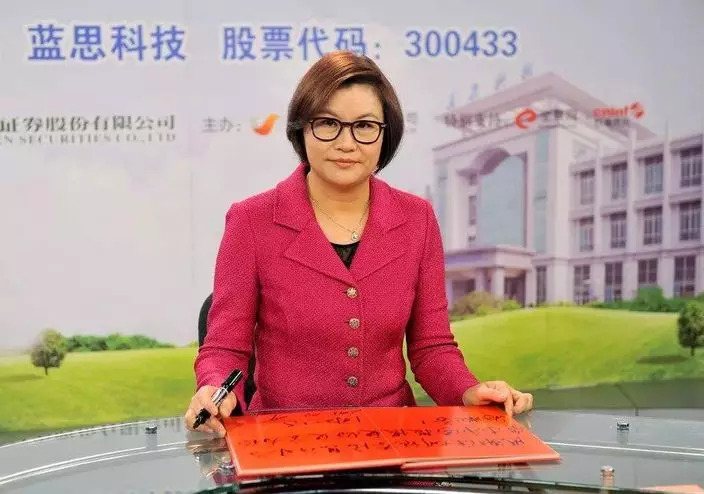
From factory girl to publicly listed startup founder.
The ultimate game-changer was a strategic pivot from watch glass to mobile phone screens. TCL demanded a screen that could drop without shattering, forcing Zhou’s team to crack the code on ion exchange technology. Lens Technology became the first supplier globally to pass the test, instantly securing a coveted spot in Motorola's supply chain.
But technological triumph invited cutthroat commercial warfare. Rivals slashed prices, hoarded raw materials, and choked off her supply lines. After hitting a dead end seeking support from Japanese clients in Hong Kong, Zhou sent a direct distress flare to Motorola's headquarters coded "LS119." This audacious move broke the siege and cemented Lens Technology's international credibility.
The reality is that technical breakthroughs are merely the opening act. This near-death experience exposed the brutal battlefield facing China's private manufacturers abroad. Securing the supply chain and defending commercial trust proved just as critical as engineering the glass itself.
Today, Lens Technology dominates the smartphone glass arena. It stands alongside Luxshare Precision and Goertek as one of the "Apple Chain Big Three," churning out more than half of the world's smartphone screens. Yet Zhou refuses to coast on consumer electronics, pivoting aggressively since 2025 into embodied AI, AI servers, and commercial aerospace.
The hardware revolution is already bearing fruit. In April 2026, a robot dubbed "Lightning" claimed first place at a competition in Yizhuang, Beijing, featuring 132 core metal components forged by Lens Technology. Financials now show the company mass-producing robotic joints and dexterous hands for Tesla, while deeply integrating into the assembly of the Zhiyuan "Lingxi X1" robot.
This transition from "Queen of Phone Glass" to "the woman behind the robots" is a powerful bellwether. It mirrors the relentless upward march of China's hardware manufacturing into high-value, intelligent sectors. Zhou's company is not just evolving alone; it serves as a live tracking shot for an entire ecosystem’s maturation.
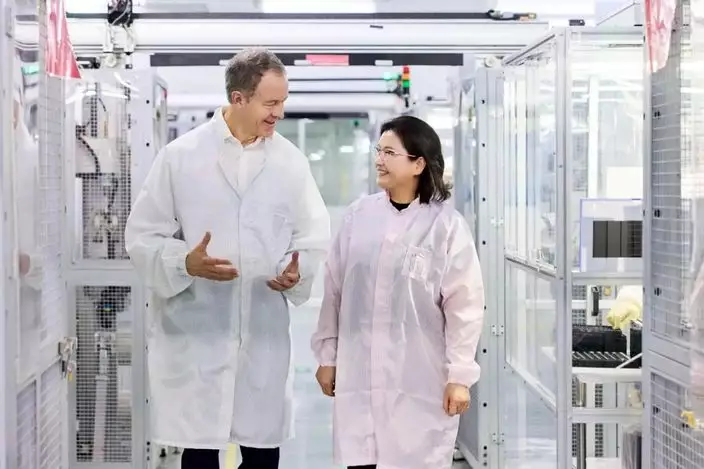
Known as the "Queen of Glass," Zhou Qunfei (right) maintains a low profile.
At 56, Zhou still operates at breakneck speed. She effectively lives at the office, routinely working past midnight with her bedroom just down the hall. When asked by Phoenix TV host Wu Xiaoli if she would change anything, Zhou was blunt: "If my character stayed the same, I would still walk this path. I have a bit of a competitive streak, and I am never content with the status quo."
Make no mistake: these traits define a distinct breed of real-economy entrepreneurs in China. They hunt for breakthroughs amid crippling scarcity, stubbornly dismantle technical barriers, and reinvent themselves ahead of industry cycles. Their individual battles run parallel to China's transformation from the "workshop of the world" into the undisputed core of global supply chains.
That banquet seating was more than mere diplomatic protocol. Zhou Qunfei’s metamorphosis from traditional factory boss to indispensable AI hardware supplier provides a masterclass for those who wish to understand the sheer resilience of China's supply chain and its drive for technological self-reliance.
The image of Cook and Musk flanking a Chinese manufacturer sends an undeniable message. The highest echelons of the global tech industry simply cannot function without deep integration from China's manufacturing base. Zhou sitting firmly in the center validates her empire while honouring the blood and sweat of tens of millions of Chinese industrial workers.
It took forty years to travel from a Shenzhen assembly line to the head table of a state banquet. In that time, China aggressively scaled the value chain from basic labour to commanding the world's most comprehensive industrial system. Countless iterations of Zhou Qunfei have spent decades pushing the technological envelope in village flats, labs, and factories across the nation.
This achievement has been earned by generations of sweat and perseverance. Yet among this vast army of strivers, Zhou Qunfei stands apart. She conquered the supply chain not through luck, but through lethal foresight and an absolute refusal to surrender.
Mao Paishou
** 博客文章文責自負,不代表本公司立場 **
France's National Assembly has passed the "Anti-Ultra-Fast-Fashion Law." The legislation aims to curb the flood of low-cost clothing into the French market. In practice, it primarily targets Chinese cross-border e-commerce platforms such as Shein, Temu (Pinduoduo's cross-border e-commerce brand) and AliExpress.

France's new law targets Chinese low-cost clothing platforms like Shein.
However, European homegrown fast-fashion giants like Zara and H&M are exempted.
China's Ministry of Commerce has lodged a formal protest, saying the law violates the World Trade Organization's non-discrimination principle and constitutes a trade barrier. Beijing has warned it will retaliate if necessary.

Commerce Ministry blasts discriminatory curbs, vows countermeasures if Chinese firms' rights are violated.
Under the law, a fine of between €0.25 and €6 will be imposed on each qualifying item starting in 2026. That fine rises to as much as €10 per item by 2030. France's National Assembly additionally passed a government amendment that toughened the penalties further. The amendment raises the maximum per-item fine in 2030 to €20, while capping total fines at 50 percent of a product's pre-tax price.
Separately, the European Union formally scrapped the customs exemption for parcels valued under €150 starting July 1. It now imposes a flat €3 duty on every low-value parcel shipped directly from outside the bloc. Together, these two policies have created unprecedented barriers for Chinese cross-border e-commerce platforms entering overseas markets.
A Ministry of Commerce spokesperson criticized France for adopting discriminatory restrictions. The spokesperson said the legislation seriously distorts fair competition, and China views the matter with grave concern.
The law is framed under the guise of "environmental" and "sustainability" standards, but in effect it is an exclusionary measure that may breach WTO non-discrimination rules. It already constitutes a trade barrier against China, a stark departure from the fair competition and free trade principles France claims to champion.
This, the spokesperson added, would harm not only the legitimate rights of Chinese companies but also French consumers' own interests.
China has urged France to immediately correct its discriminatory practices. Beijing says it will closely monitor how the implementing rules are drafted and enforced. It will take necessary countermeasures should the legitimate rights of Chinese firms be infringed.
Three Thresholds, One Clear Target
The law sets out three thresholds for products. Platforms fall under strict regulation if they launch more than 15,000 new styles a year on the EU market, sell items averaging below €5, or offer products with an expected lifespan of fewer than 30 washes. Meeting any single criterion is enough to trigger the rules. Critics say this framework appears "tailor-made" for Shein, Temu and AliExpress.

France's law looks "tailor-made" to target platforms like Temu, critics say.
France's Minister for Small and Medium-sized Enterprises and Commerce, Serge Papin, said bluntly that the law targets the fast-fashion industry's major players. He explicitly named Shein, Temu and AliExpress, singling out their business model based on stockpiling and constant turnover.
According to China News Weekly, Shein, Temu and other Chinese cross-border platforms have reshaped France's fashion market since entering the country. They have done so by riding on rock-bottom prices and a relentless pace of new arrivals. Public data show these platforms now account for 6 percent of total apparel purchases in France. Shein ranks among the country's top five clothing brands by sales.
In terms of consumer behavior, ultra-fast fashion and second-hand resale together make up a quarter of the French apparel market. Some 38 percent of French consumers have tried a Chinese cross-border platform. That figure rises to 56 percent among women aged 16 to 24.
Liu Beibei is head of overseas business at Dongguan Tongfa Knitting, a long-time contract manufacturer for European clothing brands specializing in mid-to-high-end garments. She said overseas clients have asked her why other companies' wool products are sold so cheaply after spotting the low prices on fast-fashion platforms.
Liu admits the cross-border platforms have dealt a heavy blow to Europe's fashion industry.
Using wool products as an example, she notes that the source of the wool, farming methods and spinning techniques all affect final costs. A 100 percent wool sweater can sell for as little as €40 or as much as €200, but there is a big difference in craftsmanship and quality. "There's a lot beneath the surface," she says. She believes younger consumers' preferences are shifting toward platforms offering faster new arrivals and lower prices.
A "Tiered Eco-Fine" at the Core
Reports indicate the scheme's core mechanism is a "tiered eco-fine." In 2026, fines of €0.25 to €12 will apply per item. That maximum rises to €20 per item by 2030, capped at half the product's price. This means a dress selling for €5 could face a fine of up to €2.50. On top of the EU's flat €3 duty per parcel, this would push up costs for consumers substantially.
Media calculations suggest a T-shirt selling for €10 online costs €3.50 to manufacture. Add €2 for air freight, €1.50 in import VAT, €2.50 for last-mile delivery and €1 in platform commission. That leaves only €0.50 in profit before the new €3 duty, which would push the platform into an outright loss.

Analysts warn other European nations may follow suit against platforms like AliExpress.
Kang Di is a lawyer at Beijing Ceehin (Shenzhen) Law Firm specializing in cross-border compliance and international trade rules. She said the law poses a substantive and far-reaching impact on platforms like Shein and Temu.
Kang noted the law introduces a "tiered eco-fine" mechanism, an EPR Bonus-Malus system, that directly squeezes the price advantage and profit margins of platforms selling low-priced items. This exposes companies to clear compliance red lines.
She added that the law also cuts off the social media influencer marketing channels these platforms rely on heavily. Non-compliant influencers face administrative fines of up to €100,000.
There’s a deeper political logic behind France's tough unilateral legislation in the fast-fashion sector, according to Kang. It is well rooted in a structural crisis facing its domestic retail sector.
Homegrown brands carrying the collective memory of France's middle class, such as Camaïeu and Naf Naf, have gone bankrupt or entered judicial restructuring one after another. France's traditional retail sector largely blames external competitive pressure for these struggles. It points to the tax exemption once enjoyed by Chinese cross-border platforms on small parcels, and to China's supply-chain flexibility.
Kang suggests the law is largely a defensive response to global supply-chain restructuring, one that objectively erects a trade barrier to protect the domestic textile industry.
Zara and H&M Left Untouched
European fast-fashion giants Zara, H&M and Primark are all exempt from the law. France's commerce minister openly stated, "We are here to protect French retailers." A French Senate rapporteur reportedly confirmed the government had already run simulations before the standards were finalized, showing only Chinese platforms would fall under the regulatory net.
According to China News Weekly, citing Song Liwei, a senior consultant at Shanghai Sanwei Law Firm, France's strained textile-recycling system and above-average carbon emissions from its textile sector are shared environmental problems across Europe.
The law traces its legislative roots to France's Anti-Waste and Circular Economy Law and its Climate Change Response and Resilience Law. Environmental NGOs, circular-economy associations and the garment-repair industry all lobbied throughout the process. Curbing single-use consumption and promoting circular fashion were the law's publicly stated goals.
The text itself names no specific country, platform or region, avoiding direct discrimination on paper.
However, Song also noted the rules effectively target Chinese cross-border direct-mail platforms, while European homegrown fast-fashion brands escape regulation. This has prompted even voices within the French parliament to criticize the law as "hijacked by lobbying from the domestic fashion industry, deliberately exempting Europe's own giants."
Fears of a Europe-Wide Domino Effect
Beyond French regulation, Chinese cross-border e-commerce platforms also face spillover regulatory pressure across Europe. The EU's Environment Council has begun coordinating related action. The Netherlands is raising its clothing recycling targets, while Germany is launching legislation for textile Extended Producer Responsibility (EPR).
Song warned this could trigger a chain reaction of other EU member states following France's lead. That would eventually form a unified regulatory framework across the entire EU, one that would fundamentally rewrite the underlying logic of how Chinese fast-fashion brands expand overseas.