The 2026 Beijing International Auto Show is underway — and the world is watching. The event has become a showcase of China's sweeping lead in new energy vehicles and intelligent driving technology. Foreign media are marvelling at one striking figure: the average price of a new car in the United States is enough to buy five Chinese electric vehicles.
Yet even as that price gap stuns observers, analysts warn that China's auto industry is already moving beyond the price battlefield. AI-assisted driving, ultra-fast charging, and smart cabin systems are the new frontlines — and the "price war" is becoming a "tech war."
Click to Gallery
The 2026 Beijing International Auto Show is currently underway, drawing global attention as a focal point for the world's automotive industry.
Xiaomi's SU7 model on display at the auto show, with its components disassembled for viewing.
BYD constructed a –30°C extreme cold testing chamber inside its exhibition hall, demonstrating that its batteries can still fast-charge in freezing conditions.
Mercedes-Benz's latest GLC SUV on display at the 2026 Beijing Auto Show.

The 2026 Beijing International Auto Show is currently underway, drawing global attention as a focal point for the world's automotive industry.
Reuters reported on April 28 that the contrast could hardly be more stark. China, the world's largest auto market, has driven new car prices down to a fraction of those seen in the United States, the world's second-largest market.
The numbers tell the story. Kelley Blue Book, the American automotive valuation guide, puts the average listed price of a new car in the US at US$51,000 as of March. In China, automotive information platform DCar shows more than 200 electric vehicle models — including hybrids — priced below US$25,000.
Reuters compiled a list of five of China's best-selling electric vehicles, all priced below US$12,000. They are: the Geely EX2 at US$10,060; the Wuling Hongguang Mini EV at US$6,560; the BYD Seagull at US$10,200; the BYD Yuan UP at US$10,945; and the BYD Qin Plus DM at US$11,675.

Xiaomi's SU7 model on display at the auto show, with its components disassembled for viewing.
The prices are low, but don't mistake these cars for cramped econoboxes. Auto analyst Felipe Munoz told Guancha.cn: "Once you get inside, you don't feel like you're in a small car — both the quality and the sense of space exceed what people expect from a compact vehicle."
Ethan Robertson, co-founder of the Wheelsboy YouTube channel, walked his viewers through the numbers: "You're looking at a car that's maybe $30,000 — a six-seat SUV with an extended-range powertrain, a refrigerator, a TV in the back, giant screens. And again, it's $30,000. Whereas in places like the United States, unfortunately, $30,000 barely gets you into any electric vehicle or hybrid at that price point." His largely American audience reacts with a mix of fascination and frustration. "Our comment section is full of people saying things like, 'I can't believe the government won't allow them to sell this car in my country,'" Robertson told Reuters.
Make no mistake: the price advantage is only part of the story. Multiple foreign outlets report that China's auto industry is shifting from a "price war" to a "tech war." Bloomberg declared that "China is firmly in the driver's seat," with foreign legacy automakers scrambling to survive through partnerships with Chinese tech companies. The Associated Press described China's auto industry as making "aggressive and rapid technological advances," setting the global pace in electric vehicles, batteries, and intelligent driving — with European, American, and Japanese brands being overtaken.
Reuters pointed out that Chinese automakers are now directly challenging the German luxury segment. This is no longer a simple "price war" — it has escalated into a "value-for-money war." A wave of high-end smart vehicle models is entering the market at prices well below those of German luxury brands.
Germany's own press tells the same tale. The Frankfurter Allgemeine Zeitung reported that even before the show opened, Chinese brands were pulling out all the stops — luxury hotels, factory tours, and chartered flights for Western influencers and industry journalists, on a scale never seen before. Over 180 new models were unveiled at once. Some brands went further still, announcing global expansion plans on the spot.
A board member of a German automaker was compelled to admit that the companies truly leading the industry — the ones commanding genuine respect from competitors — are Chinese firms. They are masters of Chinese-style efficiency and innovation.
The ambition is global, and the moves are concrete. Xiaomi — which only entered the car business two years ago — has planted its R&D centre directly in Munich, Germany. The company has poached more than ten senior executives and top designers from BMW, Audi, Porsche, Lamborghini, and Mercedes-Benz, deploying the world's finest talent to build products for a global audience. Xpeng Motors has announced it will bring its autonomous driving system to Europe by end of this year or early next year. Geely is targeting exports of one million vehicles next year, with ambitions to push toward 1.5 million in the near future.

BYD constructed a –30°C extreme cold testing chamber inside its exhibition hall, demonstrating that its batteries can still fast-charge in freezing conditions.
BYD delivered perhaps the show's most visceral demonstration. The company constructed a –30°C extreme cold testing chamber inside its own exhibition hall, proving to the world that its batteries can still fast-charge in just 12 minutes in freezing conditions. That directly addresses the biggest anxiety for European consumers. Nearly half of BYD's current vehicle sales are now overseas.

Mercedes-Benz's latest GLC SUV on display at the 2026 Beijing Auto Show.
The rise of Chinese automakers has pushed German carmakers to the brink. Since 2019, German brands' sales in China have plummeted by nearly a quarter, falling below four million units. By 2025, German brands held just 16.4% of the Chinese market — a sharp drop from 22.2% in 2023 — with BMW, Mercedes-Benz, Audi, Volkswagen, and Porsche all posting losses.
A senior executive at a Porsche-affiliated consultancy was blunt: many German managers have been disconnected from the Chinese market for too long. German automakers are now being forced to swallow their pride — developing models locally in China and seeking partnerships with Chinese carmakers to cut costs.
Experts at international consultancy Horváth note that one in every two Europeans is now considering buying a Chinese car. Chinese vehicles already hold more than 10% market share in Norway, the UK, and Italy, and account for 14% of Europe's pure electric vehicle market. At this trajectory, that share is expected to rise to 15–25% within four to five years, with the potential to surpass 30% within a decade.
Mao Paishou
** 博客文章文責自負,不代表本公司立場 **
When the Russia-Ukraine war broke out, energy costs in Germany, a country heavily reliant on Russian natural gas, spun instantly out of control. Electricity prices at one point surged sevenfold, forcing ordinary people to dream up all manner of clever tricks to save on their power bills. One of those tricks has become a distinctive sight on German streets: the "balcony solar" system.
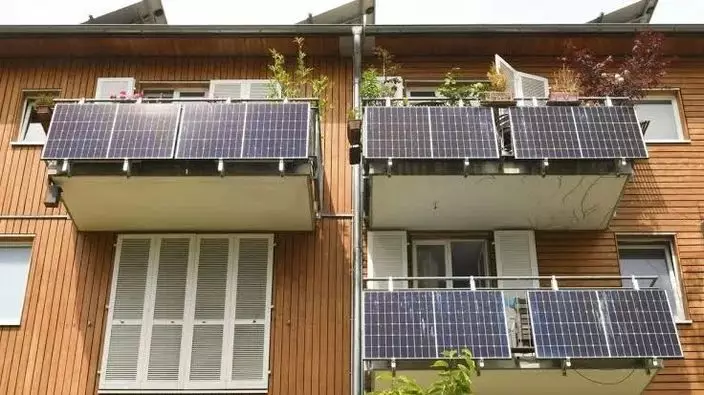
To cut power bills, Germans turned balconies into power plants.
"Balkonkraftwerk": Miracles On Balconies
This simple generating setup costs just a few hundred euros, yet more than 1.33 million units have been installed across Germany in three years. The German government has even amended the law, granting tenants with no rooftop of their own priority installation rights.
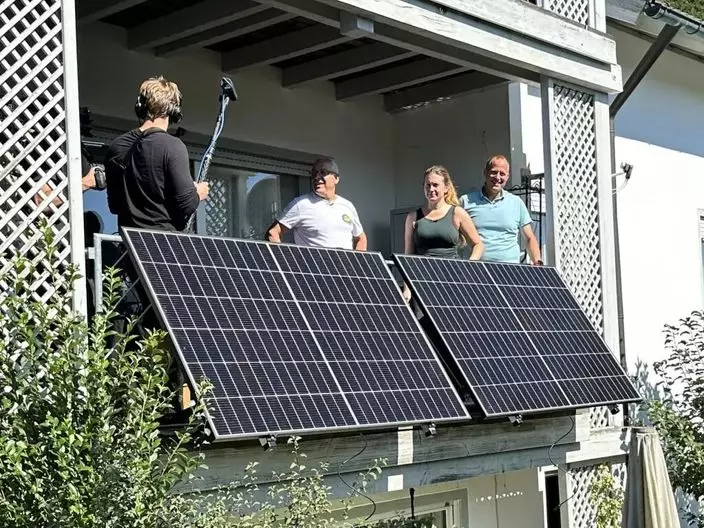
What Germans call the "Balkonkraftwerk", or "balcony power plant", is actually just one or two solar panels hung outside the railing, an inverter the size of a shoebox, and a plug that goes into a household socket. The current then flows back into the home: the inverter sets its output voltage slightly higher than the 230V household supply, so solar power feeds in reverse into the wiring. A small storage battery can be added to keep the power coming at night.
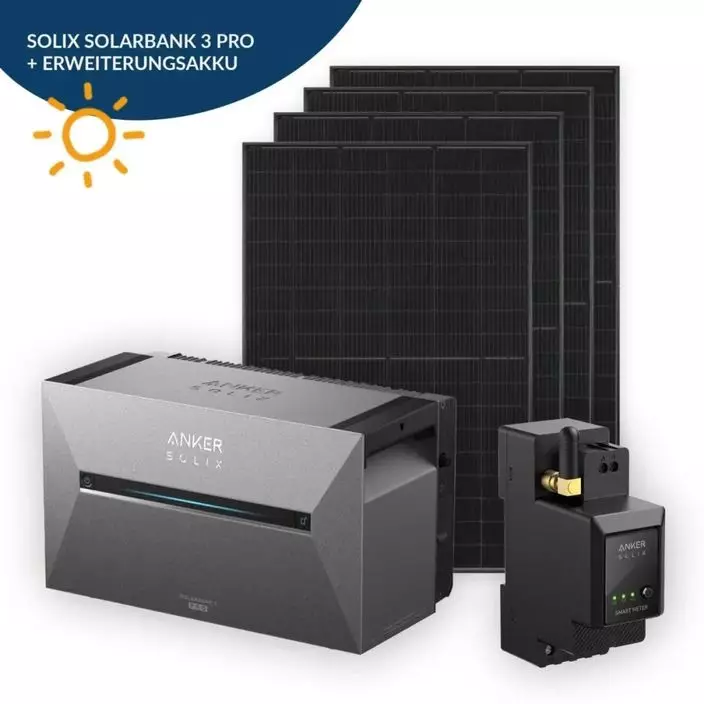
The "Balkonkraftwerk": railing-hung panels, a shoebox-sized inverter, one plug.
The principle is not complicated. It works rather like a water supply system. Pipes maintain a steady pressure; turn on the tap and the pressure difference pushes the water out. The grid works the same way. China's standard household voltage is 220V and Germany's is 230V. The inverter in a balcony photovoltaic module simply nudges its output voltage slightly above the socket voltage, pushing solar power back in.
Once the current enters the socket, it is consumed on the spot, "drunk up" by the appliances at home. Less electricity is drawn from the grid, and the meter turns more slowly. If no appliances are running, then in areas where bidirectional metering is permitted, the surplus power flows out of the home along the mains line and back into the grid.
A Few Hundred Euros, Real Money Back
A "balcony power plant" sells for roughly 200 to 500 euros, depending on output. The best-selling 800W model goes for about 350 euros. A solar-plus-storage package with a battery costs between 800 and 1,500 euros.
A granny who lives in Stuttgart finds a 300W system enough to cover her basic needs: lighting, the router and electric fans. She now checks the next day's sunshine forecast every evening. If the sun will be out, she schedules a bike charge or runs the dishwasher. "Save whatever you can," she says.

Granny's 300W system covers her lights, router and fans.
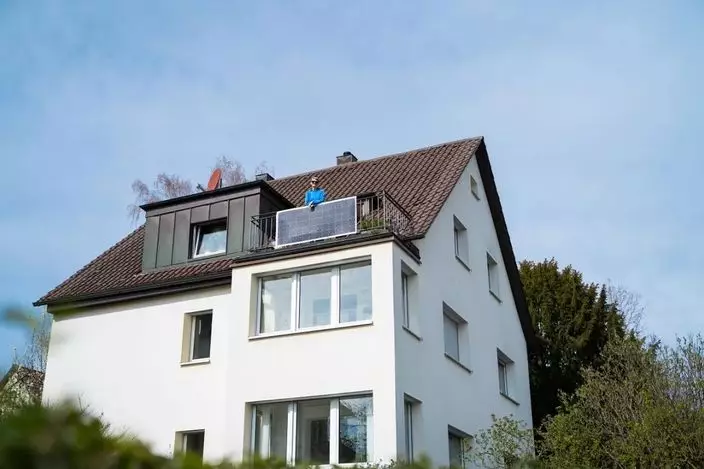
Her nightly ritual: the sunshine forecast. "Save whatever you can."
Weyland, a young man in the northern city of Kiel, hung two panels with a combined output of 600W on the balcony of his rented apartment. In good weather they cover half of his daily electricity use. The whole system cost under 500 euros, yet saves him more than 90 euros a year, a payback period of about five years. These days he spends his time glued to the app, watching the generation figures roll in.

Kiel renter Weyland's two balcony panels total 600W.
In southern Germany, where the sunshine is better, a standard 800W system generates about 750 to 850 kWh a year. At last year's average price of 0.39 euros per kWh, that puts up to 295 to 334 euros a year back in the user's pocket.
For an ordinary household consuming 3,000 kWh a year, saving is about 25 to 28 percent. A single-person household using around 1,500 kWh could ideally save 50 to 57 percent.
No Roof? No Problem
Europe used to put solar panels on rooftops. But more than half of Germany's population lives in rented housing, the highest share in the EU. That means no roof, no land, nowhere to put panels, and no eligibility for the complicated installation and grid-connection approval process.
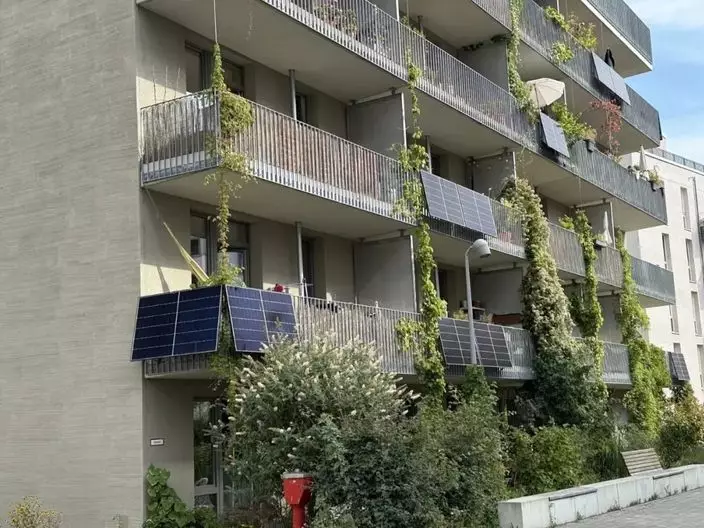
No roof, no problem: balcony solar is the tenant's lifesaver.
That was when Chinese manufacturers stepped up, Anker Innovations, EcoFlow and Zendure among them. They launched lightweight, low-cost balcony solar kits that skip the tedious paperwork and are far easier to use.
Panels have been slimmed down from the traditional 20kg to just 3 to 5kg. Hook-style railing clamps fix them in place with a few screws. Some models can simply be lashed on with metal cable ties, and they can be taken down easily when moving.
Voltage has dropped from the 600V to 1,000V high-voltage direct current of rooftop solar to a safe 30V to 60V. The plug goes straight into an ordinary socket, and monitoring is done entirely through an app. Installation and use are virtually "zero-threshold". German young people love it. Chinese manufacturers have turned solar "engineering" into a consumer electronics product for everyone.
Berlin Gives the Green Light
The German government has also given the green light. A legislative amendment in May 2024 allows self-installation without prior approval; simple registration afterwards is enough. Balcony solar is now a "privileged installation", on par with disabled-access facilities and EV charging points. Landlords and owners' committees may not block installations on grounds such as "spoiling the view". A landlord who wants to refuse must prove a safety hazard; if the tenant can fix the hazard, the installation goes ahead anyway. The government also waived the 19 percent VAT, and cities including Berlin and Stuttgart have rolled out dedicated subsidies of up to 500 euros. All income from generation is exempt from personal income tax.
With the government "loosening the reins", balcony solar has grown rapidly. Around 260,000 units were added in 2023. The figure soared to 435,000 in 2024, and another 430,000 or so were registered in 2025. That is 1.1 million units installed at lightning speed in three years. By May this year, cumulative installations had reached 1.33 million, the equivalent of more than a thousand German households signing up every day.
Policy green light: install first, register afterwards.
Other European countries have followed suit. The Netherlands had reached 600,000 cumulative installations by the end of 2025, the highest penetration after Germany, with nearly 5 percent of households equipped. Austria has installed 250,000 units, Italy 200,000 and Belgium 150,000.
Made in China, Invisible at Home
Of the solar panels imported into Europe, 98 percent come from China, and 70 percent of micro-inverters are Chinese-supplied. In balcony energy storage, Chinese companies had already secured the first seven places of the top ten best-seller spots in Europe as early as the third quarter of 2024. Industry forecasts see global installed balcony solar capacity exceeding 50 gigawatts by 2030, with China likely to claim more than 40 percent of it.
Yet in China itself, these products are practically invisible in cities. For one thing, electricity in China is genuinely cheap. For another, China follows a "centralized plus distributed" path.
The northwest builds gigawatt-scale centralized solar bases across deserts and the Gobi on a massive scale, using ultra-high-voltage transmission to solve the geographic mismatch. The east develops distributed solar on factory and detached-house rooftops. Rural rooftops easily run to tens or even hundreds of square meters, accommodating 20kW to 50kW systems. That is dozens of times the generating capacity of balcony solar.
With no domestic demand to speak of, Chinese companies have nonetheless struck overseas demand with pinpoint precision and taken command of the global balcony solar market. The same story has played out with saddle-style window air conditioners, fully automatic lawnmowers, electric-assist bicycles and AI game-tracking cameras. To Western politicians, China's technological rise is a threat. But to ordinary people abroad, Chinese products have made life better, time and again.