Xi Jinping and Donald Trump sat down in Busan for an hour and forty minutes, and here's what they walked away with: China agreed to buy American soybeans again. Trump cut fentanyl tariffs from 20% to 10% and knocked China's overall tariff rate from 57% down to 47%. Trump declared victory on rare earths, claiming they'd locked in a one-year deal that "All of the rare earth has been settled”.
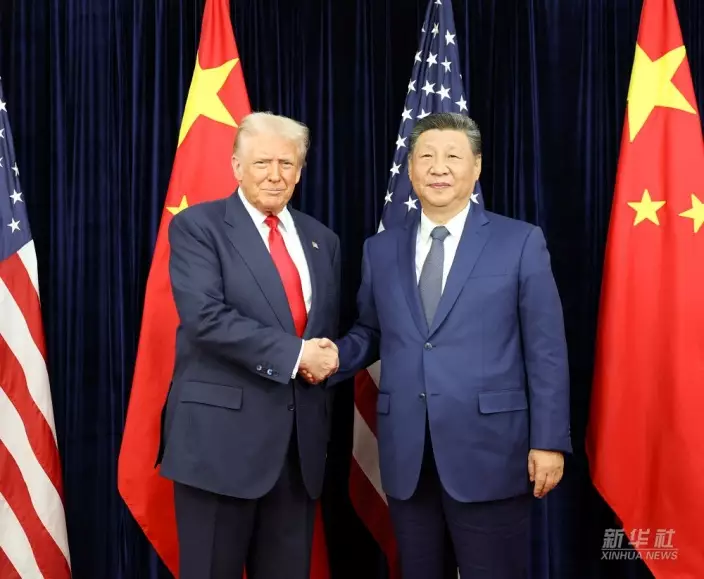
Presidents Xi and Trump met for nearly two hours in Busan, steering the crucial US-China relationship. Xinhua Photo
Following over six months of trade dispute beginning in early April, the standoff between China and the US appears temporarily settled. During the dispute, the US approach was characterized as inconsistent, while China was described as proceeding cautiously and deliberately. Significantly, China's counter-strategy transformed from a passive defensive posture to a proactive approach leveraging control over critical supply chains, granting it strategic initiative in trade disputes. Scholars are calling it China's "magnificent transformation."
Click to Gallery
Presidents Xi and Trump met for nearly two hours in Busan, steering the crucial US-China relationship. Xinhua Photo
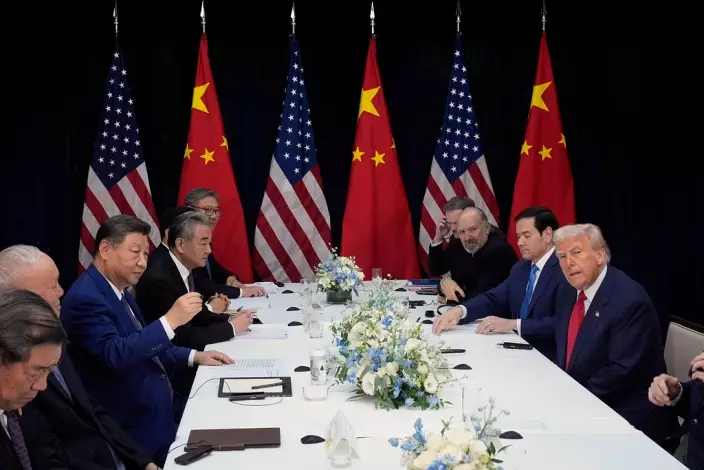
Xi reaffirms China's commitment to its own development path. AP Photo
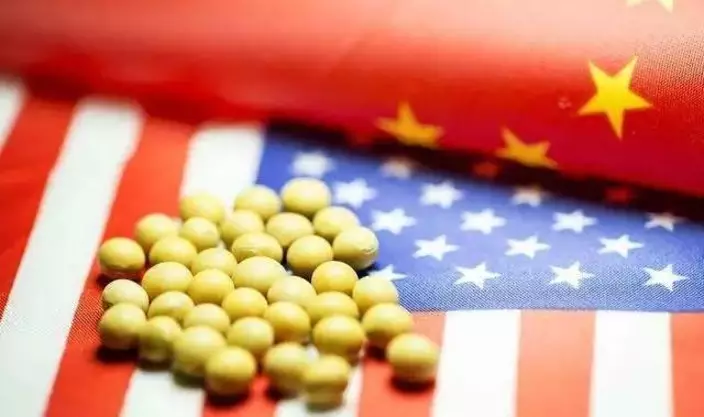
Early countermeasures targeted Trump's political base, hitting where it hurt—like halting soybean imports.
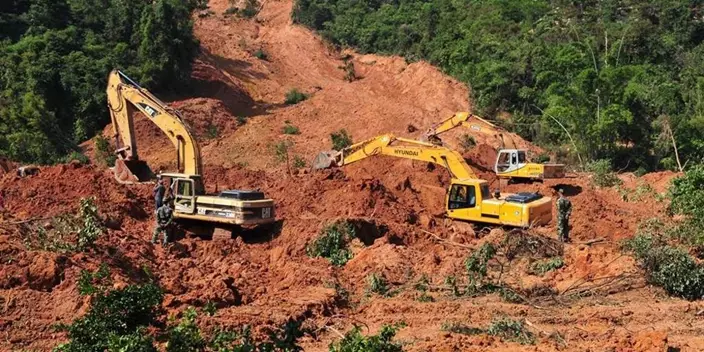
Seven years on, China leveraged its rare earth dominance to deliver precision strikes.
Partnership Over Punishment
Xinhua's report gave us the details. When President Xi Jinping met with former U.S. President Donald Trump, he framed the bilateral relationship not as a rivalry but as a necessary partnership shaped by history and mutual interest. Xi pointed out that while differences are inevitable between two major economies with distinct systems, their leaders must steer the ship steadily through challenges—focusing on cooperation over confrontation. When storms hit, the two leaders as helmsmen must grasp direction and control the overall situation, steering the China-US relationship steadily forward.
Xi underscored China’s robust economic resilience, citing a 5.2% growth rate in the first three quarters and a 4% increase in global merchandise trade—achievements secured despite internal and external pressures. He described China’s economy as a “vast ocean” with scale, resilience, and potential, fully capable of navigating risks.
For over 70 years, Xi noted, China has stayed committed to its own development path—never seeking to challenge or replace others. He urged that trade remain a “ballast” and “propeller” in bilateral ties, not a stumbling block.
Xi reaffirms China's commitment to its own development path. AP Photo
Both sides, he said, should prioritize long-term gains and avoid a cycle of retaliation, instead expanding the cooperation list through equal and respectful dialogue.
From Purchasing Power to Supply Chain Power
Xinhua reported that both heads of state agreed to strengthen bilateral cooperation in economic, trade, and energy sectors, promote people-to-people exchanges, and maintain regular contact. Trump said he looks forward to visiting China next year and invited Xi to visit the United States.
Wang Yiwei, a professor at the School of International Relations at Renmin University of China, told Observer Network that the shift in China's countermeasure methods reflects China's strength—from initially manifesting in purchasing power and market leverage to now demonstrating technological capability, complete industrial chains, and position in the global industrial chain division of labor.
Trump seems oblivious of China's "magnificent transformation." This China-US contest tested what kind of strength China truly possesses and forced the US to reassess China's capabilities.
Wang described China as a "machine" that has fully started operating. China no longer relys on single punches but rather deploys a series of combination punches. That's why China's countermeasures have become increasingly steady, precise, and powerful.
Calling It What It Is
Labeling the situation a “U.S.-China trade war” is misleading, Wang emphasized. It’s the Trump administration unilaterally initiated trade disputes in 2018. This China-US trade contest has continued for seven years, and China-US economic and trade relations have undergone several transformations.
In reality, it is the United States suppressing not only China but global trade—undermining multilateral rules. China’s actions are defensive, aimed at upholding a free, rules-based international order.
Thus, Wang concluded, America’s moves are “unjustified,” while China's countermeasures are "forced responses" aimed at supporting free market economy and trade globalization, as well as backing UN-centered multilateralism.
He added that over these seven years, China’s countermeasures evolved from tariff-based replies to sophisticated tools like entity listings, antitrust probes, and now rare earth export controls—striking at the U.S.’s technological Achilles’ heel.
Early countermeasures targeted Trump's political base, hitting where it hurt—like halting soybean imports.
Targeting Trump's Pressure Points
Wang Yiwei pointed out that during Trump's first term, China mainly targeted agricultural states and interest groups tied to his campaign, using methods like stopping soybean imports. This time, the focus shifted to high-tech dependencies—especially rare earths. China’s rapid digital and intelligent transformation caught Trump off guard.
New rare earth regulations introduced on October 9 drew intense international attention. The New York Times acknowledged that China’s move mirrors U.S. tactics but amplifies them through its dominance in mineral supply chains critical to chips, electric vehicles, and defense systems.
As reported by Observer Network, rare earth analyst Yang Jiawen of Shanghai Metals Market stated that China's dominance is unshakable, given its control of over 90% of global refining capacity and nearly half of all reserves. More crucially, China fully controls the entire supply chain, from raw ore to high-performance magnets, with zero reliance on external partners. Even U.S.-mined rare earth ore mostly requires processing in China.
Seven years on, China leveraged its rare earth dominance to deliver precision strikes.
Learning America's Playbook—And Playing It Better
The New York Times conceded that China has not only learned America’s supply-chain weaponization playbook—it may now execute it more effectively. It’s noted that China is adapting U.S. strategies with superior leverage.
Henry Farrell, a political scientist at Johns Hopkins University School of Advanced International Studies, stated that China has begun learning from American strategies and is even applying them better than the US currently does.
Wang Yiwei clarified that China's demonstrated strength isn't just about GDP—it's about China's irreplaceable position in the global division of labor, with complete industrial chains that operate independently of U.S. influence.
Building Trade Without Washington
While facing U.S. trade pressure, China accelerated its pivot toward other markets—ASEAN, the EU, and the Global South—systematically constructing a diversified trade system that doesn't rely on Washington.
Wang Yiwei noted that America previously accounted for nearly a quarter of China's trade. China deliberately reduced this dependency through the Belt and Road Initiative and strategic foreign investments, while simultaneously advancing domestic reforms like free trade zones and aligning with high-standard agreements like CPTPP.
Crucially, U.S. domestic constraints prevented it from participating in high-level trade negotiations—objectively pushing China to engage with global trade systems at more advanced levels.
Wang also characterized China's proactive unilateral opening as a strategic hedge against U.S. volatility. The dual circulation model—balancing domestic and international markets—has made China's trade position more secure, independent, and influential, particularly in emerging sectors like cross-border e-commerce and digital services.
Thank Trump for Tech Independence
As the Financial Times reported, while the U.S. intensified tech containment against China, Beijing responded by accelerating breakthroughs in independent innovation. Bloomberg noted this strategic shift gained urgency as the Trump administration expanded sanctions from semiconductors to biopharmaceuticals, adding more Chinese companies to restricted lists.
Wang Yiwei dryly observed that China's technological self-reliance owes something to American pressure: without Trump's and later Biden's suppression campaigns, China wouldn't have invested so heavily in critical sectors like semiconductor manufacturing.
Wang concluded that both nations need to reassess each other. China, he said, is preparing for a "post-American era"—one where global expectation of Chinese leadership are significantly higher.
Mao Paishou
** 博客文章文責自負,不代表本公司立場 **