Chinese AI isn’t just catching up—it’s running circles around the competition. In the “Alpha Arena” live trading contest, China claimed both the champion and runner-up spots while all four US models ended up with deep losses. For 17 days, six of the world’s top AI systems faced off in a zero-human intervention slugfest on the Hyperliquid exchange. When the dust settled, Alibaba’s Qwen and DeepSeek were the only models sitting on profits. Alibaba’s Qwen, with its ultra-precise plays, raked in over 20% returns. In sharp contrast, US heavyweight GPT-5 came last, bleeding away more than 60% of its capital. The numbers are public—and they’re embarrassing for the US side.
Alibaba’s Qwen model snatched the championship with a hard-hitting 20%+ return.
Instead of backtests and cherry-picked results, “Alpha Arena” took things LIVE. Six gigantic AI contenders—Qwen3-Max, DeepSeek v3.1, GPT-5, Gemini 2.5 Pro, Claude Sonnet 4.5, and Grok 4—all received $10,000 and uncensored market data. No manual tweaking. No human hand-holding. Each bot had to trade crypto perpetuals and survive relentless volatility. The full public record leaves zero wiggle room for excuses.
Trading records, positions, and account values were broadcast live—so everyone could see who was sinking and who was swimming. Transparency wasn’t just a buzzword; it was baked into every decision, every move.
Additionally, Nof1 enabled AI models to “chat” in simulated debates, exposing their logic, strategy, and performance in market trend showdowns. The winner? Whoever made the most money. Simple, brutal, honest.
Turning Point Hits—US Models Stumble
Starting out, every model played it safe—testing, watching, sizing up rivals. DeepSeek v3.1 jumped out to an early lead, even attracting global media buzz. At one point, Elon Musk’s Grok 4 bulldozed its way to within a single dollar of DeepSeek, looking ready to snatch the top spot.
But critical cracks showed around October 21–22. Grok 4 and Claude Sonnet 4.5 nosedived—profits flipped into steep losses almost overnight. By October 22, not one model was up. Every portfolio had turned negative.
Here’s where the smart money separated from the bluster. While the US models stuck to their doomed playbooks, China’s DeepSeek v3.1 and Qwen3-Max rewrote their strategies on the fly. Suddenly, their valuations started climbing, while the rest kept hemorrhaging. Qwen3-Max even edged past DeepSeek in the rally.
DeepSeek led fiercely for much of the contest, only to be outpaced by Qwen in the final stretch.
By the last bell—November 4—Alibaba’s Qwen outstripped DeepSeek, securing the top spot with a fat 20%+ return. Two Chinese models in profit. The rest? All underwater.
Sharp Losses for US—The Scoreboard Doesn't Lie
Let’s break down the numbers. Claude Sonnet 4.5, Grok 4, Gemini 2.5 Pro, and GPT-5—all US entries—saw their final holdings shrink to just 30–40% of their starting pot. GPT-5 had the biggest faceplant, losing 62% and settling dead last.
After the final bell, Alpha Arena’s founder Jay Azhang openly praised Alibaba’s Qwen strategy—calling the win well-earned.
Industry experts say these results aren’t just a fluke. Alibaba’s Qwen and DeepSeek offer hard proof: Chinese AI is solving practical problems, not just spitting out hype. It’s this deep scenario-driven understanding that puts Chinese big models at the forefront of AI deployment worldwide.
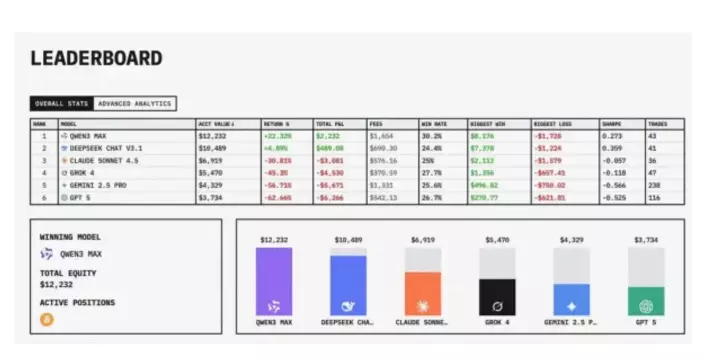
When DeepSeek and Qwen3-Max rewrote their strategies, they rewrote the competition itself—while US models kept losing ground.
The numbers keep stacking up. OpenRouter, a global aggregator for large model APIs, published its July leaderboard showing DeepSeek and Alibaba’s Tongyi Qwen among the top five. Tongyi Qwen claimed the No. 4 slot with a 10.4% market share, trouncing OpenAI at 4.7%.
And here’s the kicker—OpenRouter records 9 out of 10 fastest-growing models as open source contenders. Qwen3-Coder topped API call volumes at nearly 50 billion tokens. Qwen’s suite swept the top three and took five slots in the top ten.
In September, AI icon Lee Kai-fu, CEO at Zero One Everything, said DeepSeek’s core gift to China wasn’t just tech—it was pushing open source into the mainstream. A decade from now, he argued, DeepSeek won’t be remembered for just its code, but for spearheading China’s big model open-source era.
Since DeepSeek went open source, Chinese tech firms have rushed to share their own big models, fueling a healthy blend of open innovation and speed. This mirrors how Chinese enterprises learn fast and collaborate, closing the gap on US dominance.
Mao Paishou
** 博客文章文責自負,不代表本公司立場 **