RIO DE JANEIRO (AP) — The Brazilian head of a victims' association for the 2009 crash of Flight 447 from Rio to Paris said that justice has yet to be served in France’s worst aviation crash after a Paris appeals court found Airbus and Air France guilty of manslaughter on Thursday.
Air France and Airbus, two of France’s most emblematic companies, said in separate statements that they would appeal Thursday’s ruling, potentially prolonging the legal battle for years.
Click to Gallery
Maria Eva Marinho, who lost her son Nelson Marinho in the Air France flight 447 plane crash near the coast of Brazil on June 1, 2009, gives an interview at her home in Rio de Janeiro, Thursday, May 21, 2026. (AP Photo/Bruna Prado)
A message in Portuguese reads: "In memory of the 228 men, women and children who disappeared on 01/06/2009 in the crash of flight AF 447. This is a place of remembrance, we request due respect," on a memorial in Rio de Janeiro, Brazil, honoring the passengers who died in the crash near the coast, Thursday, May 21, 2026. (Photo AP/Bruna Prado)
Nelson Faria Marinho, who lost his son Nelson Marinho in the Air France flight 447 plane crash near the coast of Brazil on June 1, 2009, points to a photo of him during an interview at his home in Rio de Janeiro, Thursday, May 21, 2026. (AP Photo/Bruna Prado)
Maria Eva Marinho, who lost her son Nelson Marinho in the Air France flight 447 plane crash near the coast of Brazil on June 1, 2009, sits in her home before giving an interview in Rio de Janeiro, Thursday, May 21, 2026. (AP Photo/Bruna Prado)
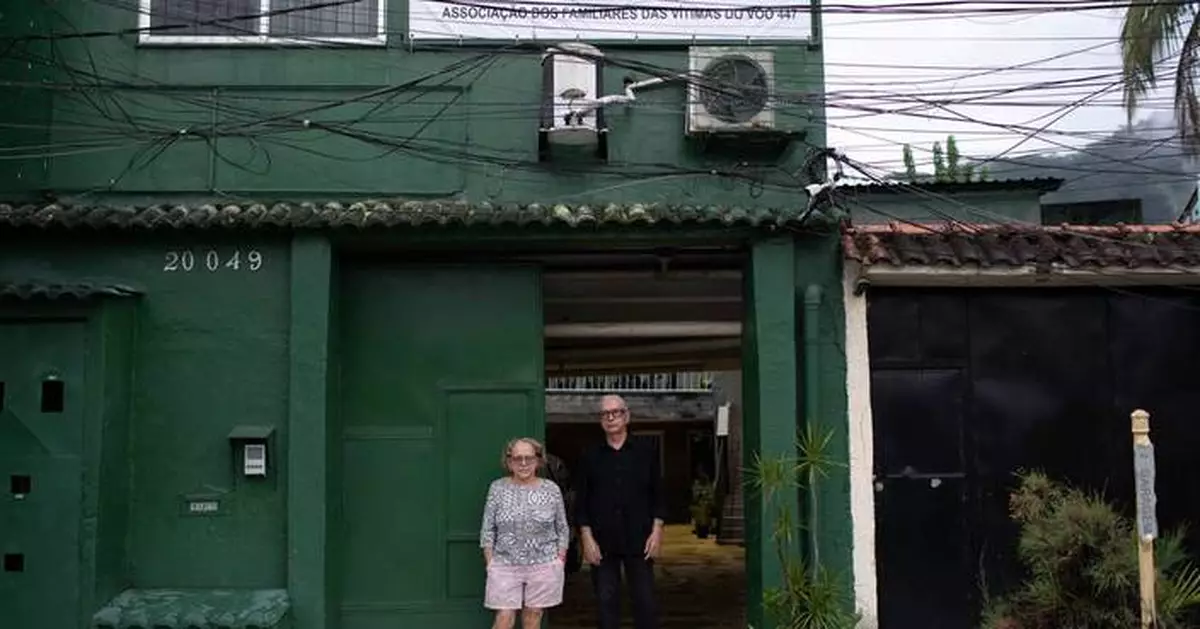
Nelson Faria Marinho and Maria Eva Marinho, who lost their son Nelson Marinho in the Air France flight 447 plane crash near the coast of Brazil on June 1, 2009, pose for a photo outside their home, where a sign with the flight number hangs in Rio de Janeiro, Thursday, May 21, 2026. (AP Photo/Bruna Prado)
Brazilian Nelson Faria Marinho, who lost his son in the crash that killed 228 passengers and crew members, said he remained unsatisfied with the verdict.
The Paris appeals court on Thursday found Airbus and Air France guilty of manslaughter over the crash, and ordered the companies to pay the maximum fine of 225,000 euros (approximately $260,000) each, according to Daniele Lamy, president of a French association of victims of the crash.
Lamy, who lost her son Eric in the crash, was in the courtroom throughout this trial and the original trial, and welcomed Thursday’s verdict.
But Marinho said he wishes to see prison sentences for the companies’ executives at the time, although the case has centered on institutional rather than personal responsibility.
“I’ve lost my father, my mother, brothers. It hurts a lot, but it is impossible to translate into words the pain of losing a child,” Marinho said, in his home office full of newspaper clippings and photos recounting his long struggle for justice.
The A330-200 plane disappeared from radar in a storm over the Atlantic Ocean on June 1, 2009, with 216 passengers and 12 crew members aboard. It took two years to find the plane and its black box recorders on the ocean floor, at depths of more than 13,000 feet (around 4,000 meters).
An Associated Press investigation at the time found that Airbus had known since at least 2002 about problems with the type of pitot tubes used on the jet that crashed, but failed to replace them until after the crash.
Air France was accused of not having implemented training in the event of icing of external sensors called pitot tubes, despite the risks. Airbus was accused of not doing enough to urgently inform airlines and their crews about faults with the pitots or to ensure training to mitigate the risk.
The crash led to changes in regulations for airspeed sensors and in how pilots are trained.
The official investigation found that multiple factors contributed to the disaster, including pilot error and the icing over of pitot tubes.
In 2023, a first instance court acquitted Airbus and Air France of manslaughter charges, prompting an outpouring of anguish from people whose loved ones were killed in the disaster.
Air France said it regretted Thursday’s conviction and recognized that its appeal will prolong an already lengthy procedure, particularly for the families and loved ones of the victims, but noted that the company’s criminal liability had previously been dismissed.
Airbus said it would file an appeal before France’s highest court in order to allow a reexamination of the legal issues raised by this case.
A French pilot’s union said it was satisfied with the decision. It would be “unacceptable to place responsibility for the outcome of this accident solely on the pilots, without taking into account all of the systemic failures that led to the disaster,” the National Union of Airline Pilots said.
Victims’ lawyer Alain Jakubowicz, speaking to reporters outside the courtroom, was overcome with emotion.
This verdict shows “there is no fight that is unwinnable," he told French TV. "Even when we are simply passengers, we can make global giants bend.”
Back in Rio, Marinho’s wife Maria Eva said that the pain of losing one of her five children remains vivid, but that her faith has helped with her grief.
“This trail of destruction left many hearts wounded,” she said from her living room featuring a representation of the Eiffel Tour. “But as long as there is life there is hope.”
Angela Charlton in Paris contributed.
Follow AP’s coverage of Latin America and the Caribbean at https://apnews.com/hub/latin-america

Maria Eva Marinho, who lost her son Nelson Marinho in the Air France flight 447 plane crash near the coast of Brazil on June 1, 2009, gives an interview at her home in Rio de Janeiro, Thursday, May 21, 2026. (AP Photo/Bruna Prado)

A message in Portuguese reads: "In memory of the 228 men, women and children who disappeared on 01/06/2009 in the crash of flight AF 447. This is a place of remembrance, we request due respect," on a memorial in Rio de Janeiro, Brazil, honoring the passengers who died in the crash near the coast, Thursday, May 21, 2026. (Photo AP/Bruna Prado)

Nelson Faria Marinho, who lost his son Nelson Marinho in the Air France flight 447 plane crash near the coast of Brazil on June 1, 2009, points to a photo of him during an interview at his home in Rio de Janeiro, Thursday, May 21, 2026. (AP Photo/Bruna Prado)

Maria Eva Marinho, who lost her son Nelson Marinho in the Air France flight 447 plane crash near the coast of Brazil on June 1, 2009, sits in her home before giving an interview in Rio de Janeiro, Thursday, May 21, 2026. (AP Photo/Bruna Prado)
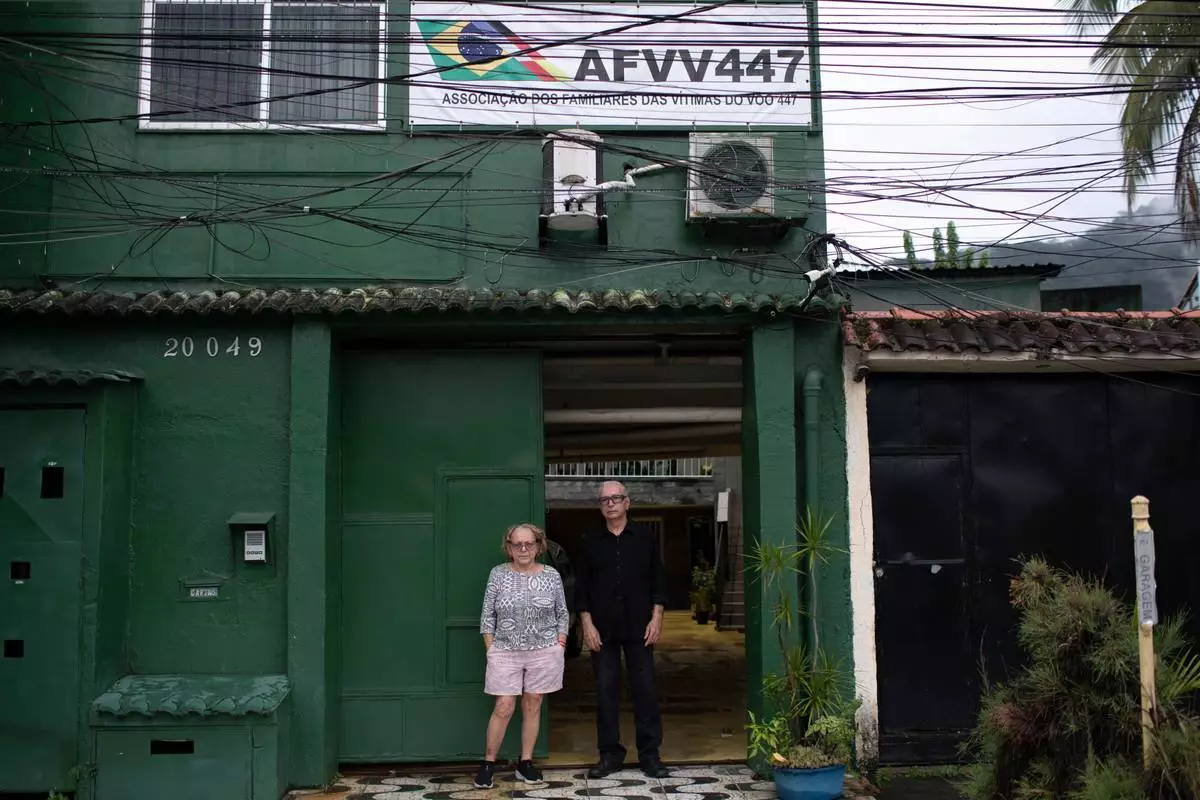
Nelson Faria Marinho and Maria Eva Marinho, who lost their son Nelson Marinho in the Air France flight 447 plane crash near the coast of Brazil on June 1, 2009, pose for a photo outside their home, where a sign with the flight number hangs in Rio de Janeiro, Thursday, May 21, 2026. (AP Photo/Bruna Prado)
WASHINGTON (AP) — In the year since President Donald Trump signed an executive order promising to create a deep-sea mining industry from scratch, businesses have raised millions of dollars from investors, stock prices have soared and federal regulators have raced to fast-track a permitting process.
At least nine companies are in talks with the government for access to seabed minerals, according to an Associated Press review. Sections of the seafloor from American Samoa to Alaska could be auctioned for offshore mining this summer and through the fall.
All the action suggests the U.S. may soon give the green light for companies to commercially mine the seabed — something that’s never been done in international waters.
But a close look at some of the companies involved reveals uncertain track records and histories spattered with legal disputes, while major questions about how the minerals would be processed and refined remain unanswered. Watchers of the nascent industry are skeptical the promised riches will ever materialize.
“It just feels right to people thinking that there is a cornucopia of metals on the bottom of the seafloor that are just there to be plucked up like seashells on the seashore,” said Victor Vescovo, a private equity investor and deep-sea explorer who has chosen not to back any deep-sea mining companies.
“If there’s more scrutiny on their actual financial models,” he added, “you would go, ‘Wait a second, this is much more uncertain.’”
Trump’s executive order in April last year marked a sudden embrace of an industry long dormant in the U.S. The president hailed seafloor minerals as vital to America’s future prosperity and its trade independence from China. He directed U.S. agencies to expedite permitting.
The most widely prized ores are fist-shaped rocks known as polymetallic nodules, formed over millions of years from the remains of sunken shark teeth and shells. They contain high grades of manganese, copper, nickel and cobalt, and much smaller amounts of rare earth elements.
Other parts of the seafloor have drawn prospectors, too: the mineral-rich crusts atop volcanic seamounts, and the rocky mounds flecked with gold and silver near hydrothermal vents. Nearer to shore, companies have proposed dredging ocean sands for titanium, zirconium and phosphorites. But for many companies, seafloor nodules hold the most allure.
Trillions of nodules lie on the international seabed between Mexico and Hawaii, scientists say. For more than a decade, delegates from dozens of countries have convened at the headquarters of the International Seabed Authority in Jamaica with the difficult task of creating globally agreed upon mining rules for those areas, which belong to no single country.
The agency has so far granted exploration rights to nearly two dozen contractors, but has not allowed any to mine commercially. Under its mandate, the minerals are designated for the shared benefit of “all humankind.”
Trump’s order suggests the U.S. will decide for itself when to mine the global seabed, reversing the decision of previous administrations to honor the seabed authority’s rules.
In a statement, a White House spokesperson said “all presidential actions are legally sound.”
Geologists have known about polymetallic nodules for more than a century, but it wasn’t until the 1960s that companies started building technology to haul them to the surface.
At the time, the laws of the sea were still in the making, with ongoing talks at the United Nations over how countries would use and protect the oceans beyond their borders. When it came to seabed mining, the U.S. was at odds with much of the world over how the resources and technology should be shared.
In 1980, with global talks still in progress, Congress passed the Deep Seabed Hard Mineral Resources Act and created a process for U.S. companies to mine the deep sea. The U.S. issued four exploration licenses in 1984.
Yet in the decades that followed, low metals prices and the brewing uncertainty around international rules pushed several of those companies to forfeit their licenses or dissolve. Today, more than 150 countries agree that deep-sea mining should be mutually governed by the seabed authority. Lockheed Martin holds the only two exploration licenses still active in the U.S.
Two U.S. agencies will enforce rules: the National Oceanic and Atmospheric Administration, which oversees minerals beyond U.S. borders, and the Bureau of Ocean Energy Management, a division of the Department of the Interior that regulates offshore oil, gas, wind and minerals in U.S. waters.
NOAA has never approved a commercial project for seabed mining; nor has BOEM, beyond a short-lived mining effort in California waters more than 60 years ago. But their leaders, appointed by Trump, are pushing for that to change.
In June, Interior Secretary Doug Burgum announced a mandate for BOEM to “speed up” the development of critical minerals offshore, and outlined steps to streamline the regulatory process. The agency soon announced it was evaluating seabed mining in the waters of Alaska, Virginia, American Samoa and the Northern Mariana Islands. It plans to hold the first lease sale as early as August, according to a budget proposal, and in the coming months will restructure under the new name of the Marine Minerals Administration.
NOAA, too, is working quickly to approve permits. Until this year, the agency required companies to have an exploration license before they could pursue commercial operations; in January, it said companies could apply for both activities at once. NOAA has requested funds to expand its permitting staff and set a target of processing 16 applications next fiscal year.
So far, the companies answering the call of Trump’s executive order include a firm that once made its money hunting for sunken treasure, and a South Carolina-based startup that sprung from an effort to find Amelia Earhart’s long-lost plane.
And it includes The Metals Company, long seen as the front-runner in the industry. If the U.S. grants a permit, the firm says it is ready to commercially mine the seafloor before the end of next year. It is one of few companies to have tested equipment in deep-water conditions — hauling up 3,000 metric tons of nodules in a 2022 trial.
The company has close ties to the Trump administration. CEO Gerard Barron says he was in the White House on the day Trump signed the executive order, and since then, he’s been invited to speak at three congressional hearings on deep-sea mining. The Metals Company has received financial advice from Cantor Fitzgerald, the investment group Commerce Secretary Howard Lutnick led for decades until Trump appointed him to federal office. Lutnick is now in charge of NOAA and could be influential in the final decision on permits.
In a January congressional hearing, U.S. Rep. Ed Case, a Hawaii Democrat, accused The Metals Company of being “in bed” with NOAA and having advance knowledge of the agency’s plans, citing the close timing of certain events. The Metals Company submitted its seabed mining applications within a week of the executive order last year, and resubmitted them under the streamlined regulations one day after NOAA finalized the new rules.
At the hearing, Barron denied the accusation, saying it’s the company’s job to respond to and anticipate government action. “We had lobbied hard” against some of the regulatory inefficiencies, he added.
Since 2024, records show the company spent nearly $800,000 on lobbying for seabed mining issues, including permitting. Its stock price hit record highs across the last year.
A spokesperson for The Metals Company said in a statement the firm had no unfair advantages, and is well-poised to address the strategic priorities of the U.S. after 15 years of preparation and testing.
Barron got his start in deep-sea mining as an investor of a company, Nautilus Minerals, which won a license from Papua New Guinea for the world’s first commercial seabed mining effort in 2011. But Nautilus folded before mining began, leaving the government, which had a 15% stake in the project, with more than $100 million in debt.
Tampa, Fla.-based Odyssey Marine Exploration has also signaled interest in offshore mining. Odyssey formed in the 1990s with a mission to discover sunken treasure and sell the artifacts for profit. The company claims to have found more shipwrecks than any other organization in the world.
But Odyssey ran into trouble in 2007, when it discovered an underwater shipwreck littered with silver and gold coins that Odyssey brought to the U.S. Later, the government of Spain said the wreck matched descriptions of a Spanish naval ship sunk by the British in 1804. Warships are immune to the claims of salvagers. Odyssey argued the remains couldn’t reliably be identified, but after years of bitter court battles, relinquished the treasure.
Amid the legal fight, the company pivoted to pursuing seafloor minerals.
There, too, Odyssey ran into controversy. The company’s subsidiary was awarded mining permits in Mexico’s Gulf of Ulloa for a project that would have dredged 7 million tons of mineral sands per year, operating 24 hours per day, according to Odyssey’s proposal, with a goal of extracting phosphate for fertilizer.
But the Mexican government withdrew its support during its environmental review out of concern the mining would disturb marine habitats and threaten loggerhead turtles. Officials later argued Odyssey didn’t have enough mining experience.
The company sought damages from the government of Mexico, winning $37 million in 2024 in arbitration, more than 10 years after it received the first mining permit.
In December, BOEM announced that Odyssey had requested the agency begin the regulatory process to consider mining off the coast of Virginia. As in Mexico, the company is hoping to dredge coastal sands.
In a statement, an Odyssey spokesperson said the company carefully selected the area to avoid sensitive marine habitats and shipping traffic, and that dredging is an established tool for construction projects and can be done safely.
This spring, the company said it will merge with and adopt the name of American Ocean Minerals Corporation, which incorporated last year and has applied for NOAA’s permission to explore for seafloor nodules.
Out in the U.S. territories of the Pacific Ocean, another fight is brewing over potential mining. The startup Impossible Metals has set its sights on seafloor nodules in U.S. waters near American Samoa and the Northern Mariana Islands, despite growing outcry from local residents and leaders.
American Samoa has banned deep-sea mining in local waters, while a similar push is underway in the Northern Marianas. Nearby Guam has banned deep-sea mining, too. Republican House representatives from all three territories worry their constituents will bear the environmental and economic harms. But the final decision is in the hands of the federal government, which controls U.S. waters beyond 3 miles from shore.
Impossible Metals boasts of being the most environmentally friendly deep-sea mining company. Most mining machines are built to drive along the seafloor, endangering the sea sponges, nematodes and brittle stars that live among nodules. Impossible Metals is building a fleet of robots that it says will float above the seabed and collect only rocks that don’t contain marine life. The company has offered island territories 1% of future profits.
Critics question whether the technology will work, and if there will in fact be any profits to share.
Impossible Metals didn’t respond to the AP’s questions or requests for comment. The company has said previously that it’s engaging with local communities and is committed to building something lasting.
Still other companies are lining up for U.S. permission. American Metal Resources and SeaX, both formed last year, applied for exploration licenses that are under NOAA review.
Deep Sea Minerals Corp., founded in 2022, is publicly traded in Canada and announced its application to explore for nodules in March. The company recently issued a press release saying its advertisements may have “overstated” the certainty of its future growth. It does not yet have deep-sea mining rights or any specialized marine technology, it said.
There are some early signs of discord: American Metal Resources and The Metals Company have both sued each other, alleging the misuse of confidential information.
Deep-sea ecologists and ocean advocates have fought against seabed mining for years on the grounds that the deep ocean remains vastly under-studied, and that mining could extinguish its fragile life.
But a number of analysts and investors also question its economic merit.
Of the four metals contained in polymetallic nodules, copper is the surest bet to see sustained demand given the booming need for electrical wiring.
But mineral forecasts, said mining consultant Lyle Trytten, “often get a lot of attention when they’re very high, and then things change.”
Five years ago, The Metals Company built its marketing on the surging demand for metals to build electric vehicle batteries. Forecasters projected global shortages and prices soared.
In the years since, battery design has evolved and no longer depends as much on cobalt and nickel, leaving seabed mining companies with a more subdued outlook on profits. Even highly-sought copper is already being replaced in some industry sectors with aluminum.
Ian Lange, a professor of mineral economics at the Colorado School of Mines, said deep-sea mining advocates seem to overlook the more affordable and widely available sources of minerals on land. He questioned whether demand is strong enough: Copper mines in Michigan and Wyoming are fully permitted but inactive; a cobalt mine is idled in Idaho.
“I personally am skeptical that what’s holding people back (from deep-sea mining) is nonmarket things like permitting,” he said.
The Securities and Exchange Commission requires publicly listed mining companies to assess the economic viability of their projects in a document known as a pre-feasibility study.
The Metals Company did so last year, and forecast that it would break even in its eighth year of commercial seabed mining – the same year that it forecast the mineral reserves to be “all mined.”
“No one goes into a project saying, ‘In the best-case scenario, we’ll break even,’” said mining consultant Steven Emerman. “Anyone at my level would know to come to the conclusion that now is the time to abandon the project.”
Unless the project expands, said Simon Jowitt, Nevada’s state geologist and director of the Nevada Bureau of Mines and Geology, “there’s not going to be any profit in the project.”
The Metals Company says it expects to find billions of dollars’ worth of seabed minerals after the project breaks even. But it has yet to prove those additional resources are economical to mine.
Forecasting this way is unusual, Jowitt said.
Other experts, including Trytten and Emerman, said the company’s forecast is overly optimistic, projecting high metals prices and low costs. Trytten reviewed the forecasts at the request of an environmental group, the National Ocean Protection Coalition, and Emerman at the request of opponents to deep sea mining, including Greenpeace. Both said their analysis was independent.
The Metals Company said it had completed mining plans and seafloor surveys for the first eight years of the project, and that the costs of surveying, sampling and analyzing additional seafloor minerals were best incurred once the project was underway. The company is confident those resources will be minable, a spokesperson said.
It would take at least three land-based mines to produce the four minerals that exist in seafloor nodules, the company said, and this variety makes the project resilient to economic headwinds or changing demand for metals.
Deep-sea mining companies will also face challenges around where to process the nodules. Despite Trump’s focus on trade independence, the U.S. currently has no major processing facilities for nickel, manganese or cobalt.
Building these facilities on U.S. soil will take time and money – a lot of it. “That is going to take some engineering and some capital,” said James Deckelman, head of Deep Sea Minerals Corp. “But there’s just so much support from the U.S. government right now, so much momentum.” Indeed, the White House told AP it’s a priority to expand domestic refining capacity.
Records show The Metals Company began lobbying around “financing for domestic processing of minerals” early this year.
In the near term, companies will have to rely on existing supply chains abroad. The Metals Company has thus far explored processing in Japan, South Korea and Indonesia.
But reliance on foreign partners could raise a host of legal issues for companies. Most other countries involved in deep-sea mining are bound by their commitments to the International Seabed Authority. Their governments, companies or citizens could be sued for helping the U.S. tap the global seabed, said Coalter Lathrop, a legal expert on the law of the sea.
It could be financially devastating to The Metals Company if foreign companies cut ties. The firm relies heavily on the Swiss company Allseas, which owns the deep-sea mining ship and designed the deep-sea “collector vehicles” that would gather nodules from the seafloor. In a statement, Allseas said it was committed to following all national and international laws, and would deploy its technology “only once we are confident that all relevant regulatory conditions are satisfied.”
In a congressional hearing, Impossible Metals suggested the U.S. government could smooth over some of these hurdles by purchasing nodules for the National Defense Stockpile — a store of metals held in reserve for supply chain emergencies.
Stockpiling the nodules would offer deep-sea mining companies “a guaranteed buyer” in the government, said Oliver Gunasekara, CEO of Impossible Metals, in his January testimony. Not only would it spur industry investment, he suggested, but the government could profit in the future as metals prices rise.
Trytten, the mining consultant, disagrees. “If you can’t process it, it doesn’t do you any good sitting there in a warehouse.”
A spokesperson for the Defense Logistics Agency, which runs the national stockpile, said there was currently no plan to acquire seafloor nodules.
Elizabeth Klein, BOEM’s director under the final two years of Joe Biden’s presidency, denied a 2024 request from Impossible Metals to consider a mining lease near American Samoa. She told the AP she was concerned about local opposition and the suitability of current regulations to a novel industry.
“You want to make sure that the operators are financially capable … (that) they actually have the skills and the resources that would be required,” Klein said. “The current regs don’t speak to much of that at all.”
A spokesperson for BOEM said in a statement that companies demonstrate their financial capability in the bidding process for a mining lease, along with a required deposit. Current regulations require BOEM to ensure the project is carried out safely and responsibly, the spokesperson said.
Tony Romeo, founder of Deep Sea Rare Minerals, which changed its name to Eco Minerals this week, isn’t discouraged by the naysayers. Every new source of energy or metal requires some trial and error before it becomes profitable, he told AP.
His South Carolina company got its start in deep-sea operations by pursuing a personal obsession of his – scanning the seafloor for Earhart’s plane. Now, the company is awaiting updates from NOAA on its application to explore for nodules and is considering bidding on mining leases near Alaska and the Northern Mariana Islands.
“There’s going to be some flops. There’s going be some failures. Some businesses aren’t going to make it, but somebody will,” Romeo said. He hopes his company will be producing offshore minerals by 2028.
By then, Trump’s second term will be in its final year. Company executives are pushing hard for assurances that their projects won’t be canceled by a future president who’s not as eager to mine the sea.
At an industry conference in January, top officials at NOAA and BOEM deflected when asked about what kind of certainty they can promise. No one has a crystal ball, they said – but for now, they’re “open for business.”
—-
The Associated Press receives financial support from multiple private foundations. AP is solely responsible for all content. Find AP’s standards for working with philanthropies, a list of supporters and funded coverage areas at AP.org.
—-
Contact AP’s global investigative team at Investigative@ap.org or https://www.ap.org/tips/
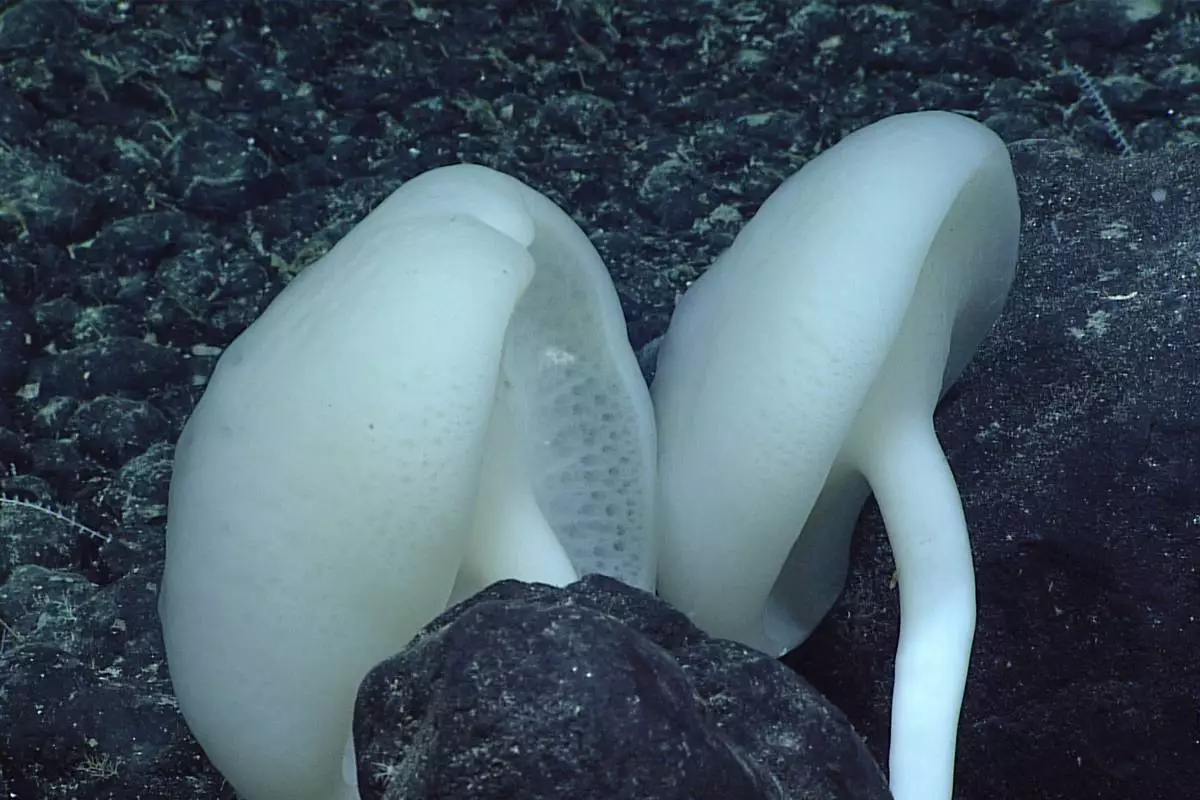
In this photo provided by NOAA, rosellid "mushroom" sponges grow amid ferromanganese boulders mixed with smaller nodules during Dive 16 of the 2021 North Atlantic Stepping Stones expedition. (NOAA via AP)

FILE - President Donald Trump arrives at Leesburg Executive Airport on Marine One in Leesburg, Va., Thursday, April 24, 2025, en route to Trump National Golf Club Washington DC in Sterling, Va. (AP Photo/Jacquelyn Martin, File)
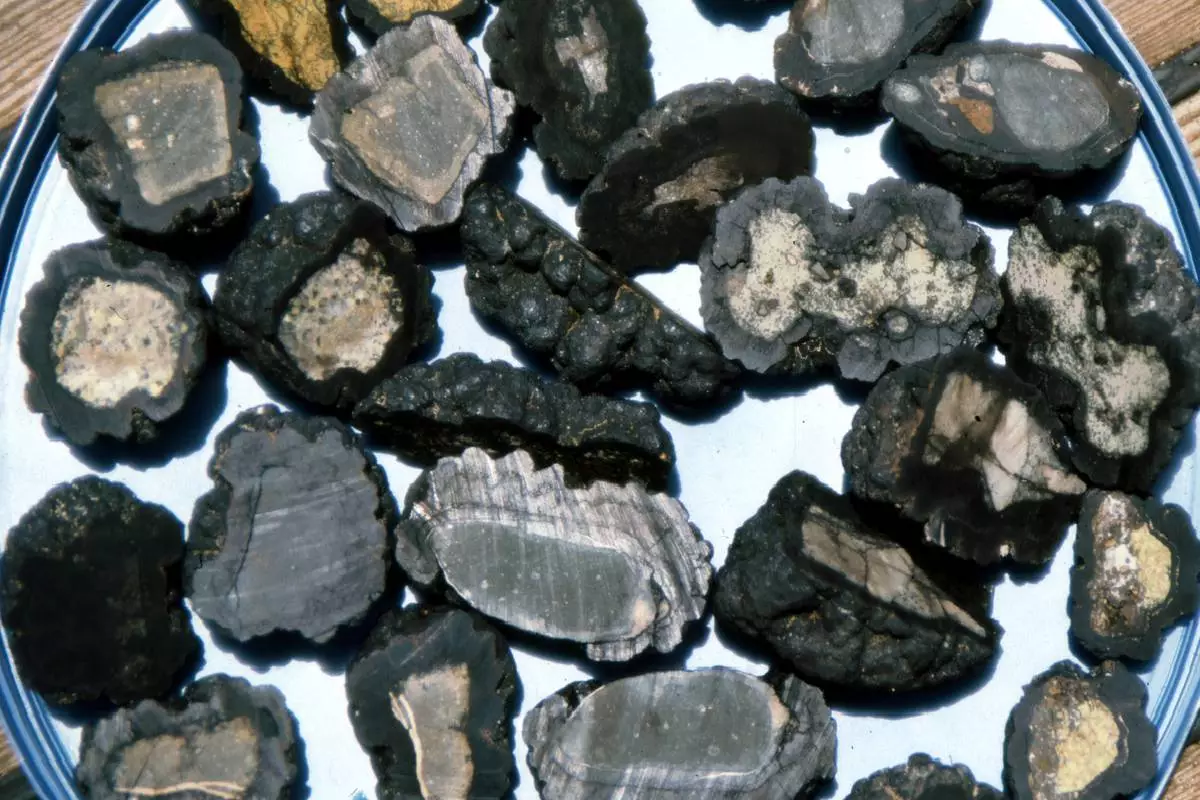
This undated photo provided by the U.S. Geological Survey shows ferromanganese nodules collected from seamounts in the Pacific Ocean. (U.S. Geological Survey via AP)
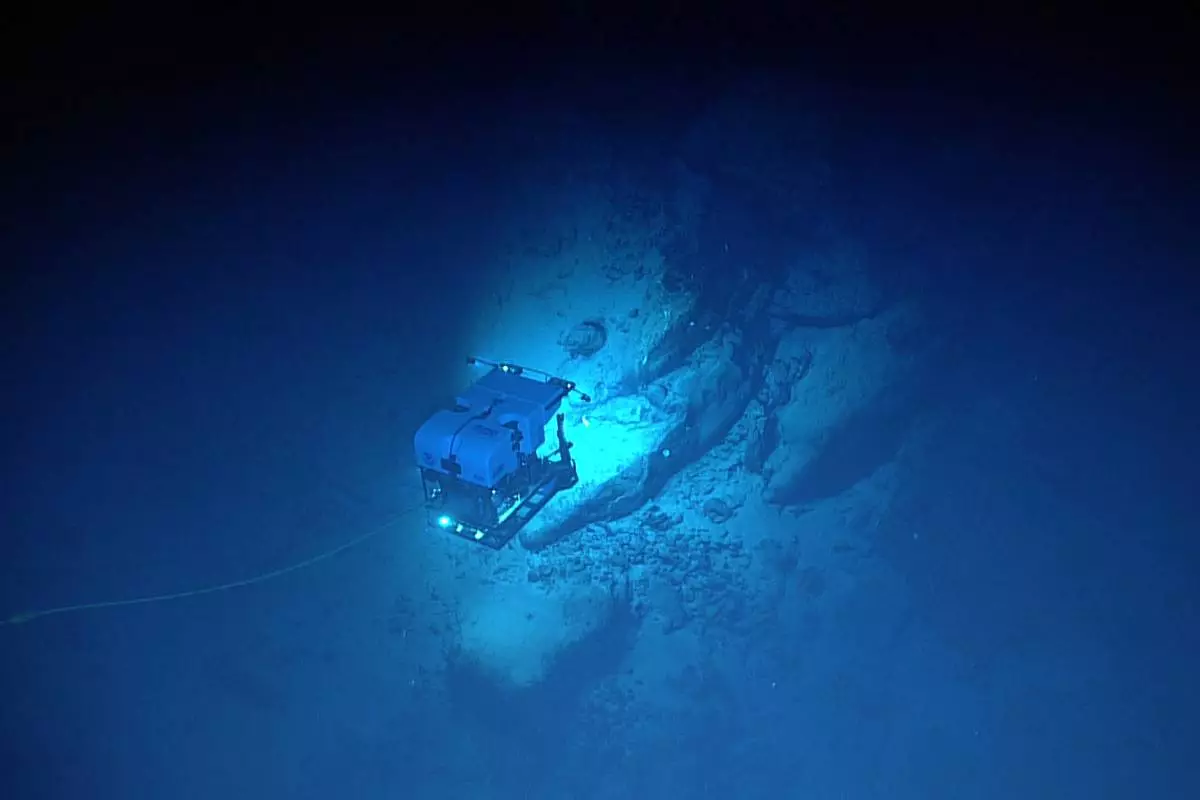
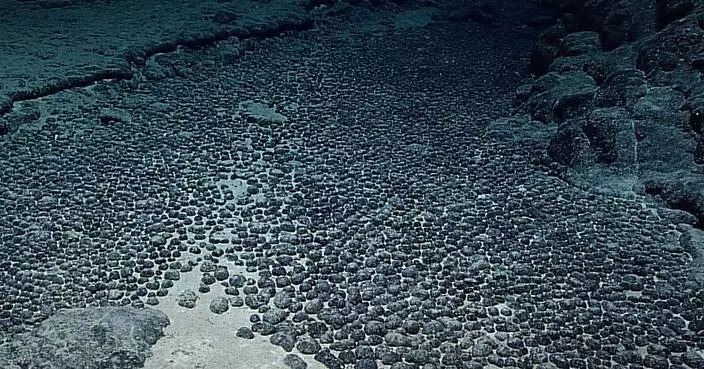
In this photo provided by NOAA, a remotely operated vehicle encounters a large undersea boulder field during the 2021 North Atlantic Stepping Stones expedition. (NOAA via AP)
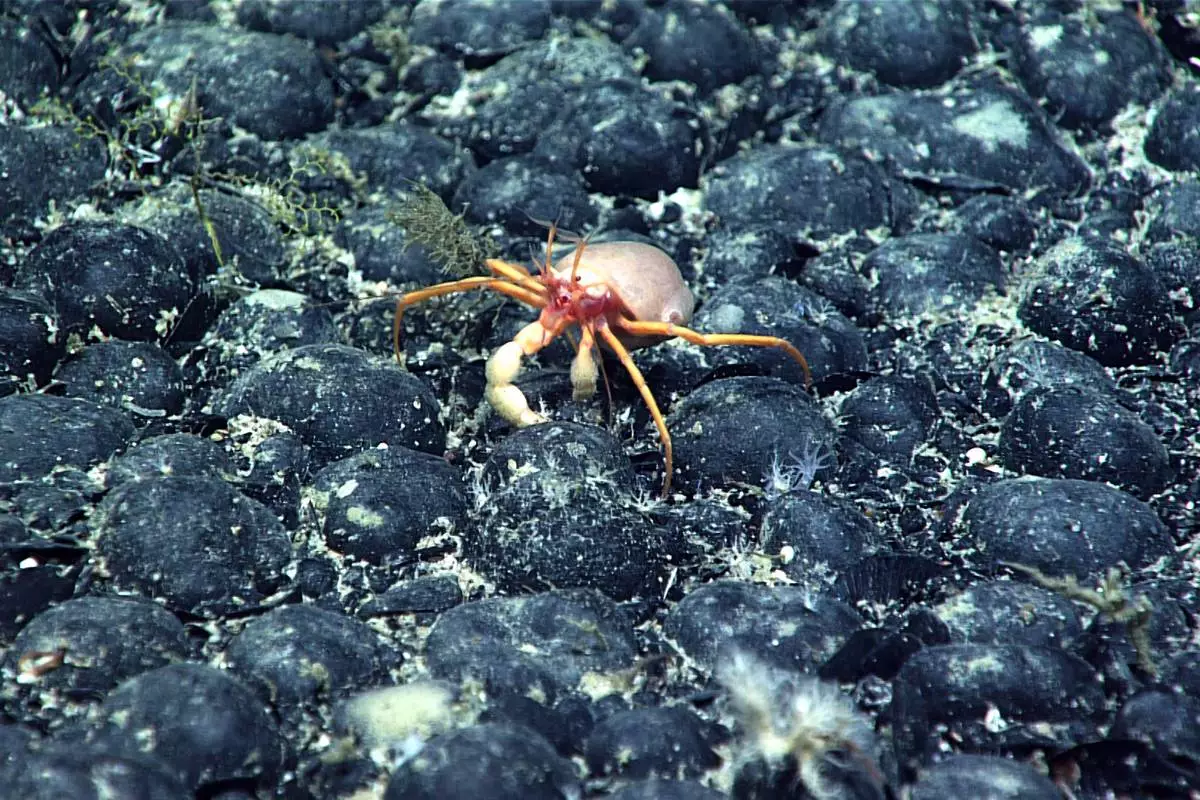
In this photo provided by NOAA, a Parapagurus sp. crab with a coral on its back walks across a field of ferromanganese nodules on the seafloor of Gosnold Seamount, explored during Dive 16 of the 2021 North Atlantic Stepping Stones expedition. (NOAA via AP)