World Health Organization (WHO) Director-General Tedros Adhanom Ghebreyesus on Saturday called on countries that have imposed travel bans or closed borders in response to the Ebola outbreak in the Democratic Republic of the Congo (DRC) and Uganda to reconsider such measures.
Speaking at a joint press conference in Bunia, the capital of the northeastern Ituri Province and the epicenter of the Ebola outbreak, Tedros said such restrictions could complicate response efforts and risk discouraging transparency and trust, which are essential to saving lives.
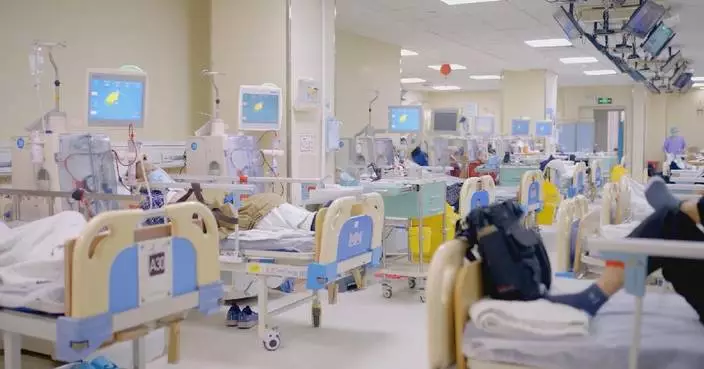
Despite the lack of approved vaccines and specific medicines, the WHO chief said patients could still recover if they receive timely, quality medical care.
He pledged commitment to ensuring that other essential health services and humanitarian assistance continue to be provided to communities across Ituri and beyond.
On Thursday, the WHO chief arrived in Kinshasa, the DRC capital, as the country steps up its response to the fast-spreading Ebola outbreak with joint efforts of the WHO and other international partners.
Upon his landing, Tedros told reporter that "it is a very complex outbreak."
Tedros traveled to Bunia during his visit to inspect the situation and support response.
The latest crisis is the DRC's 17th Ebola outbreak since 1976, which is caused by the Bundibugyo strain, for which there is currently no licensed vaccine or specific treatment.
On Thursday, Africa CDC reported a total of 1,077 suspected cases and 246 probable deaths have been recorded since the DRC declared its 17th Ebola outbreak two weeks ago.
WHO chief calls for reconsideration of travel bans as DR Congo battles Ebola outbreak
A senior Chinese military scholar on Saturday called on the international community to jointly inject positive energy into safeguarding global strategic stability.
Meng Xiangqing, head of the Chinese People's Liberation Army expert delegation and a professor at China's National Defense University said at a session at the Shangri-La Dialogue 2026 in Singapore that global strategic stability faces multiple challenges.
Against this backdrop, China has put forward the Global Security Initiative and the Global Governance Initiative, advocating a vision of common, comprehensive, cooperative and sustainable security, Meng said in a speech at the session.
The initiatives uphold multilateralism and the rule of law in international affairs, providing important ideas and solutions for addressing global challenges, he said.
Meng also said that all countries should firmly safeguard the post-war international order and strengthen the political foundation for strategic stability. He emphasized the need to remain alert to any resurgence of militarism and to uphold the outcomes of World War II and the post-war international order.
"For a country that has never thoroughly eradicated the specter of militarism, is it qualified to discuss defense cooperation on the international stage? Can it win the trust of the international community, especially the Asian countries it once invaded? I have serious doubts. The lessons of the past are not far behind us. Today, the world once again stands at a new crossroads. We must remain vigilant against any attempt to revive militarism, and earnestly safeguard the achievements of World War Two and the post-war international order," said Meng.
On nuclear issues, Meng reiterated China's long-standing position.
He said that China's stance is consistent and clear. China remains committed to peaceful development, adheres to a nuclear strategy of self-defense, and pursues a policy of no-first use of nuclear weapons.
China supports a comprehensive ban and eventual elimination of nuclear arms, and this policy has never changed, he added.
Since its launch in 2002 by the British think tank the International Institute for Strategic Studies (IISS), the Shangri-La Dialogue, officially known as the Asia Security Summit, has been held annually except in 2020 and 2021 with the support of the Singaporean government.
As Asia's premier defense and security summit, the Shangri-La Dialogue 2026 opened Friday in Singapore amid growing geopolitical tensions.
The three-day event, which focuses on major security challenges facing the region, brought together 550 delegates from over 40 countries and regions. It features six plenary sessions, two ministerial roundtables, three special sessions, and a special address.
Chinese scholar calls for positive energy in maintaining global stability