CONCORD, N.H. (AP) — The New Hampshire Supreme Court on Thursday reversed a murder conviction for a man accused of killing his 5-year-old daughter and moving her corpse around for months before disposing of it.
Though her body has never been found, police believe Harmony Montgomery was killed in 2019, nearly two years before she was reported missing. Her father, Adam Montgomery, was sentenced to a minimum of 56 years in prison in 2024 after being convicted of second-degree murder, abuse of a corpse, falsifying evidence, witness tampering and assault.
The Supreme Court, however, reversed the most serious charge, agreeing with Montgomery that the lesser assault charge should have been prosecuted separately. It sent the second-degree murder charge back to the lower court while letting the other convictions stand.
In their unanimous ruling, justices said combining the cases jeopardized Montgomery’s right to a fair trial because jurors may have used the stronger evidence about the assault to conclude, based on weaker evidence, that he killed her months later.
“There was a significant risk that the jury would draw the impermissible inference that because the defendant assaulted the victim before by striking her in the head, he must be the one who fatally assaulted her in December by again striking her in the head,” the justices said.
The second-degree murder conviction accounts for 45 years of Montgomery’s 56-years-to-life sentence, which was imposed on top of an earlier 32 ½-year sentence he already was serving on unrelated gun charges.
The attorney general’s office said Thursday it will pursue a retrial on the second-degree murder charge.
“We remain confident in the facts of this case, the evidence presented, and the exceptional work of our prosecutors, investigators, and law enforcement partners,” said spokesperson Michael Garrity. “We will continue our efforts to seek justice for Harmony Montgomery and all those who knew and loved her.”
Montgomery's attorneys did not respond to emails seeking comment.
Last year, the state agreed to pay $2.25 million to Harmony Montgomery's mother to settle a lawsuit accusing social workers of ignoring signs that the girl was being abused by her father after he was awarded custody in early 2019. Crystal Sorey went to police in 2021, and in 2022 authorities announced that they believed Harmony was dead.
Adam Montgomery did not attend his trial in February 2022, and his lawyers called no defense witnesses. His attorneys acknowledged he was guilty of falsifying evidence and abusing a corpse, but they said he did not kill Harmony and instead suggested the girl actually died while alone with her stepmother, Kayla Montgomery.
Kayla Montgomery, who served an 18-month prison sentence for lying to a grand jury about where she was when Harmony was last seen, was the star witness for the prosecution. She testified that her husband killed Harmony on Dec. 7, 2019, while the family lived in their car. Montgomery was driving to a fast-food restaurant when he turned around and repeatedly punched Harmony in the face and head because he was angry that she was having bathroom accidents in the car, she said. He then hid the body in the trunk of a car, in a ceiling vent of a homeless shelter and in the walk-in freezer at his workplace before disposing of it in March 2020, she said.
Kayla Montgomery said she tried to stop her husband from hitting the girl but was scared of him and that he beat her as well as he grew paranoid that she would go to police.

FILE - Adam Montgomery listens during his sentencing hearing at Hillsborough Superior Court, May 9, 2024, in Manchester, N.H. (AP Photo/Charles Krupa, Pool, File)
WASHINGTON (AP) — El Nino, Nature's chaotic climate agent, has formed in a warmed-up Pacific Ocean and is expected to grow to historic strength, meteorologists announced Thursday.
Experts said the El Nino, a natural warming cycle, should further heat a globe already warming from fossil fuel pollution and will likely turbocharge extreme weather across the planet. Meteorologists forecast it will rival — or exceed — a record El Nino that began in 1997 and helped trigger billions of dollars in damage from heat waves, floods, droughts, tornadoes and wildfires.
The U.S. National Oceanic and Atmospheric Administration officially confirmed the existence of the El Nino, which is a warming of the Pacific near the equator that affects weather patterns across the globe. NOAA's announcement said there's a 63% chance that the El Nino will get so intense this late fall and early winter that it “would rank among the largest El Nino events in the historical record going back to 1950.”
The warm, deep waters of an El Nino affect weather patterns by bringing “a lot of extra heat to the surface, fueling a lot of extreme events for a lot of places around the world,” said Clark University climate scientist Abby Frazier.
She said, especially in the Pacific, “it can get dire very quickly.”
United Nations Secretary-General António Guterres described El Nino as an “urgent climate warning.”
“El Nino conditions will pour fuel on the fire of a warming world,” Guterres said in a video message.
The weather pattern's effects vary by region. El Nino often dampens — but doesn't eliminate — Atlantic hurricane season activity, but increases it in the Pacific. So while the U.S. East and Gulf coasts may get a break, Hawaii and other islands are more in danger, Frazier said.
The drought-stricken Middle East could benefit, climate scientists said. Other places are looking at more danger. Parts of western South America — where the first El Ninos were noticed decades ago — often get heavy rain and floods, along with an extra warm summer. India faces more intense heat waves, while drought, wildfires and heat threaten Australia.
Northeastern Africa is likely going to get weather whiplash from intense drought to dangerously heavy rains, said Columbia University climate scientist and El Nino expert Muhammad Azhar Ehsan.
In the U.S., El Ninos can cause more intense storms with heavier rainfall in the South, but they also tend to generally benefit the U.S. agriculture industry, said Jon Gottschalck, operational branch chief at NOAA's Climate Prediction Center.
Michael Ferrari, meteorologist and head of research at the investment research firm Moby, said conditions for grains and seed, especially soybeans, look favorable in 18 major growing states, but are more mixed when it comes to dairy and cattle.
The northern Rockies and Southwest — where there’s an “off the charts” snow drought — could get some strong summer rains, Gottschalck said. The biggest effect in the U.S. is often in the winter, when the south can get wetter and the Pacific Northwest warmer and drier.
But overall, temperatures raised by the weather pattern can dampen American economic growth, said Stanford climate economist Marshall Burke. Several climate scientists forecast that 2027 will be the hottest year on record because of lagging effects of this El Nino, which is expected to peak in the fall or winter.
“We have pretty clear evidence that the U.S. economy grows more slowly when temps are above normal,” Burke said.
The weather extremes caused by an El Nino also depend on when it develops.
Usually El Ninos form in the summer, peak in the late fall or early winter, and peter out the next spring, scientists said.
However, Ehsan's team forecasts that this El Nino will peak a month or two earlier based on strong early signs from recent weeks. Princeton University climate scientist Gabriel Vecchi said large El Ninos like these also tend to last longer.
The early indications — including warmer water pushing toward the surface of the Pacific — have been so strong and noticeable that forecasters have all been predicting the same ultra strong El Nino, Vecchi said, adding that El Nino forecasts often are all over the place at this time of year.
Scientists predict stronger El Ninos as the world warms from the burning of coal, oil and gas, Frazier and others said. But she said it is too early to say if this El Nino is part of that.
Even before it officially formed, this El Nino has gotten nicknames ranging from “super” to “Godzilla.”
“Instead of scared, we can ask people to be prepared,” Columbia's Ehsan said
The Associated Press’ climate and environmental coverage receives financial support from multiple private foundations. AP is solely responsible for all content. Find AP’s standards for working with philanthropies, a list of supporters and funded coverage areas at AP.org.
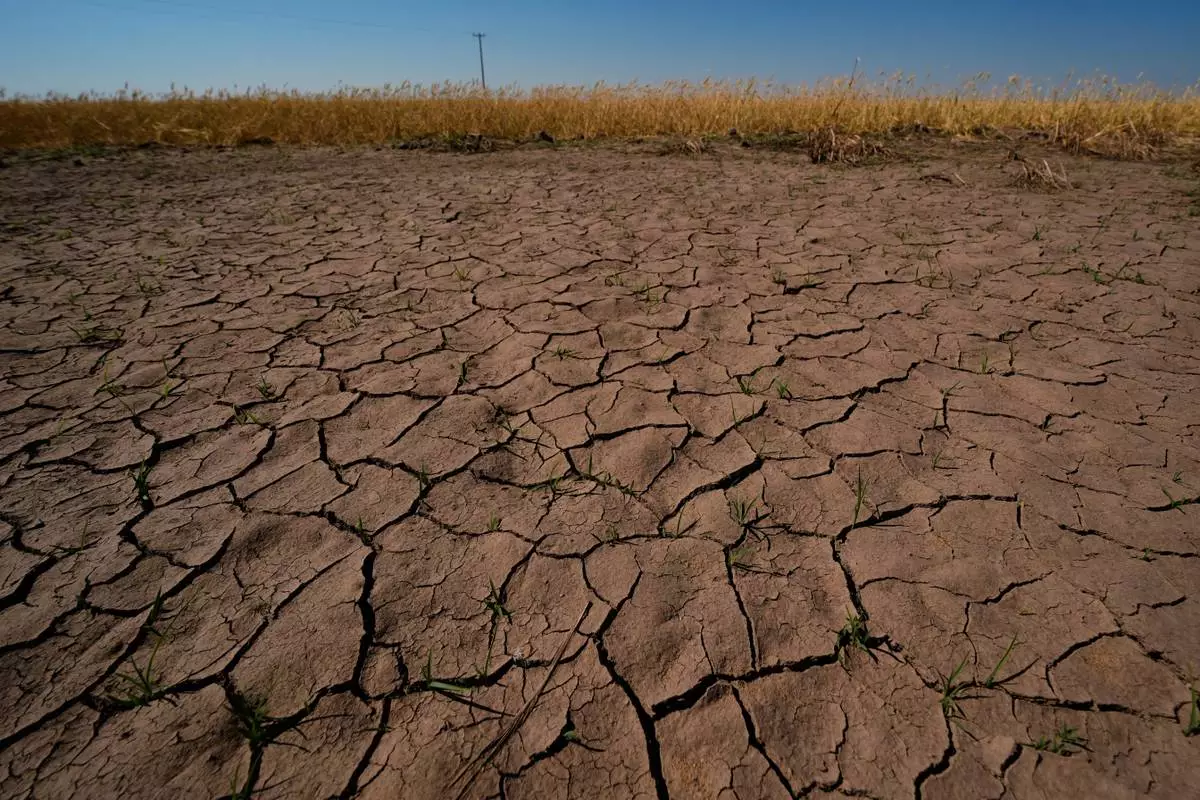
FILE - Drought-stressed wheat plants stand adjacent to parched ground in a field near Macksville, Kan., May 16, 2026. (AP Photo/Charlie Riedel, File)

FILE - Joe Chyuwei, right, Addison Black, front center, James Black, front left, and back row from left, Helen Chyuwei, Jameson Black, Grace Chyuwei and Grayson Black watch the sunset in the heat at Zabriskie Point, Aug. 3, 2025, in Death Valley National Park, Calif. (AP Photo/John Locher, File)

FILE - A person uses a fan during a heat advisory in the Brooklyn borough of New York, May 19, 2026. (AP Photo/Adam Gray, File)
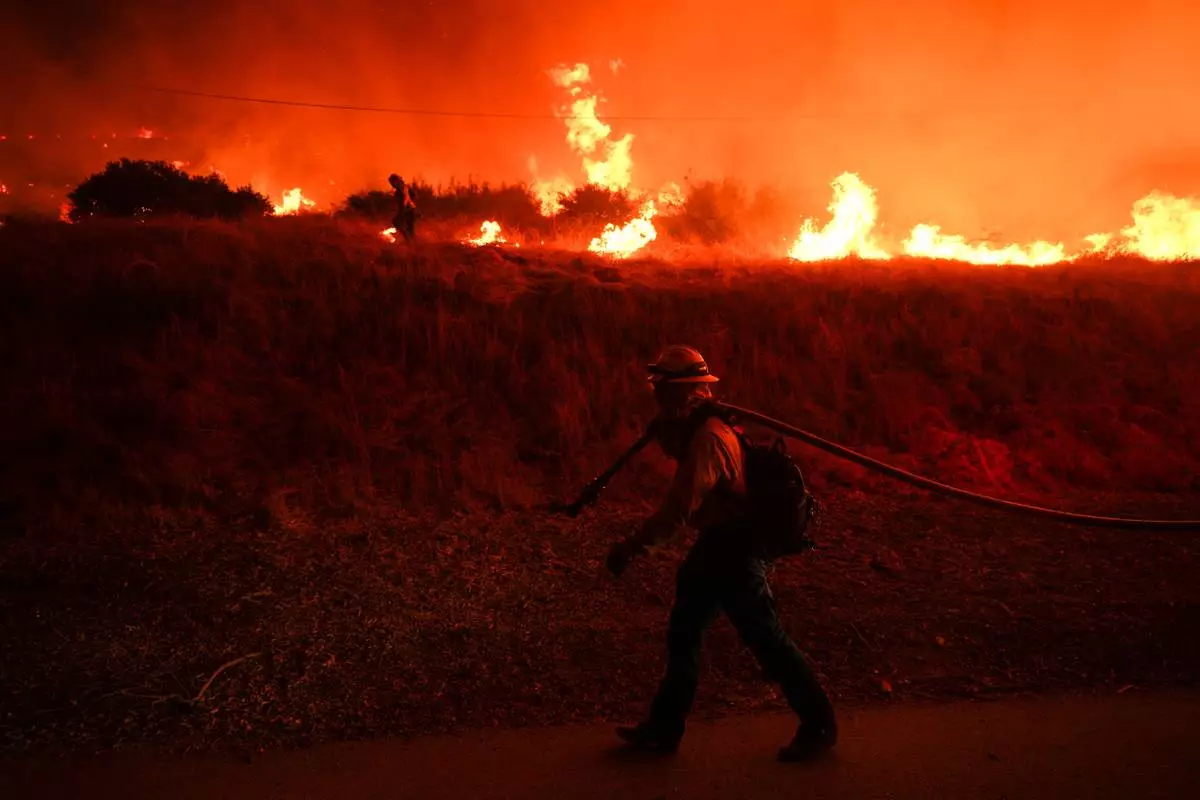
FILE - A firefighter monitors flames caused by the Hughes Fire along Castaic Lake in Castaic, Calif., Jan. 22, 2025. (AP Photo/Jae C. Hong, File)